Push a box across the floor and you've done work. Drop a ball and it trades height for speed. Run a motor and you measure how fast it delivers energy. Work, energy and power are three ways of describing the same underlying physics. This resource shows you how they connect, how to calculate each one, and presents one real world example of how Australia's first Indigenous female aerospace engineer is applying these principles to make aviation more sustainable.
Work \(W\)
Work \(W\) is done when a force causes a displacement in the direction the force is applied. It is a scalar quantity with no direction. For a constant force acting along a straight line, work is given by:
\[W=Fd\]
where:
\(W\) is the work done in joules \(\text{J}\)
\(F\) is the force in Newtons \(\text{N}\)
\(d\) is the displacement in metres \(\text{m}\).
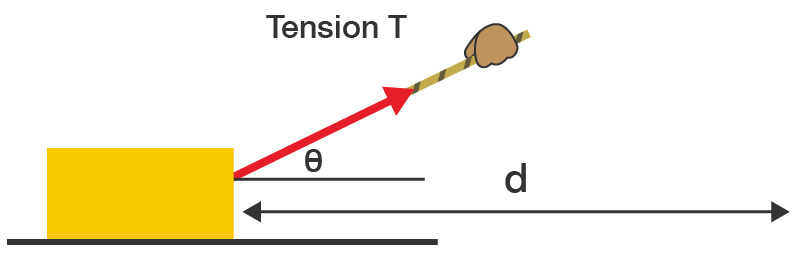
Consider a force that acts at an angle. For example, a block is pulled with tension \(T\) by a string at an angle \(\theta\) to the horizontal.
If the block moves a horizontal distance \(d\), only the component of the force in the direction of motion, i.e. horizontal, does work. This is given by the equation:
\[W=Fd=(T\cos\theta)d\]
where:
\(T\) is the tension in Newtons \(\text{N}\)
\(\theta\) is the angle between the force and the direction of motion in degrees.
Here, \(F=T\cos\theta\) is the horizontal component of the tension. We resolve the force along the direction of motion before calculating work. If the force is perpendicular to the displacement, no work is done, since:
\[W=Fd\cos\theta=Fd\cos90^{\circ}=0\]
Using force–distance graphs to calculate work
If the force is not constant, the formula \(W=Fd\) does not directly apply. Instead, we can draw a force–distance graph and find the work done from the area under the curve. This is similar to using the area under a force–time graph to find the impulse of a force, but here, the horizontal axis is distance rather than time.
Example – calculating work using force–distance graphs
Suppose a force increases linearly from \(\mathbf{0}\,\textbf{N}\) to \(\mathbf{200}\,\textbf{N}\) over a distance of \(\mathbf{5}\,\textbf{m}\). Calculate the work done.
Since the force increases linearly from \(0\,\text{N}\) to \(200\,\text{N}\), the force–distance graph is a straight line from the origin, forming a triangle. The work done is the area of this triangle, with base \(5\,\text{m}\) and height \(200\,\text{N}\).
\(m\) is the mass of the object in kilograms \(\text{kg}\)
\(v_i\) and \(v_f\) are the initial and final speeds, respectively, in metres per second \(\text{m s}^{-1}\).
Kinetic energy
Kinetic energy (KE) is the energy of motion. For a body of mass \(m\) moving at speed \(v\), its KE is given by:
\[\text{KE}=\frac{1}{2}mv^{2}\]
If an object’s speed doubles, its KE increases by a factor of four, since KE is proportional to \(v^{2}\). Tripling the speed increases KE by a factor of nine.
Gravitational potential energy
Gravitational potential energy (GPE) is energy 'stored' due to an object’s position in a gravitational field. For an object of mass \(m\) at height \(h\) above a reference level, its GPE is given by:
\[\text{GPE}=mgh\]
where \(g\) is the gravitational acceleration in metres per second squared \(\text{m s}^{-2}\).
In many problems, we use conservation of mechanical energy, where energy transfers between kinetic and potential forms but the total remains (approximately) constant. For example, a ball of mass \(m\) dropped from a height \(h\) loses gravitational potential energy and gains kinetic energy as it falls.
Elastic potential energy (EPE, or strain energy) is the energy stored in an elastic material when it is stretched or compressed. Elastic materials behave differently from rigid materials because they can extend and compress, and then return (approximately) to their original shape.
Hooke’s law
Hooke’s law describes how the force needed to stretch or compress a spring is related to its extension. It states that the force applied to a spring is proportional to its extension (or compression):
\[F = -k x,\]
where:
\(F\) is the force in Newtons \(\text{N}\)
\(k\) is the spring constant in Newtons per metre \(\text{N m}^{-1}\)
\(x\) is the extension or compression in metres \(\text{m}\).
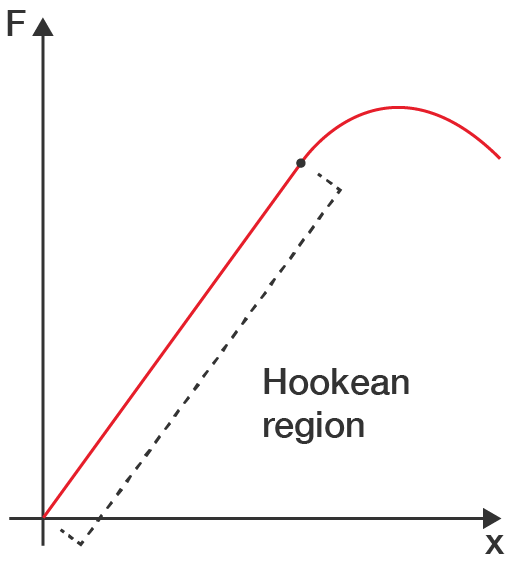
The spring constant is equivalent to the slope of the straight-line 'Hookean' region of the force–extension graph. It measures the stiffness of the spring, with a steeper slope meaning a stiffer spring. The negative sign before the \(k\) indicates that the force required to restore the spring to its (approximately) original shape acts in the opposite direction to the displacement – it pulls back towards the natural length.
Many materials obey Hooke’s Law only up to a certain extension, called the elastic limit. Beyond this point, the behaviour becomes non-linear; the material may stiffen, weaken, or eventually break. Stretching a material beyond its elastic limit can cause permanent deformation so that it does not return to its original length.
From this, the elastic potential energy stored in a spring that obeys Hooke’s law is given by:
\[\text{EPE}=\frac{1}{2}kx^{2}\]
Using force–extension and force–compression graphs to calculate work
Just as the area under a force–distance graph gives the work done by a force, the area under a force–extension (or compression) graph gives the work done in stretching or compressing a spring.
For a spring that obeys Hooke’s law, the force–extension graph is a straight line from \(0\) to \(F=kx\). The work done (and energy stored) when the spring is extended from \(0\) to \(x\) is the area of the triangle under the graph.
Power is the rate at which work is done (or energy is transferred):
\[\text{Power}=\frac{W}{t}\]
where:
\(W\) is the work done in joules \(\text{J}\)
\(t\) is the time taken in seconds \(\text{s}\).
If a constant force moves an object at constant velocity in the direction of the force, then:
\[P=\frac{Fd}{t}=Fv\]
where:
\(P\) is the power in watts \(\text{W}\)
\(F\) is the force in the direction of the motion in Newtons \(\text{N}\)
\(d\) is the distance in metres \(\text{m}\)
\(t\) is the time taken in seconds \(\text{s}\)
\(v\) is the velocity in metres per second \(\text{m s}^{-1}\).
Indigenous knowledges in physics
First Nations-led sustainable aviation fuel
Renee Wootton Tomlin is a proud Tharawal woman of the Yuin Nation and Australia's first Indigenous female aerospace engineer. As founder and CEO of New Era Energy, her mission is to decarbonise aviation by shifting it away from fossil fuels and toward Sustainable Aviation Fuel, working across feedstocks, land partnerships, project sites, fuel pathways, Indigenous governance and market requirements to build enduring low-carbon fuel pathways. Renee says, 'For me, these worlds aren't separate. They are part of the same story. Culture teaches us stewardship and long-term thinking. Aerospace engineering gives us the tools to explore and innovate.'
Aviation depends heavily on the work–energy–power chain you have been studying: chemical energy stored in fuel is converted to kinetic energy by the engine, which then does the work of generating thrust against air resistance. A commercial aircraft cruising at constant velocity requires a continuous power output to maintain speed against drag. Every joule of the energy released by conventional fossil fuel adds carbon to the atmosphere that has been locked underground for millions of years, permanently shifting the balance of energy stored in the Earth's systems. SAF addresses this by changing the source of energy supplying it, drawing on sustainable feedstocks rather than ancient fossil carbon. The same power is generated, but with a much gentler impact on the environment.
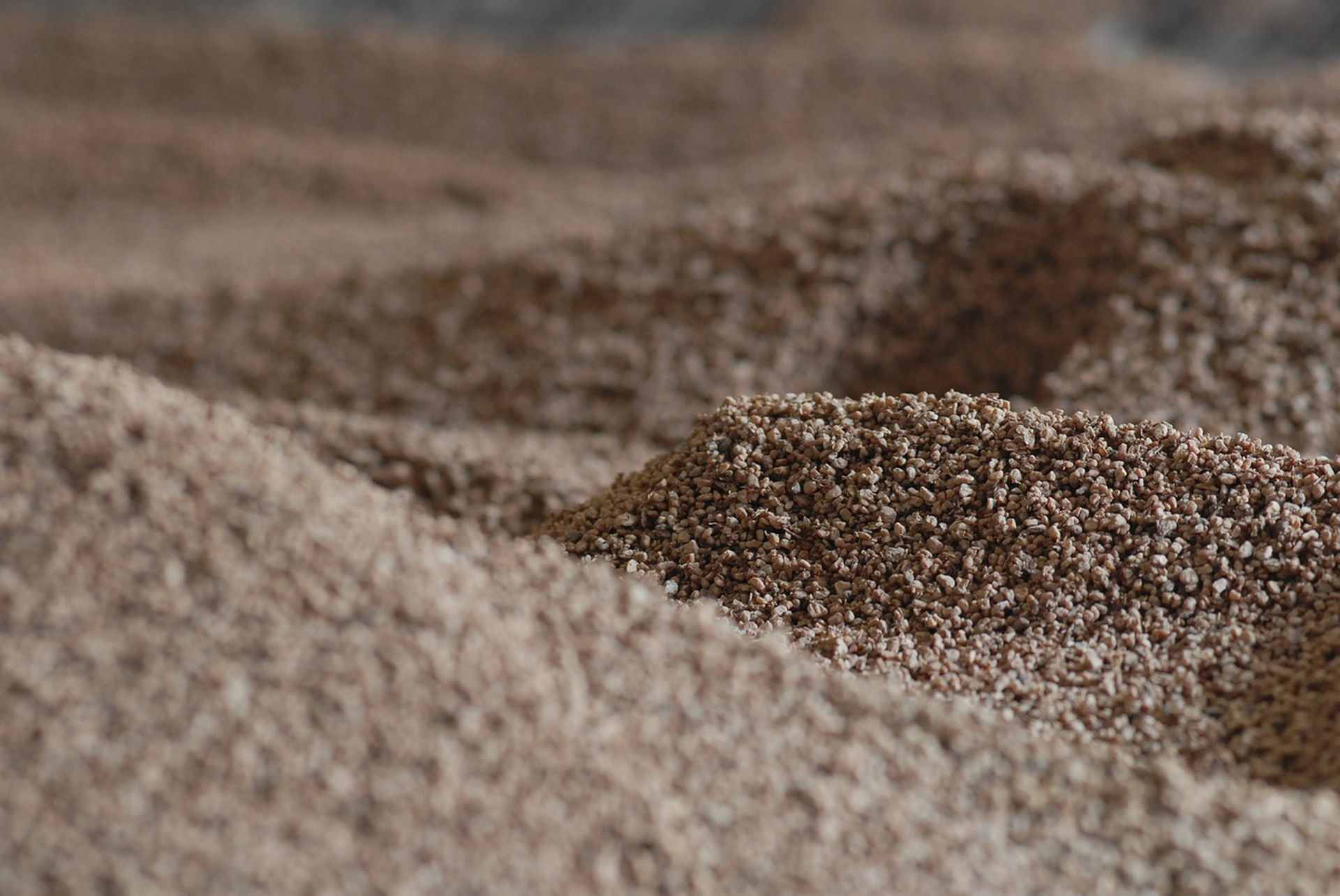
Biomass is one example of a sustainable feedstock for aviation fuel. Image by rizox via Pixabay
We would like to acknowledge and thank the Indigenous Science Committee (School of Science, RMIT University) for their consultation, which has helped shape this example. For further information, please explore the following resources:
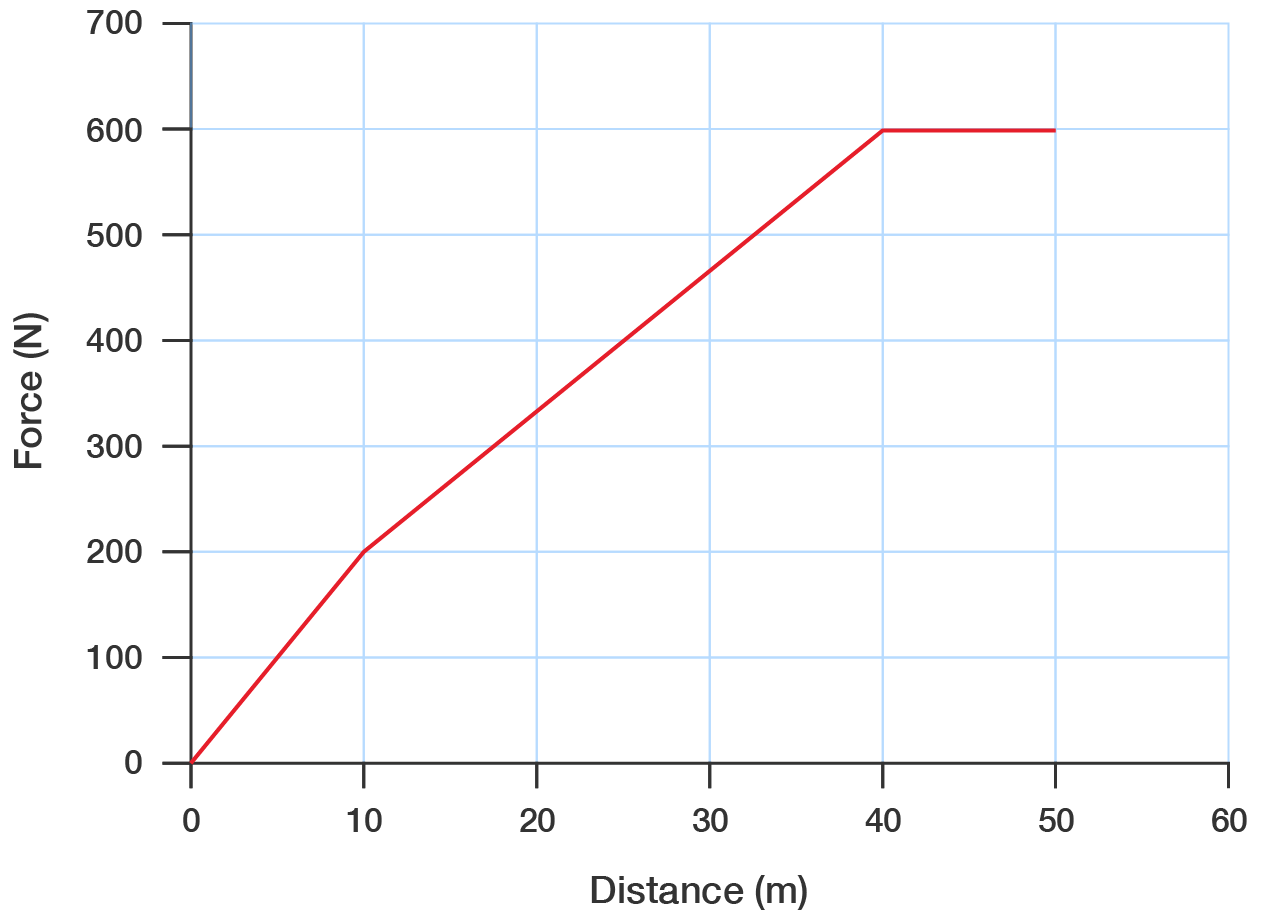
The following graph shows how the total resistance forces acting on a cyclist and her bicycle vary with distance at the start of a race. The cyclist applies a constant force over the first \(\mathbf{50}\,\textbf{m}\) of the race and her velocity becomes constant after travelling \(\mathbf{40}\,\textbf{m}\). The cyclist and bicycle have a combined mass of \(\mathbf{80}\,\textbf{kg}\).
Calculate the amount of work the cyclist does against the resistance force over the first \(\mathbf{40}\,\textbf{m}\) of the race.
The area under the graph has two regions: a triangle from \(0\) to \(10\,\text{m}\), and a trapezoid from \(10\) to \(40\,\text{m}\).
The cyclist does \(13\,\text{kJ}\) of work over the first \(40\,\text{m}\).
Calculate the power developed by the cyclist during the first \(\mathbf{40}\,\textbf{m}\) of the race if she took \(\mathbf{10}\,\textbf{s}\) to cover this distance.
Power is work done per unit time. Using the work calculated in part a:
She develops \(1300\,\text{W}\) of power during the first \(40\,\text{m}\).
Calculate the magnitude of the constant force applied by the cyclist over the first \(\mathbf{50}\,\textbf{m}\) of the race.
When velocity becomes constant at \(40\,\text{m s}^{-1}\), the net force is zero, meaning that the driving force exactly equals the resistance force. From the graph, the resistance force at \(40\,\text{m}\) is \(600\,\text{N}\), so the cyclist's constant driving force must also be \(600\,\text{N}\) throughout.
Exercise – calculating work, energy and power
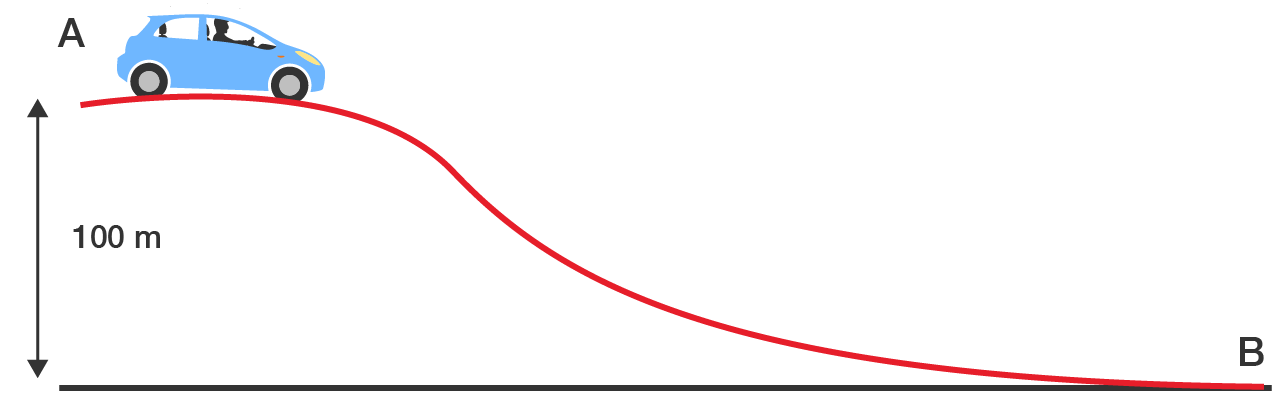
A car is at rest at the top of an extremely steep hill (point A) of height \(100\,\text{m}\). The mass of the car and driver is \(1200\,\text{kg}\).
Assuming frictional forces are ignored, calculate the speed that the car has at point B if it is allowed to roll down the hill without the driver applying the brakes.
Assuming the driver applies brakes and does \(1.0\times10^{6}\,\text{J}\) of work against friction as it rolls down the hill, determine the speed of the car at B.
\(44.3\,\text{m s}^{-1}\)
\(17.1\,\text{m s}^{-1}\)
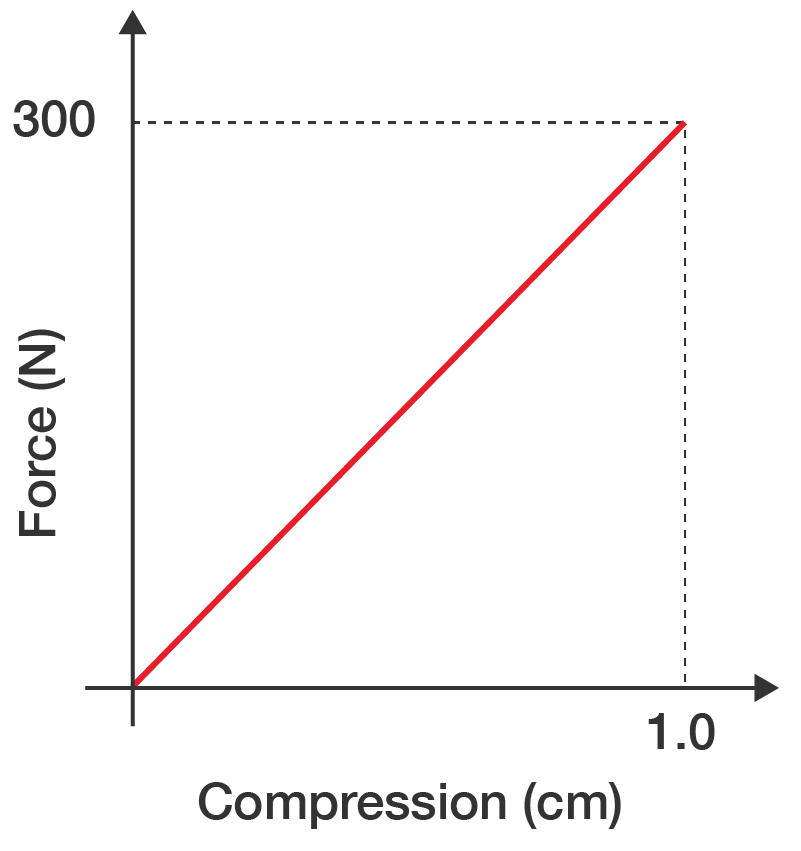
The following graph shows how the force applied by a pinball spring plunger changes as it is compressed during a pinball game.
The plunger is compressed \(1\,\text{cm}\) and then released. If the pinball has a mass of \(50\,\text{g}\), calculate its speed at the instant it leaves the plunger.
\(7.7\,\text{m s}^{-1}\)
A person pulls a \(20\,\text{kg}\) suitcase \(50\,\text{m}\) along a flat airport terminal floor. They apply a force of \(80\,\text{N}\) at an angle of \(30^{\circ}\) above the horizontal. Calculate the work done.
\(3.5,\text{kJ}\)
A spring is stretched \(0.15\,\text{m}\) by a force of \(45\,\text{N}\).
Calculate the spring constant.
Calculate the elastic potential energy stored in the spring.
\(300\,\text{N m}^{-1}\)
\(3.4\,text{J}\)
A cyclist rides at a constant speed of \(0.8\,\text{m s}^{-1}\) against a total resistance force of \(0.5\,\text{m s}^{-1}\). Calculate the power output of the cyclist.
\(960\,\text{W}\)
An electric motor lifts a \(200\,\text{kg}\) load at a constant speed of \(0.5\,\text{m s}^{-1}\). Calculate the power output of the motor, using \(g=9.81\,\text{m s}^{-2}\).
\(981\,\text{W}\)
A \(15\,\text{kg}\) box is pushed \(8.0\,\text{m}\) up a slope inclined at \(25^{\circ}\) to the horizontal at a constant speed. The frictional force acting on the box is \(30\,\text{N}\). Calculate the total work done, using \(g=9.81\,\text{m s}^{-2}\).