Circular functions
Sine and cosine feeling a bit unfamiliar? You might like to visit this resource to remind yourself what they are.
Place a book on a tilted surface and it either slides down or stays put depending on the angle and how rough the surface is. What determines this? This resource helps you to understand the components of gravitational forces that affect this and use them to analyse forces on inclined surfaces. Also learn about how an understanding of forces on slopes can be applied, like in the Budj Bim aquaculture system.
When an object sits on a slope, gravity doesn't act along or against the surface directly; it acts straight down. To analyse the motion, we break that gravitational force into two components:
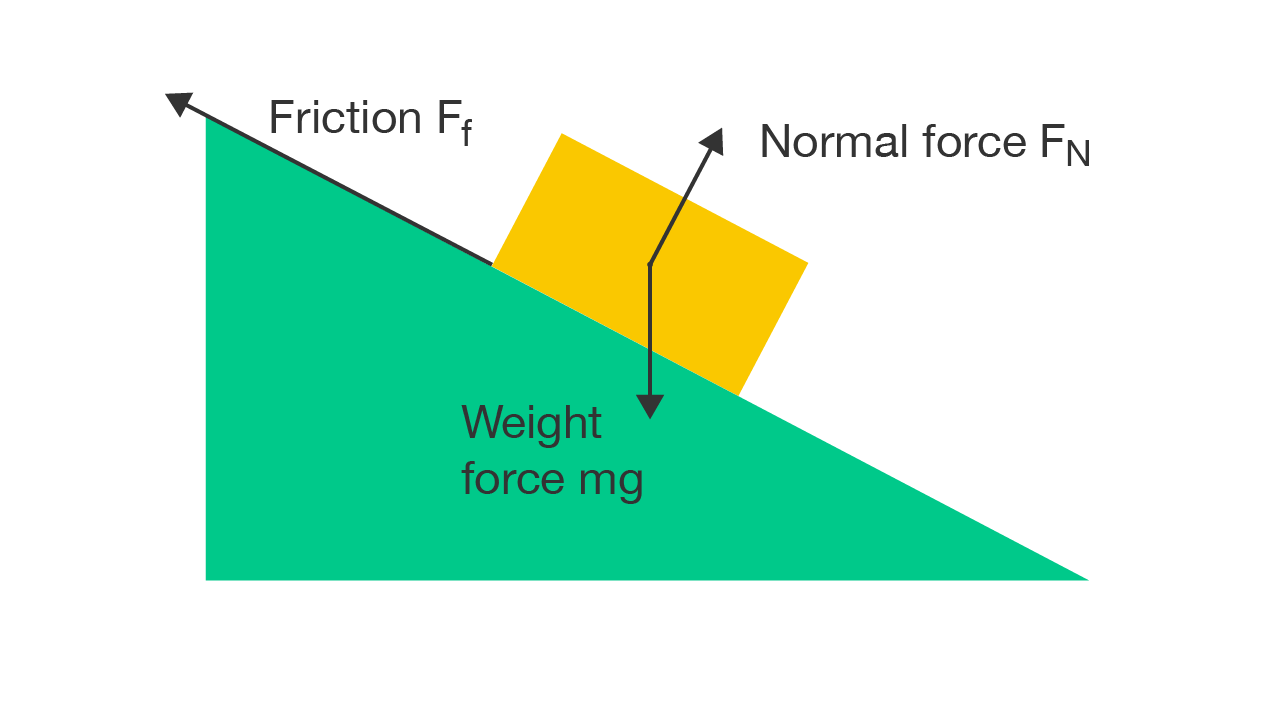
Breaking a force into components like this is called resolving the force.
Just as we can analyse horizontal and vertical motion separately on a flat surface, here we analyse forces perpendicular and parallel to the sloping surface. The same principle applies: the normal force always acts perpendicular to the surface, while friction and the driving force act parallel to it.
Consider this object on a plane, where weight (\(W=mg\)) acts through the centre of mass.
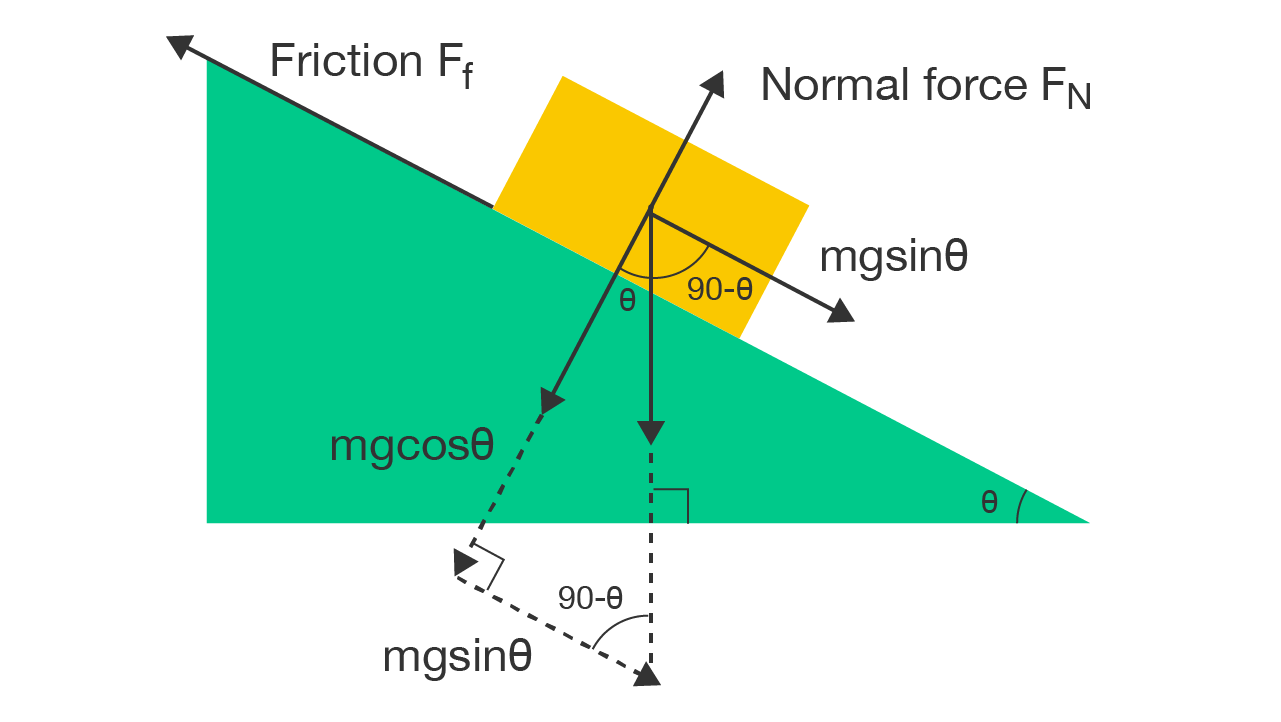
A frictional force \(F_{F}\) acts on the object, stopping it from sliding down the slope. The force driving the object down the slope is given by \(mg\sin\theta\). The difference between these two forces is the resultant force down the slope:
\[\sum F = mg\sin\theta -F_{F}\]
Friction acts to oppose sliding motion, preventing the object from sliding down the plane. For example, if the mass were being dragged uphill, friction would act downhill.
The normal force \(F_{N}\) is at right angles to the surface. The force pushing the object into the surface is given by \(mg\cos\theta\). These forces are equal and opposite one another, otherwise the object would fall through the plane. The resultant force perpendicular to the slope is zero because it sits on the slope, hence:
\[mg\cos\theta=F_{N}\]
To work out the angles, remember that sum of angles in any triangle is \(180^{\circ}\) and a right angle is \(90^{\circ}\).
Indigenous knowledges in physics
The steeper the slope, the faster something moves down it. The Gunditjmara people of South-Western Victoria understood and applied the principle across more than 6,600 years of aquaculture at Budj Bim, a UNESCO World Heritage Site on Gunditjmara Country.
Using volcanic rock from the ancient Budj Bim lava flows, the Gunditjmara constructed an intricate network of channels, weirs, dams and holding ponds to manage the seasonal flow of water from nearby Lake Condah. The gradient of each channel determined the speed of water flow through it: too steep and kooyang (short-finned eels) would be swept through rather than trapped; too shallow and water would not flow at all.
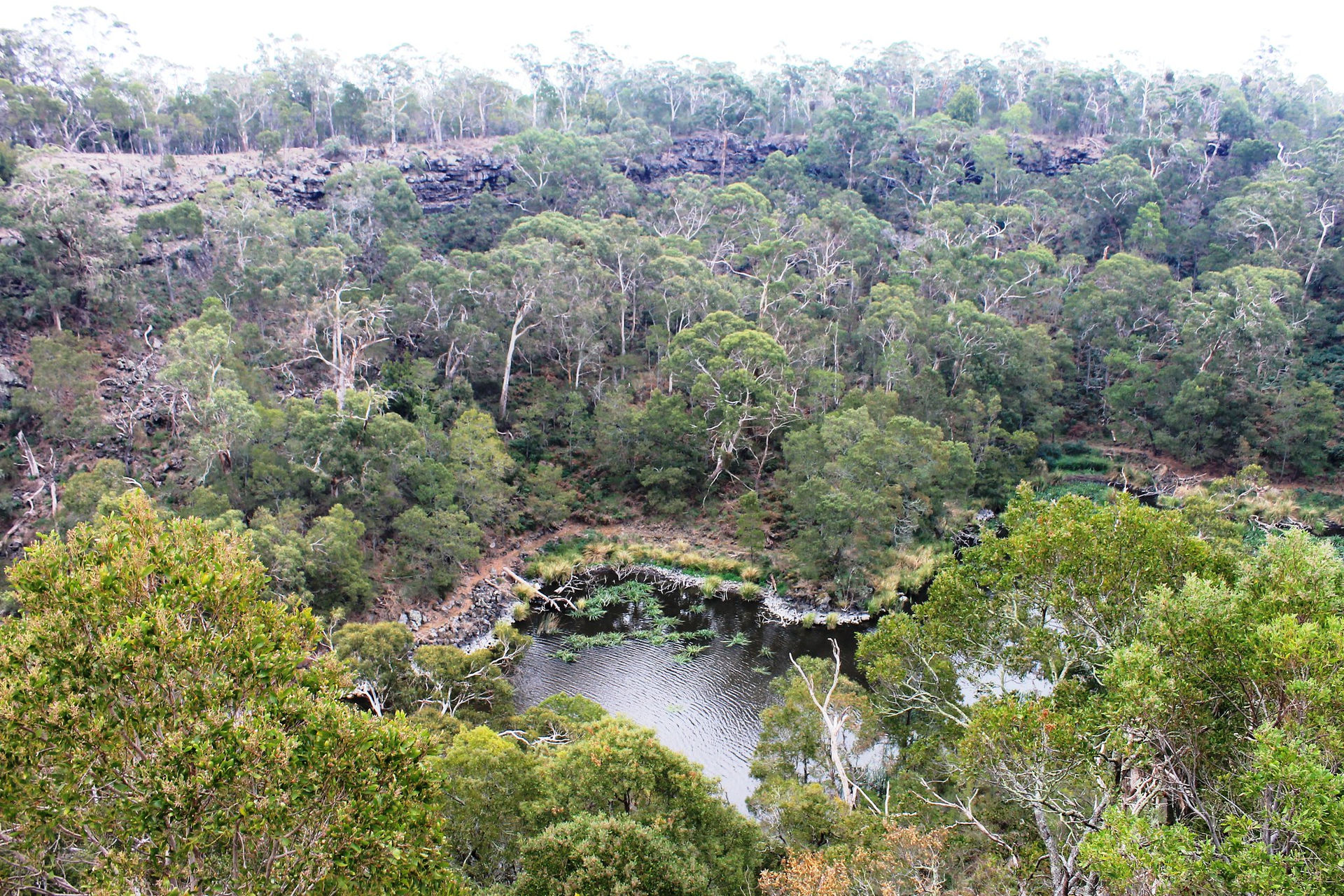
This knowledge has never been static. Through colonisation, the Gunditjmara were dispossessed of their Country, forced onto missions and actively discouraged from their traditional practices. Following severe flooding in 1946, the government constructed a large drain through Lake Condah—without consulting the Gunditjmara—that left the lake dry by the late 1950s, silencing more than 6,600 years of active aquaculture.
In 2008, Lake Condah was reclaimed by the Gunditjmara people and in 2010, a cultural weir was constructed, reinstating traditional water flows across the aquaculture system. The restoration was led by Gunditjmara Traditional Owners, with Indigenous workers involved in every aspect of the construction. In 2019, the Budj Bim Cultural Landscape was inscribed on the UNESCO World Heritage List – the first site in Australia to receive this recognition purely for its Aboriginal cultural importance.
We would like to acknowledge and thank the Indigenous Science Committee (School of Science, RMIT University) for their consultation, which has helped shape this example. For further information, please explore the following resources:
A toy car of mass \(\mathbf{50}\,\textbf{g}\) travels down a smooth incline at \(\mathbf{30^{\circ}}\) to the horizontal. Calculate:
Always start with a force diagram. Friction may be ignored as the incline is described as 'smooth'. Gravity, \(g=9.8\,\text{m s}^{-2}\). As the slope is \(30^{\circ}\), then \(90-30=60^{\circ}\) in top corner and \(90-60=30^{\circ}\) from the normal to vertical force. This allows us to use \(mg\sin30^{\circ}\) as the component parallel to the slope.
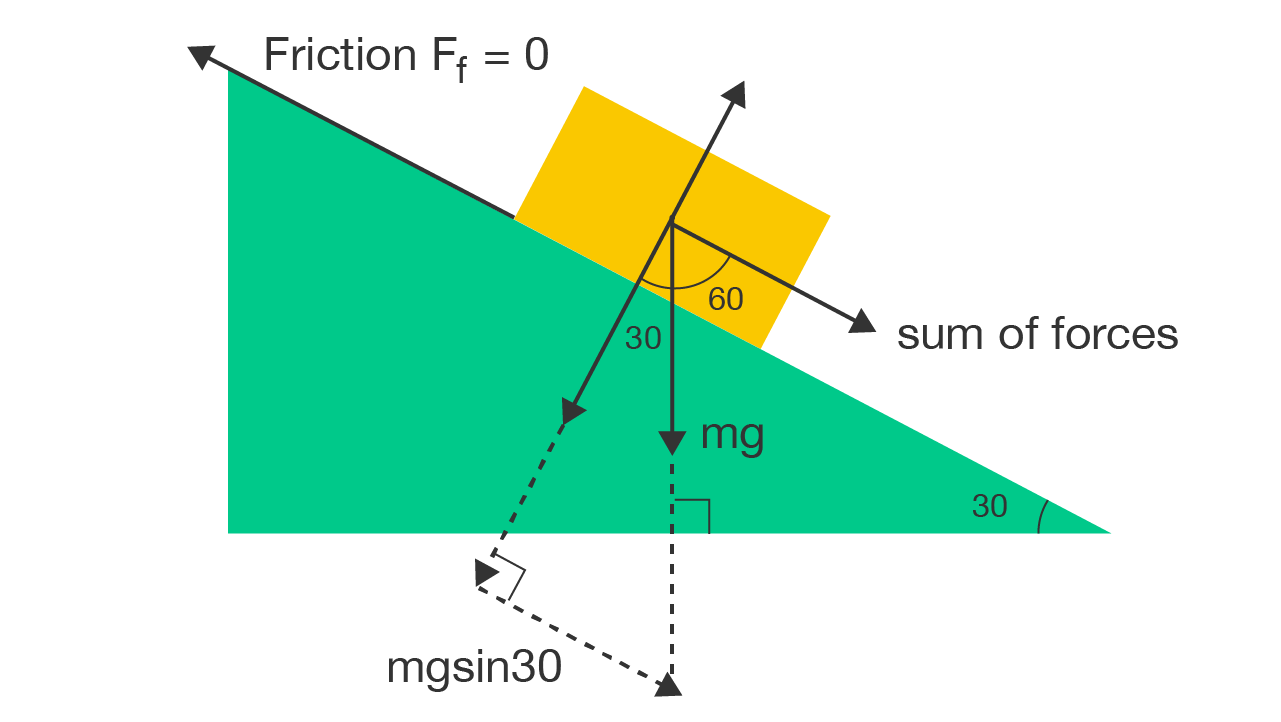
As \(mg\sin30^{\circ}\) is the component of the force parallel to the slope:
\[\begin{align*} \sum F & = ma \\[6pt]
& = mg\sin30^{\circ}-F_{f}\\[6pt]
& = mg\sin30^{\circ}-0\\[6pt]
& = mg\sin30^{\circ} \end{align*}\]
The surface is frictionless (\(F_{F}=0\)). Therefore, the only force allowing the car to roll down the incline is the component of the gravitational force \(mg\sin\theta\). Remember to convert mass in \(g\) to \(kg\).
\[\begin{align*} \sum F & = mg\sin\theta \\[6pt]
& = 50\times10^{-3}\times9.8\times\sin30^{\circ}\\[6pt]
& = 0.25\,\text{N} \end{align*}\]
The net force acting on the car as it rolls down the slope is \(0.25\,\text{N}\).
Again, as the slope is \(30^{\circ}\), the angle in the top corner is \(90-30=60^{\circ}\) and the angle from the normal to vertical force is \(90-60=30^{\circ}\). This allows us to use \(mg\cos30^{\circ}\) as the component perpendicular.
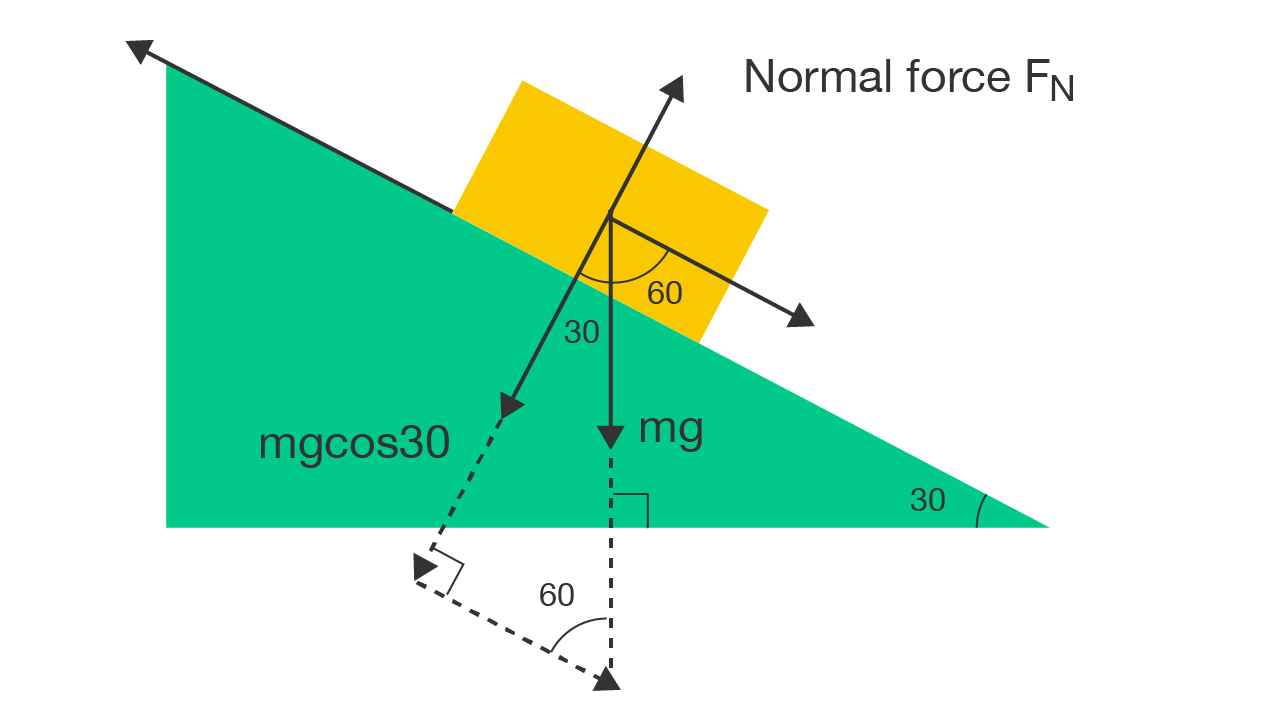
The force of the incline on the car \(mg\cos\theta\) is equal to the normal force \(F_{N}\).
\[\begin{align*} F_{N} & = mg\cos\theta \\[6pt]
& = 50\times10^{-3}\times9.8\times\cos30^{\circ}\\[6pt]
& = 0.43\,\text{N} \end{align*}\]
The force of the incline on the car as it travels down the slope is \(0.43\,\text{N}\).
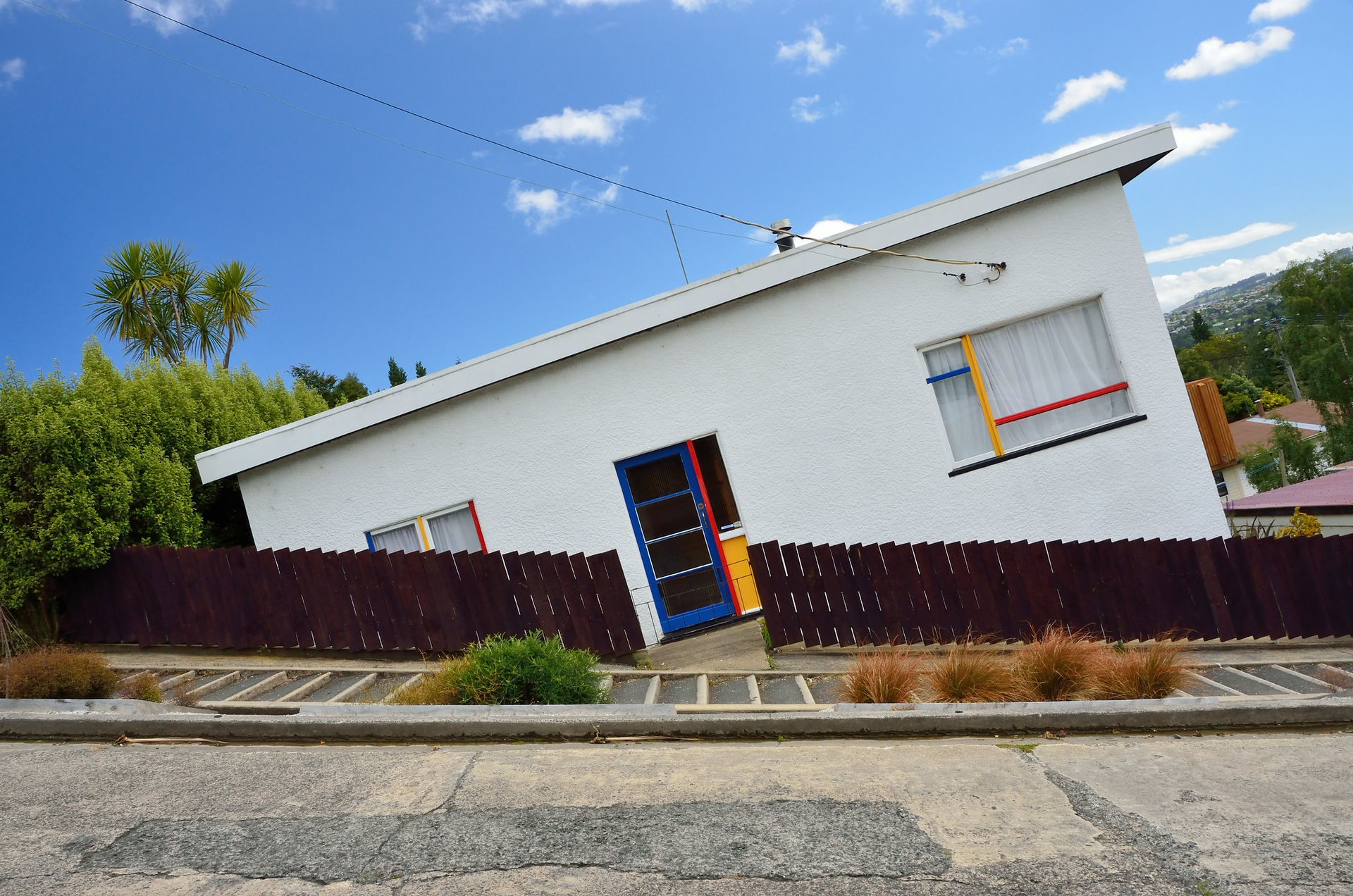
Since the surface is frictionless, the only force acting on the slope is \(mg\sin\theta\). Applying Newton's second law:
\[\begin{align*} \sum F & = ma \\[6pt]
mg\sin\theta & = ma\\[6pt]
g\sin\theta & = a\\[6pt]
& = 9.8\times\sin52^{\circ}\\[6pt]
& = 7.7\,\text{m s}^{-2} \end{align*}\]
A car left with its handbrake off would accelerate at \(7.7\,\text{m s}^{-2}\) down Baldwin Street if the road was frictionless.
Images on this page by RMIT, licensed under CC BY-NC 4.0


RMIT University acknowledges the people of the Woi wurrung and Boon wurrung language groups of the eastern Kulin Nation on whose unceded lands we conduct the business of the University. RMIT University respectfully acknowledges their Ancestors and Elders, past and present. RMIT also acknowledges the Traditional Custodians and their Ancestors of the lands and waters across Australia where we conduct our business - Artwork 'Sentient' by Hollie Johnson, Gunaikurnai and Monero Ngarigo.
More information