In everyday life you might notice that it is harder to stop a heavy truck than a light car at the same speed, or a fast tennis ball than a slow one. This is because of momentum – a measure of how hard it is to stop a moving object. When a force acts for a short time to change an object’s momentum, we describe this using impulse.
Momentum \(p\)
Momentum \(p\) describes the motion of an object by combining its mass and velocity. Objects have more momentum if they have more mass or a higher velocity. This makes it harder to stop or change the object’s motion.
Momentum is given by the equation:
\[p=mv\]
where:
\(p\) is the momentum in kilograms metre per second \(\text{kg m s}^{-1}\)
\(m\) is the mass in kilograms \(\text{kg}\)
\(v\) is the velocity in metres per second \(\text{m s}^{-1}\).
Momentum is a vector quantity, so both magnitude and direction must be considered. When solving problems, always choose a sign convention (for example, 'to the right' or 'East' is positive) and stick to it.
Change in momentum \(\Delta p\)
Suppose an object of mass \(m\) changes its velocity from \(v_{i}\) (initial velocity) to \(v_{f}\) (final velocity) in a time interval \(\Delta t\) under a resultant force \(\sum F\). From Newton’s second law, \(\sum F=ma\), and using \(a=\dfrac{v_{f}-v_{i}}{\Delta t}\), we get:
The right-hand side is the change in momentum \(\Delta p\):
\[\begin{align*} \Delta p & = p_{f}-p_{i} \\[6pt]
& = m v_{f}-m v_{i} \end{align*}\]
where:
\(p_{f}\) and \(p_{i}\) are the final and initial momentum, respectively, in kilogram metres per second \(\text{kg m s}^{-1}\)
\(v_{f}\) and \(v_{i}\) are the final and initial velocity, respectively, in metres per second \(\text{m s}^{-1}\).
These calculations require you to be comfortable with vector subtraction. If you need a refresher, check out this resource.
Impulse \(I\)
The left-hand side of the equation is the impulse of the force \(I\).
\[\begin{align*} I & = \sum F\Delta t \\[6pt]
& = \Delta p \end{align*}\]
where:
\(I\) is the impulse in Newton-seconds \(\text{N s}\) (or kilogram metres per second \(\text{kg m s}^{-1}\))
\(\sum F\) is the resultant force in Newtons \(\text{N}\)
\(\Delta t\) is the time interval in seconds \(\text{s}\).
Impulse and change in momentum are not just numerically equal. They are two ways of describing the same physical event. Impulse describes it from the perspective of the force that caused the change (how hard and for how long the force acted), while change in momentum describes it from the perspective of the object (how much its motion changed).
Like momentum, change in momentum and impulse are vectors.
A negative \(\Delta p\) indicates a decrease in momentum in the chosen positive direction (or a gain in the opposite direction).
A positive \(\Delta p\) indicates an increase in momentum in the chosen positive direction (or a loss in the opposite direction).
Using force–time graphs to calculate impulse
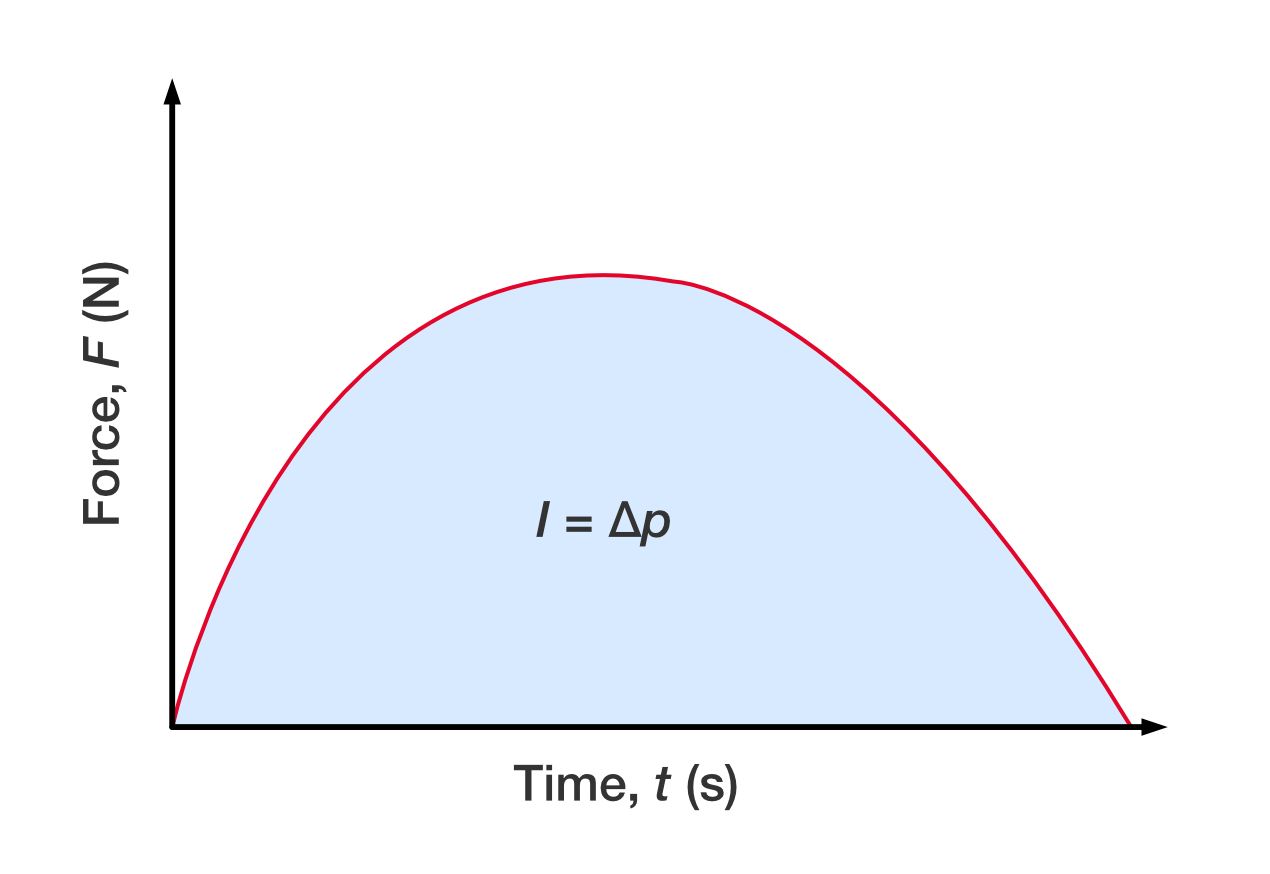
The area under a force–time graph gives the impulse of the force.
This is especially useful when the force is not constant. For example, in car safety design, we often want to increase the time of impact (such as by using crumple zones or airbags) so that the force on the occupants is reduced.
For a given change in momentum \(\Delta p\):
\[\begin{align*} \sum F\Delta t & = \Delta p\quad\text{(a constant)} \\[6pt]
& \Rightarrow F \propto \frac{1}{\Delta t} \end{align*}\]
If the stopping time \(\Delta t\) is small (for example, hitting a rigid wall), the average force is large.
If \(\Delta t\) is larger (for example, hitting a barrier that deforms), the average force is smaller.
Conservation of momentum
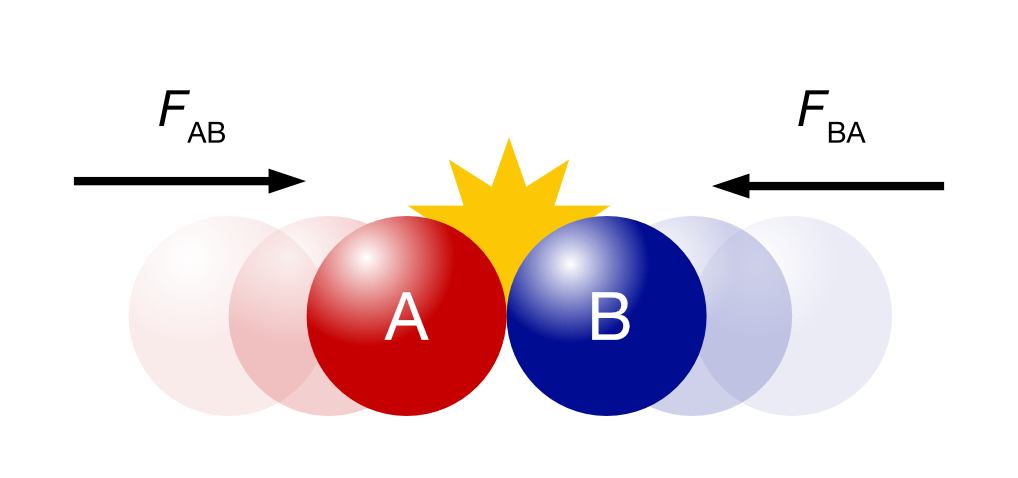
Consider this scenario. According to Newton's third law of motion, when two balls A and B collide, the action of A on B (\(F_{AB}\)) is equal and opposite to that of B on A (\(F_{BA}\)).
This means that the rate of change of momentum of A (\(\Delta p_{A}\)) is equal and opposite to the rate of change of momentum of B (\(\Delta p_{B}\)).
Since the time of contact is the same for both, \(\Delta p_{A}\) is equal and opposite to \(\Delta p_{B}\). That is, the total momentum before impact equals the total momentum after impact. Therefore, \(\Delta p_{A}\) and \(\Delta p_{B}\) cancel out when added together. For example, if two cars collide and stay together after the collision, then the momentum of the two cars before the collision is equal to the momentum of the locked-together cars after the collision.
\[\Delta p_{A}+\Delta p_{B} = 0\]
This means that the total change in momentum of the system is zero. In other words, whatever momentum one ball gains, the other loses by exactly the same amount. The total momentum of the system therefore remains constant.
\[\sum p_{i}=\sum p_{f}\]
This is known as the law of conservation of momentum. The total momentum is the same before, during and after impact:
\(m_{A}\) and \(m_{B}\) are the masses of A and B, respectively, in kilograms \(\text{kg}\)
\(u_{A}\) and \(u_{B}\) are the velocities of A and B before impact, respectively, in metres per second \(\text{m s}^{-1}\)
\(v_{A}\) and \(v_{B}\) are the velocities of A and B after impact, respectively, in metres per second \(\text{m s}^{-1}\).
Example – calculating momentum and impulse
A cyclist and their bicycle have a combined mass of \(\mathbf{90}\,\textbf{kg}\). They are travelling at \(\mathbf{8.0}\,\textbf{m s}\mathbf{^{-1}}\) East along a flat road, when they stop pedalling. Friction brings them to rest in \(\mathbf{4.0}\,\textbf{s}\). Taking East as the positive direction, calculate:
the initial momentum of the cyclist
Momentum is the product of mass and velocity. Since the cyclist is moving East (our positive direction), the momentum is positive.
The cyclist comes to rest, so the final velocity is \(v_{f}=0\). Since the cyclist has lost all their momentum, we expect \(\Delta p\) to be negative, meaning that momentum has decreased in the Eastward direction.
\[\begin{align*} \Delta p & = mv_{f}-mv_{i} \\[6pt]
& = \left(90\times0\right)-\left(90\times8.0\right) \\[6pt]
& = -720\,\text{kg m s}^{-1} \end{align*}\]
The negative sign confirms that the change in momentum is directed West, opposing the original motion. In other words, the cyclist has lost \(720\,\text{kg m s}^{-1}\) of Eastward momentum.
the impulse exerted on the cyclist by friction
Since impulse equals change in momentum, we do not need to do any additional calculation here. The impulse is whatever force was needed to produce the change in momentum we calculated in part b.
\[I = \Delta p = -720\,\text{N s}\]
The impulse is \(720\,\text{N s}\) directed West, meaning friction has acted Westward on the cyclist throughout the stop. This makes physical sense since friction always opposes motion.
the average friction force acting on the cyclist.
We know the impulse and the time over which it acted, so we can find the average force. We rearrange \(I=\sum F\Delta t\) to:
The average friction force is \(180\,\text{N}\) directed West. This force acted on the cyclist for \(4.0\,\text{s}\), producing just enough impulse to bring them to rest. This momentum was not destroyed; it was transferred to the Earth via friction.
A tennis ball of mass \(\mathbf{60}\,\textbf{g}\) is hit horizontally against a wall at \(\mathbf{20}\,\textbf{m s}\mathbf{^{−1}}\) East. It rebounds horizontally at \(\mathbf{16}\,\textbf{m s}\mathbf{^{−1}}\) West. The contact time between the ball and the wall is \(\mathbf{0.04}\,\textbf{s}\). Taking East as the positive direction, calculate:
the initial and final momentum of the ball
Before calculating, it is important to assign signs to each velocity according to our sign convention. The ball initially travels East (positive), so \(v_{i}=+20\,\text{m s}^{-1}\). After rebounding, it travels West (negative), so \(v_{f}=-16\,\text{m s}^{-1}\).
The change in momentum is the final momentum minus the initial momentum. Because the ball has reversed direction, both values contribute to the magnitude of \(\Delta p\). This is why rebounds produce a larger change in momentum than simply stopping would.
\[\begin{align*} \Delta p & = p_{f}-p_{i} \\[6pt]
& = -0.96-1.2\\[6pt]
& = -2.16\,\text{kg m s}^{-1}\end{align*}\]
The change in momentum is \(2.16\,\text{kg m s}^{-1}\) West. This is larger than either the initial or final momentum alone.
the impulse exerted on the ball by the wall
Impulse is equal to the change in momentum.
\[I=\Delta p=-2.16\,\text{N s}\]
The impulse is \(2.16\,\text{N s}\) West. This makes physical sense: the wall had to first stop the ball and then accelerate it back in the opposite direction, which is why the impulse is larger than you might expect.
the average force exerted by the wall on the ball.
Now that we know the impulse and the contact time, we can find the average force the wall exerted on the ball during contact. Rearranging \(I=\sum F\Delta t\):
The average force exerted by the wall on the ball is \(54\,\text{N}\) West. According to Newton's third law, the ball exerts an equal and opposite force of \(54\,\text{N}\) East on the wall during contact.
Exercise – calculating momentum and impulse
A tennis ball of mass \(100\,\text{g}\) hits the wall horizontally at \(8.0\,\text{m s}^{-1}\) East and rebounds at \(6.0\,\text{m s}^{-1}\) West. The contact time with the wall is \(0.07\,\text{s}\). Calculate, stating the magnitude and direction:
the impulse on the ball by the wall
the change in momentum of the ball
the force exerted on the ball by the wall
the force exerted on the wall by the ball
\(1.4\,\text{N West}\)
\(1.4\,\text{kg m s}^{-1}\,\text{West}\)
\(20\,\text{N West}\)
\(20\,\text{N East}\)
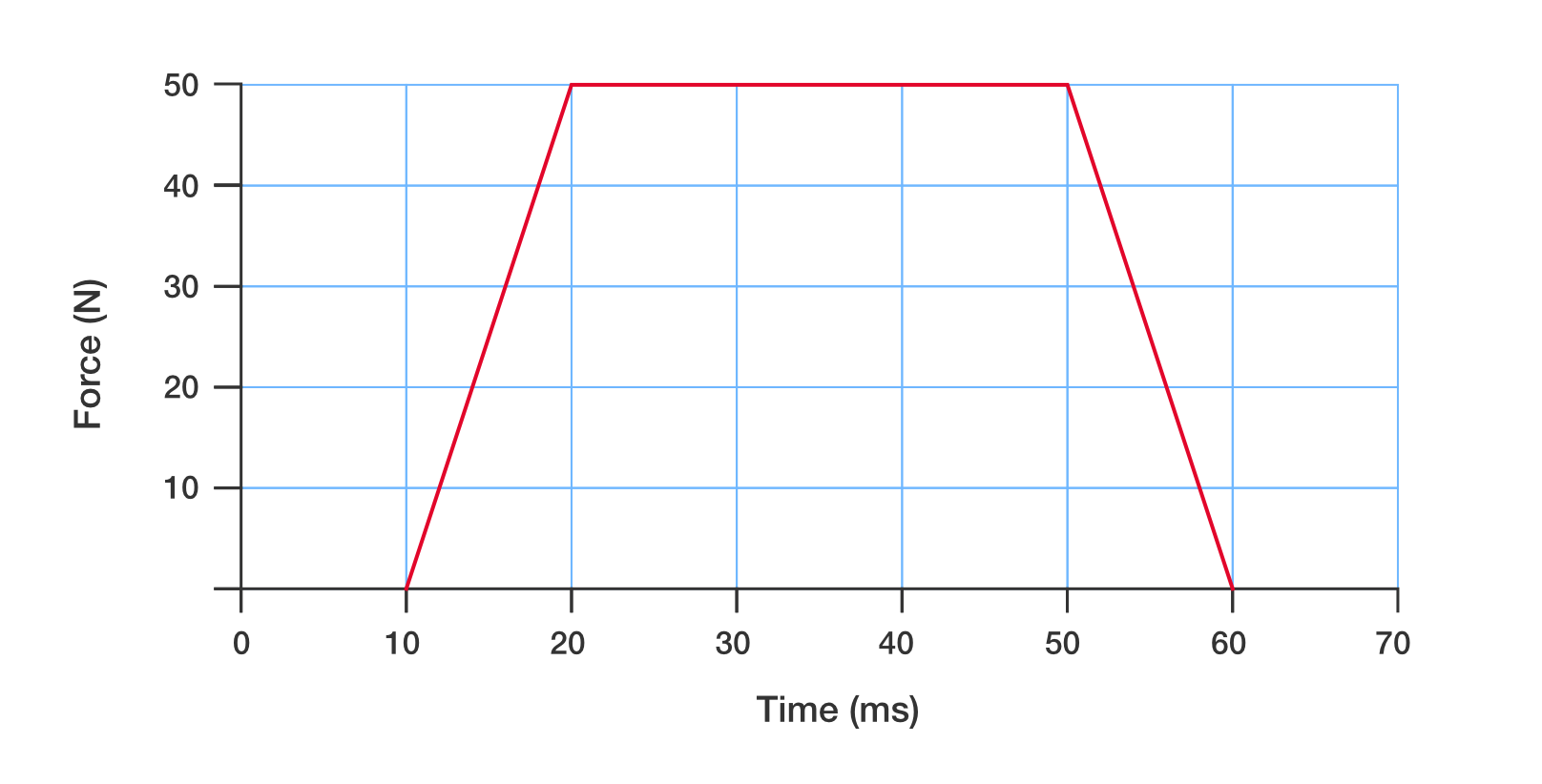
The following graph shows how force varies with time for a miniature crash test dummy of mass \(2\,\text{kg}\) moving to the right. It is involved in a collision with a large concrete block set into the ground, which brings it to rest. Calculate the dummy's initial speed.
Miniature crash test dummy graph transcript
A graph showing force on the vertical axis and time in milliseconds on the horizontal axis. The graph starts from 0 Newtons at 10 milliseconds and goes up in straight line to 50 Newtons at 20 milliseconds. From 20 to 50 milliseconds, the graph is stable at 50 Newtons, then goes down in a straight line to 0 Newtons at 60 milliseconds.
\(1.0\,\text{m s}^{-1}\)
A truck of mass \(2500\,\text{kg}\) travelling at \(20\,\text{m s}^{-1}\) West collides head on with a car of mass \(800\,\text{kg}\) travelling in the opposite direction at \(15\,\text{m s}^{-1}\). The two vehicles become locked together.
What is the total momentum of the two vehicles before the collision? Assume the trucks motion (West) is positive.
What is the speed and direction of the car and truck immediately after the collision?
\(3.8\times10^{4}\,\text{kg m s}^{-1}\)
\(11.5\,\text{m s}^{-1}\,\text{West}\)
A racing car negotiating a tight bend at \(30\,\text{km h}^{-1}\) collides with a crash barrier. The air bag in their car inflates and the time taken for it to inflate is \(0.16\,\text{s}\). The driver's head has a mass of \(7.0\,\text{kg}\). Explain why the driver is less likely to suffer head injury in a collision with the air bag than if their head collided with the car dashboard, or other hard surface.
\(F\times\Delta t=\text{constant}\)
Since \(m\Delta v\) is constant, \(F\propto\dfrac{1}{\Delta t}\). In other words, the force of impact is inversely proportional to the time of impact.
For the dashboard injury, \(\Delta t\) is small, therefore \(F\) is large, resulting in a serious injury.
For the air bag injury, \(\Delta t\) is large, therefore \(F\) is small, resulting in a much less serious injury.