Without static friction, nothing would stay put. It is the force that keeps objects at rest when a force is applied – stopping a parked car from rolling down a hill, keeping your feet from sliding when you walk, and holding a stack of books in place on a tilted surface. This resource explores how static friction works, what determines its maximum value, and how it applies to objects on slopes.
Remember that friction is the force that resists motion when two surfaces come into contact. Static friction is specifically the frictional force acting between two contacting surfaces when they are at rest. It arises from the tiny interactions between the surfaces and is crucial for preventing motion until a certain threshold force is applied.
Static frictional force
When a block sitting on a table is at rest, static friction is \(0\). When a force is applied to the block, static friction imparts an equal and opposite force to keep the block from moving. If more force is applied and this exceeds a value called the maximum static friction force, the block will move – that is, it is the force required to overcome static friction.
The static friction force can be calculated using:
\[F_{\text{S,max}}=\mu_{\text{S}}N\]
where:
\(F_{\text{S,max}}\) is the maximum static friction force in Newtons \(\text{N}\)
\(\mu_{\text{S}}\) is the coefficient of static friction, which is dimensionless (it has no units)
\(N\) is the normal force in Newtons \(\text{N}\).
Static friction is different from kinetic friction, which is the frictional force acting between two contacting surfaces when one or more of them are in motion.
Coefficient of static friction
The coefficient of static friction \(\mu_{S}\) describes how 'grippy' two surfaces are with each other. It is determined experimentally and depends on the materials in contact – for example, rubber on concrete has a high coefficient (between \(0.6\) and \(0.8\)), meaning a large force is needed to overcome friction, while ice on steel has a very low coefficient (around \(0.03\)), meaning very little force is needed.
A higher \(\mu_{S}\) means the surfaces resist sliding more strongly.
A lower \(\mu_{S}\) means the surfaces slide past each other more easily.
The coefficient has no units because it is the ratio of the friction force to the normal force. Both are measured in Newtons, so the units cancel.
Example – calculating forces on slopes with static friction
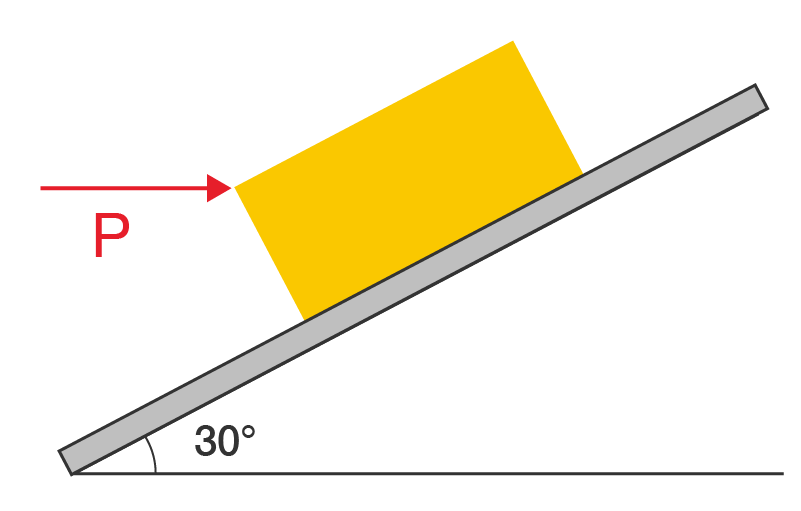
The crate shown has a mass of \(\mathbf{50}\,\textbf{kg}\) and the coefficient of static friction between the crate and the plane is \(\mathbf{\mu_{s}= 0.25}\). Take \(\mathbf{g=9.81}\,\textbf{m s}\mathbf{^{-2}}\).
Calculate the minimum force \(\mathbf{P}\) required to stop the crate from sliding down the plane.
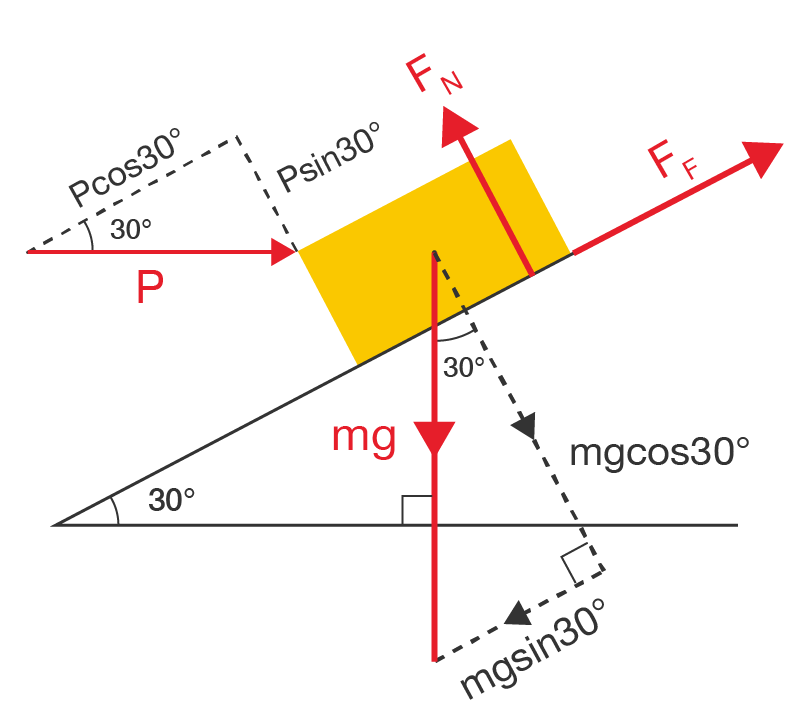
For these problems, we always start by drawing or annotating a free-body diagram which shows only the external forces acting on the one object: the crate.
For the impending motion of sliding down the plane, friction \(F_{F}\) acts up the plane. The other forces on the crate are: weight \(mg\), the normal force \(F_{N}\), and the applied force \(P\).
The maximum static friction is \(F_{S}=\mu_{S}N\). To find \(N\), we resolve the forces parallel and perpendicular to the plane, using the \(30^{\circ}\) angle between the plane and the horizontal. This gives us simultaneous equations to solve for \(N\).
Parallel to the plane:
\[P\cos30^{\circ}+F_{S}-mg\sin30^{\circ}=0\]
Perpendicular to the plane:
\[N=P\sin30^{\circ}-mg\cos30^{\circ}\]
To solve for \(N\), we can substitute \(F_{S}=\mu_{S}N\) with \(\mu_{S}=0.25\), \(m=50\,\text{kg}\) and \(g=9.81\,\text{m s}^{-2}\). The perpendicular equation becomes:
The minimum horizontal force required to prevent the crate from sliding down the plane is approximately \(140\,\text{N}\).
Calculate the minimum force \(\mathbf{P}\) required to push the crate up the plane.
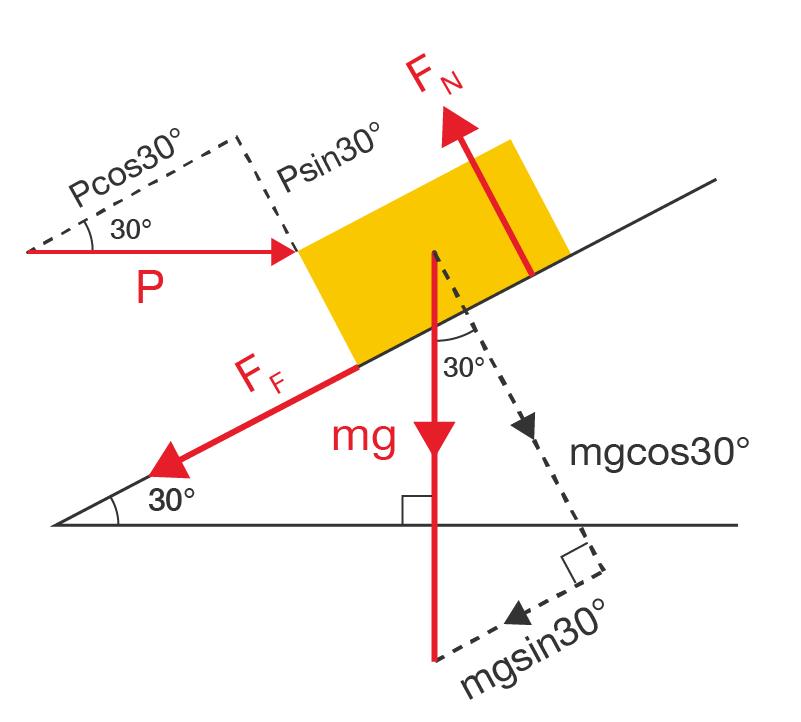
Again, starting with the free-body diagram. For the impending motion of sliding up the plane, friction \(F_{F}\) acts down the plane. The forces are \(mg\), \(F_{N}\), \(P\) and static friction \(F_{S}\), with \(F_{S}=\mu_{S} N\).
Parallel to the plane:
\[P\cos30^{\circ}-F_{S}-mg\sin30^{\circ}=0\]
Perpendicular to the plane:
\[N=P\sin30^{\circ}-mg\cos30^{\circ}\]
Solving for \(N\), we substitute \(F_{S}=\mu_{S}N\) with \(\mu_{S}=0.25\), \(m=50\,\text{kg}\) and \(g=9.81\,\text{m s}^{-2}\). The perpendicular equation becomes:
The minimum horizontal force required to push the crate up the plane is approximately \(474\,\text{N}\).
Exercise – calculating forces on slopes with static friction
A \(30\,\text{kg}\) cardboard box is placed on a warehouse loading ramp inclined at \(20^{\circ}\) to the horizontal. The coefficient of static friction between the box and the ramp is \(0.45\). Will the box slide or remain stationary?
The box remains stationary. The maximum static friction force (\(124.5\,\text{N}\)) exceeds the component of weight driving it down the slope (\(100.7\,\text{N}\)).
A \(1200\,\text{kg}\) car is parked on a hill inclined at \(15^{\circ}\). The coefficient of static friction between the tyres and dry asphalt is \(0.70\).
Calculate the maximum static friction force acting on the car.
Determine whether the car will roll.
\(7959.6\,\text{N}\)
The driving force down the slope is \(3046.8\,\text{N}\), so the car remains stationary.
A \(75\,\text{kg}\) snowboarder stands stationary on a \(25^{\circ}\) slope. The coefficient of static friction between the board and snow is \(0.10\).
Calculate the normal force acting on the snowboarder.
Calculate the maximum static friction.
Determine whether the snowboarder will begin to slide.
\(666.8\,\text{N}\)
\(66.7\,\text{N}\)
The driving force down the slope is \(310.9\,\text{N}\), so the snowboarder will slide.
A worker pushes a \(40\,\text{kg}\) crate up a \(20^{\circ}\) ramp with a force applied parallel to the surface. The coefficient of static friction between the crate and the ramp is \(0.35\). Calculate the minimum force required to just start the crate moving up the ramp.
\(263.3\,\text{N}\)
A \(5\,\text{k}\)g book is placed on a wooden board. The board is slowly tilted until the book just begins to slide at an angle of \(30^{\circ}\) to the horizontal. What is the coefficient of static friction between the book and the board?