In everyday life, forces are all around us, from the push of your feet on the ground when you start walking, to the pull of gravity that keeps you on Earth. Newton’s three laws of motion describe how these forces affect the way objects start moving, keep moving, or come to rest. This resource introduces these laws and shows how they apply in common situations, including objects inside building lifts, sleds being pulled, and using Indigenous tools and watercraft.
A force \(F\), measured in Newtons \(\text{N}\), is any action that makes an object stay still, move or distort. The relationships between the motion of objects and the forces acting on them is described by Newton’s laws.
Newton's first law of motion
An object moving at a certain velocity tends to stay moving at that velocity and an object at rest tends to stay at rest unless acted upon by an unbalanced force.
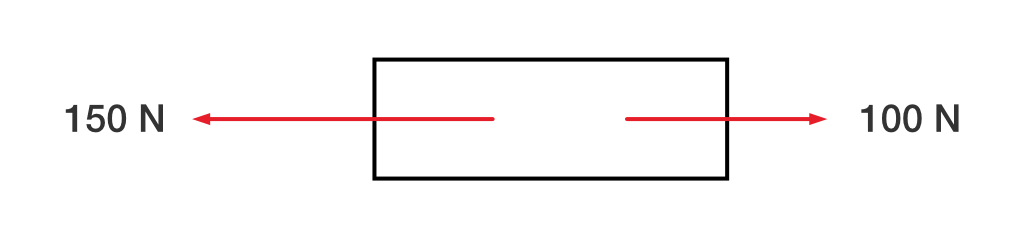
Consider the following force diagram. There is a force of \(100\,\text{N}\) applied to the left of the object and a force of \(150\,\text{N}\) to the right.
Force is a vector quantity, so direction must be taken into consideration. To find the sum of the forces \(\sum F\) or the net force, we need to set one direction as positive and one direction as negative. Here, we will let right be the positive direction and left be the negative direction. This means we have a force of \(150\,\text{N}\) in the positive direction, and \(-100\,\text{N}\) in the positive direction.
\[\begin{align*} \sum F & = 150-100 \\[6pt]
& = 50\,\text{N to the right}\end{align*}\]
There is an unbalanced force causing the object to accelerate to the right.
Click to reveal more examples.
There is a force of \(100\,\text{N}\) acting to the right of the object and \(150\,\text{N}\) acting to the left. If we take the right as the positive direction, we have \(100\,\text{N}\) and \(-150\,\text{N}\).
\[\begin{align*} \sum F & = 100-150 \\[6pt]
& = -50\,\text{N to the right, or }50\,\text{N to the left}\end{align*}\]
There is an unbalanced force causing the object to accelerate to the left.
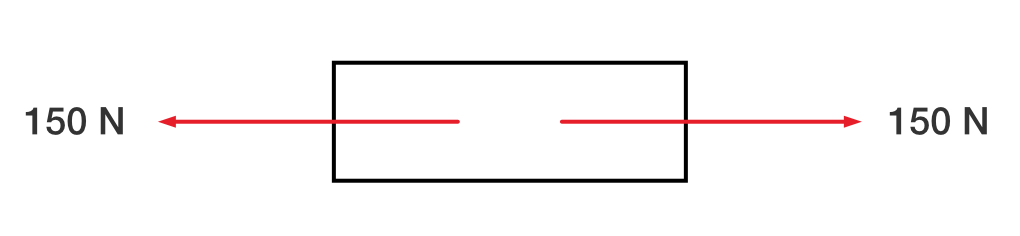
There is a force of \(150\,\text{N}\) acting in opposite directions. If we take the right direction as positive, our two forces are: \(150\,\text{N}\) and \(-150\,\text{N}\).
\[\begin{align*} \sum F & = 150-150 \\[6pt]
& = 0\,\text{N}\end{align*}\]
There is a balanced force, so the object remains stationary or moves at a constant speed (does not accelerate).
Newton's second law of motion
Force equals mass times acceleration:
\[\sum F=ma\]
where:
\(m\) is the mass of the object in \(\text{kg}\)
\(a\) is the acceleration in \(\text{m s}^{-2}\).
Example 1 – using Newton's second law
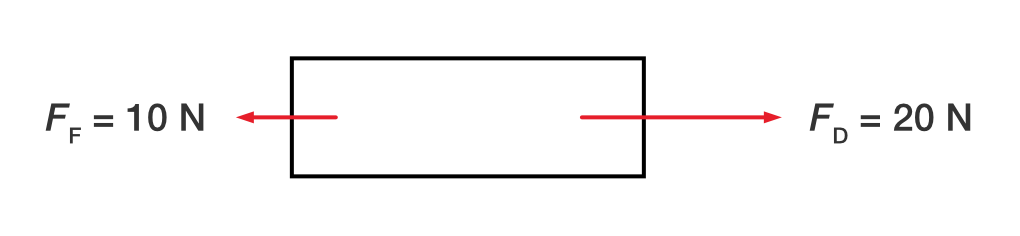
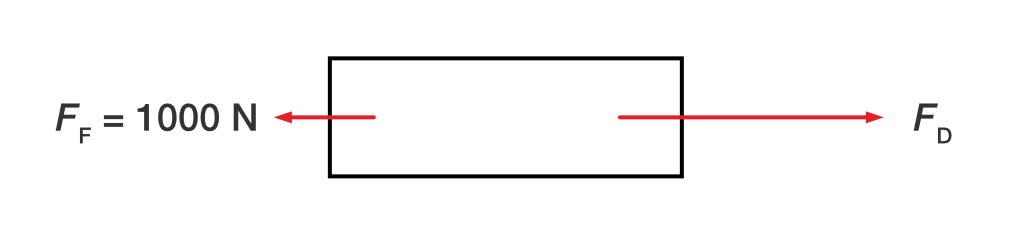
A toy car of mass \(\mathbf{2}\,\textbf{kg}\) has a driving force \(\mathbf{F_{D}}\) of \(\mathbf{20}\,\textbf{N}\). The frictional force \(\mathbf{F_{F}}\) acting on the car is \(\mathbf{10}\,\textbf{N}\). Find the car's acceleration.
When solving problems using Newton's second law, it helps to draw all the forces acting on the object. In this example, the driving and frictional forces are opposing.
We take the direction the car is driving in as the positive direction. Therefore, the net force is:
\[\begin{align*} ma & = 10\\[6pt]
2a & = 10\\[6pt]
a & = 5\,\text{m s}^{-2}\end{align*}\]
Therefore, the magnitude of the car’s acceleration is \(5\,\text{m s}^{-2}\).
A car of mass \(\mathbf{800}\,\textbf{kg}\) accelerates from rest to \(\mathbf{20}\,\textbf{m s}\mathbf{^{-1}}\) in \(\textbf{8.0}\,\textbf{s}\). The resistance forces acting on the car total \(\mathbf{1000}\,\textbf{N}\). Find:
the acceleration of the car
The force diagram is:
Acceleration is the change in velocity divided by the time taken. We must also remember that 'from rest' means \(u=0\). The final velocity is \(v=20\) and time is \(t=8\).
The driving force of the car is \(3000\,\text{N}\).
Newton’s third law of motion
For every action there is an equal and opposite reaction.
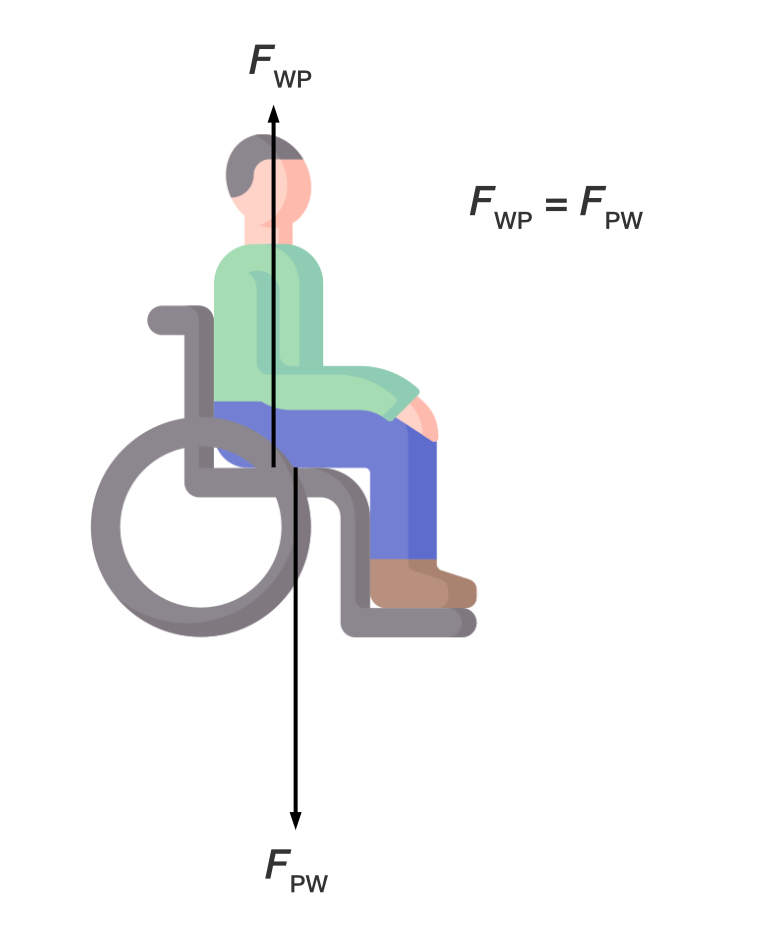
When two objects interact, the forces they exert on each other are equal in size but opposite in direction. These pairs of forces are called action–reaction forces. Each force in an action–reaction pair acts on a different object – this is what distinguishes the third law from the second law, where you consider all forces acting on the same object.
Consider a person sitting on a wheelchair. The person pushes down on the wheelchair (action, \(F_{PW}\)), and the wheelchair pushes back up on the person with an equal and opposite force (reaction, \(F_{WP}\)). These two forces act on different objects—one on the person, one on the wheelchair—which is the defining feature of a Newton's third law pair.
Newton's laws describe how forces affect motion, but so far we've treated force as a single abstract quantity. In practice, there are many different types of forces, each arising from a specific physical interaction.
Gravitational force and weight \(W\)
Gravitational force pulls all objects with mass toward each other. For example, all objects near the Earth are pulled towards its centre by the force of gravity. The gravitational field strength near the Earth’s surface is about \(g=9.8\,\text{m s}^{-2}\).
Mass tells you how much matter an object has; weight tells you how strongly gravity pulls on that mass. The weight of an object is the gravitational force acting on it. It is a vector as it acts downwards towards the centre of the Earth.
\[W=mg\]
where:
\(W\) is the weight in Newtons \(\text{N}\)
\(m\) is the mass in kilograms \(\text{kg}\)
\(g\) is the gravitational field strength in metres per second squared \(\text{m s}^{-2}\).
Normal force \(F_{N}\)
The normal force arises whenever two surfaces are in contact. It acts at right angles to the surface with which it is in contact.
Consider a book resting on a table. Two forces act on the book: its weight \(W=mg\) pulling it downward, and the normal force \(F_{N}\) from the table pushing it upward. Since the book is not accelerating, Newton's second law tells us that the net force must be zero:
\[\sum F = F_{N}-mg = 0\quad\therefore F_{N}=mg\]
Applying Newton's laws
We can put these ideas together to analyse real situations. In each of the scenarios below, the approach is the same: identify all the forces acting on the object, assign a positive direction, and apply Newton's second law to find the unknown quantity. Drawing a force diagram before writing any equations is a good habit – it makes it much easier to see which forces are acting and in which direction.
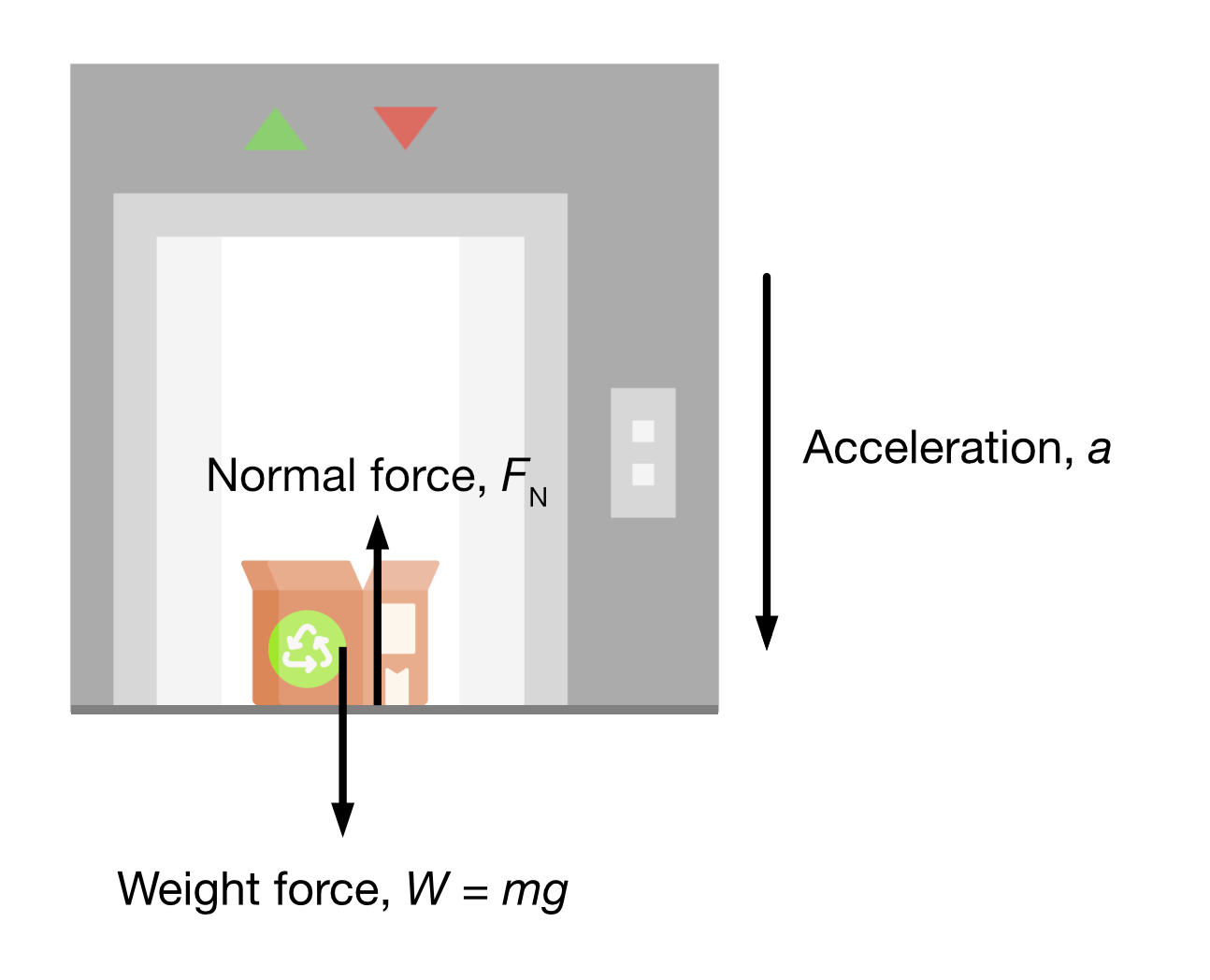
Consider a box sitting on the floor of a lift. Two forces act on it: its weight \(W=mg\) pulling it downward, and the normal force \(F_{N}\) from the lift floor pushing it upward. What changes between the three scenarios below is not the forces themselves, but their relative sizes – and that difference determines the acceleration.
Let's take upwards as the positive direction in each case.
If the lift is accelerating downward (as shown): The weight force is larger than the normal force, so the net force acts downward (negative direction). Applying Newton's second law:
\[\begin{align*} \sum F & = ma \\[6pt]
F_{N}-mg & = -ma \end{align*}\]
This tells us that \(F_{N}=m(g−a)\), which is less than the object's weight \(mg\). This is why you feel lighter when a lift first starts moving downward: the floor is pushing up on you with less force than usual.
If the lift is accelerating upward: The normal force is larger than the weight force, so the net force acts upward. Taking upward as positive:
\[\begin{align*} \sum F & = ma\\[6pt]
F_{N}-mg & = ma \end{align*}\]
This gives us \(F_{N}=m(g+a)\), which is greater than \(mg\). This is why you feel heavier when a lift accelerates upward: the floor pushes up on you with more force than your weight alone.
If not accelerating at all, or the lift is stationary or moving at a constant velocity: There is no net force, so Newton's law gives us \(\sum F=0\).
The normal force exactly equals the weight, and you feel your normal weight.
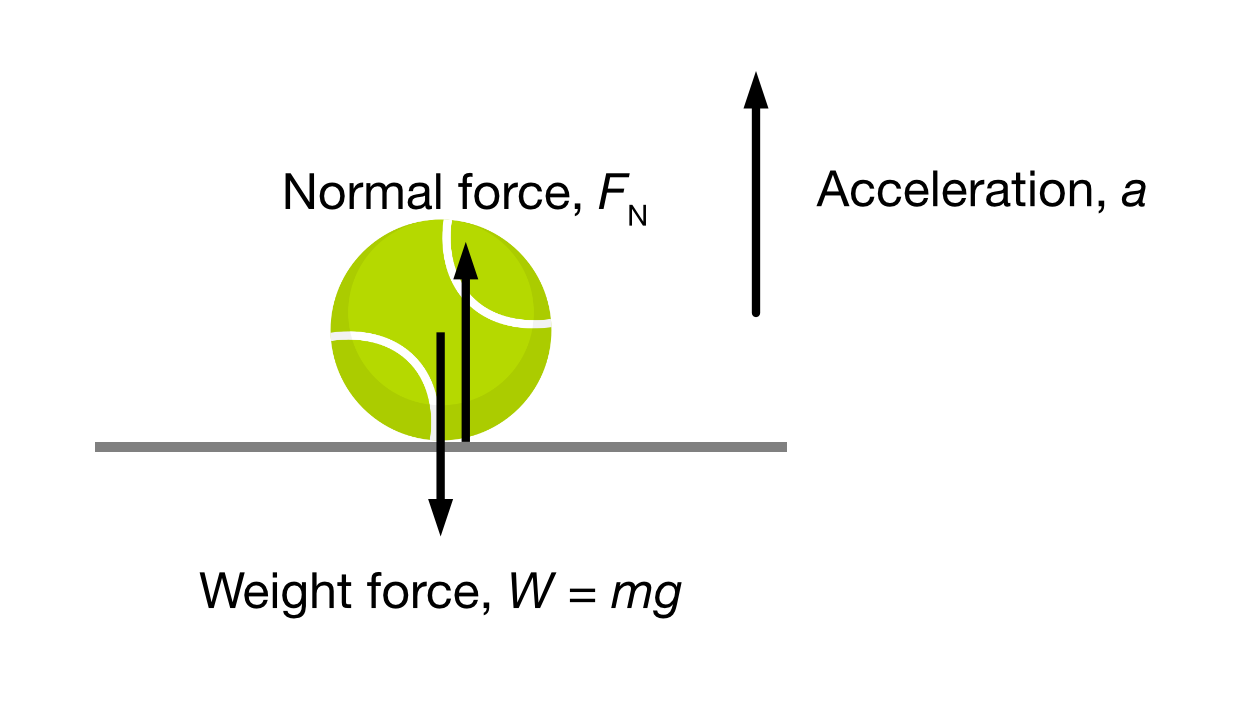
Consider a ball at the moment it makes contact with the ground during a bounce. Two forces act on it: its weight \(W=mg\) pulling it downward, and the normal force \(F_{N}\) from the surface pushing it upward. Just like the lift example, what changes across the three phases of the bounce is the relative size of these two forces.
Again, let's take upwards as the positive direction.
During the bounce (ball in contact with the surface): The normal force is larger than the weight force, so the net force acts upwards, reversing the ball's direction.
\[\begin{align*} \sum F & = ma \\[6pt]
F_{N}-mg & = ma \end{align*}\]
This tells us that \(F_{N}=m(g+a)\), which is greater than \(mg\). In practice, \(F_{N}\) can be much larger than \(mg\) during this phase; the surface pushes back hard and briefly to send the ball back up. This is why a ball bounces higher off a hard surface than a soft one: a rigid surface exerts a larger normal force.
At the instant the ball is momentarily stationary (maximum compression, just before it heads back up): The velocity is zero but the ball is about to accelerate upward. At this precise instant, the net force is zero.
Once the ball has left the surface: There is no longer any contact, so the normal force drops to zero. The only force acting on the ball is its weight \(mg\) pulling it downward, causing it to decelerate as it rises.
\[\sum F = -mg\]
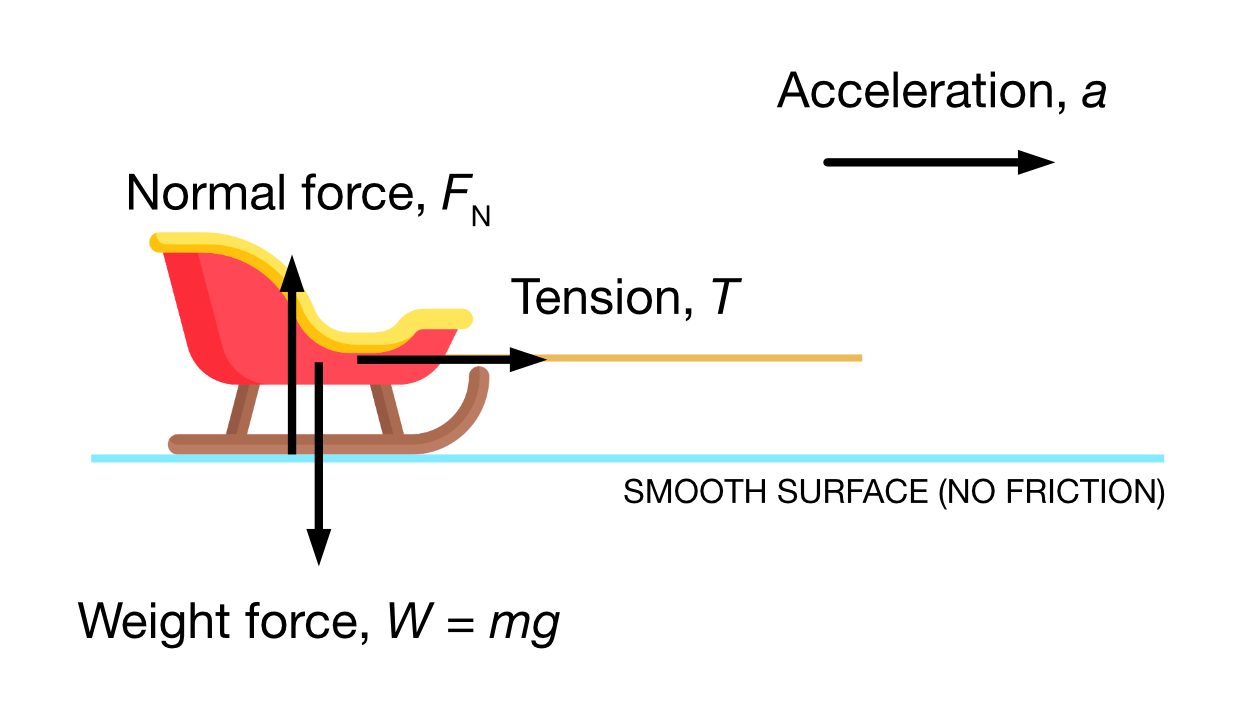
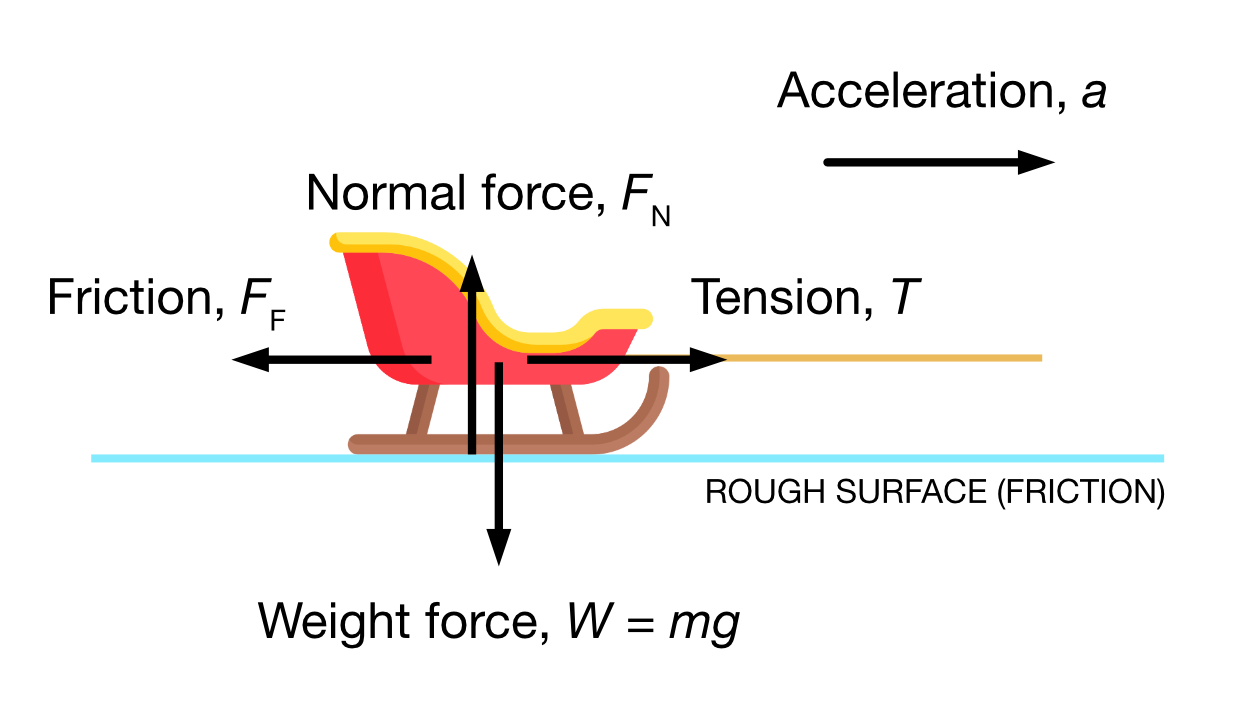
Consider a sled being pulled along a horizontal surface by a rope with tension \(T\). Four forces act on the sled:
the tension \(T\) pulling it horizontally
its weight \(mg\) pulling it downward
the normal force \(F_{N}\) from the surface pushing it upward
(depending on the surface) a frictional force \(F_{F}\) opposing its motion.
Because the sled moves horizontally and does not accelerate vertically, we can analyse the horizontal and vertical directions separately.
On a frictionless surface: With no friction, the only horizontal force is the tension \(T\).
Horizontally: \(\sum F=ma =T-F_{F}\) as friction now opposes the tension
Vertically: \(F_{N}=mg\) as the sled still doesn't accelerate vertically.
Not all of the tension goes into accelerating the sled; some is used to overcome friction. For a given tension \(T\), the sled will accelerate more slowly on a rough surface than on a frictionless one.
Indigenous knowledges in physics
Applying Newton's third law in Aboriginal and Torres Strait Islander science
Newton's third law of motion tells us that for every action there is an equal and opposite reaction. Two examples from across Australia and the Torres Strait bring this principle to life.
Defending with a parrying shield
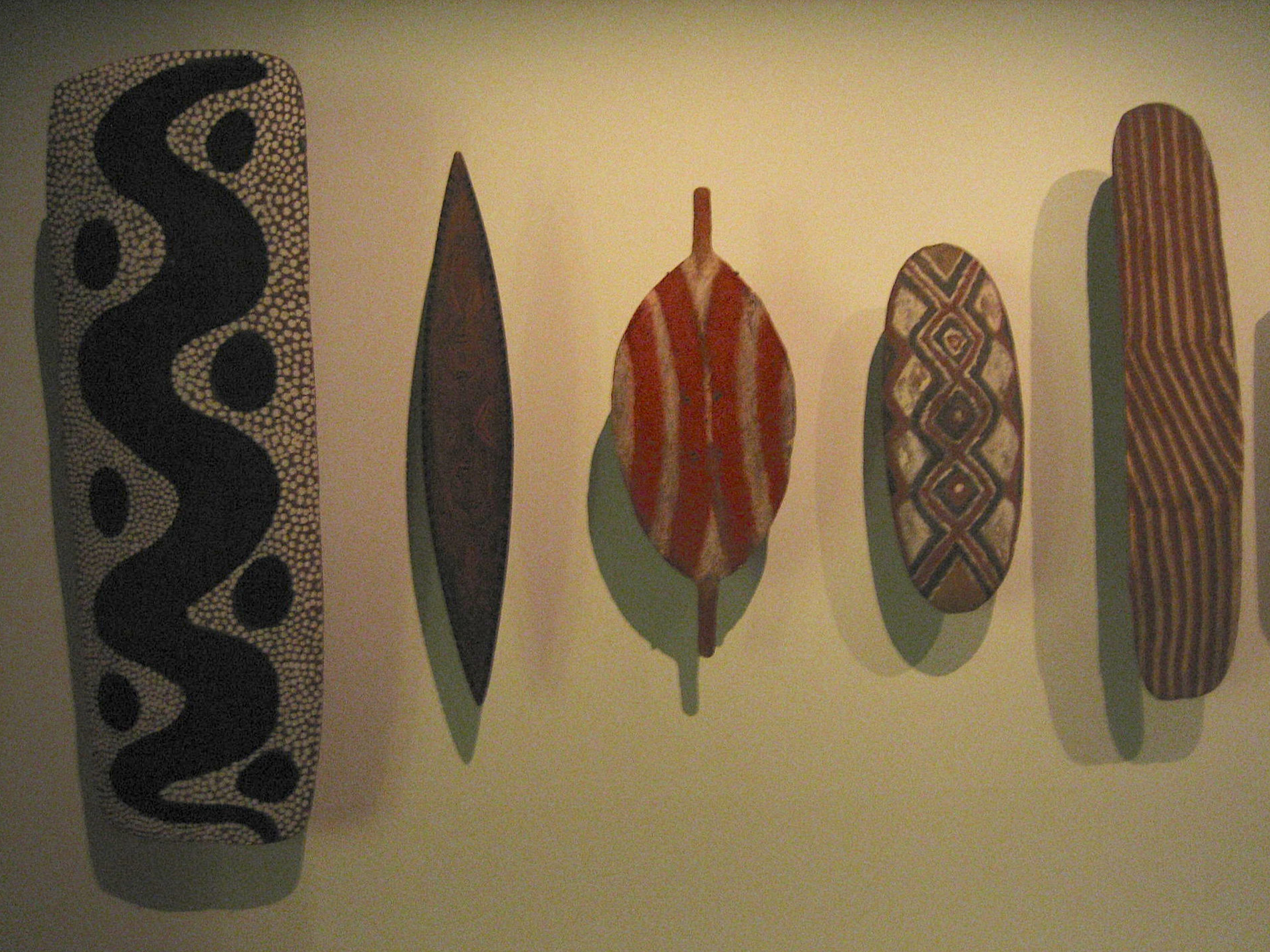
The leangle is a hardwood combat club used by Aboriginal peoples of South-Eastern Australia, including communities of the Murray-Darling Basin. It was always used alongside a parrying shield: a narrow, convex board designed to deflect incoming blows.
When the leangle strikes the shield, it exerts a force on it. The shield exerts an equal and opposite force back. The shield's convex shape meant that this reaction force is directed away from the defender's body — a practical application of the direction of action-reaction pairs.
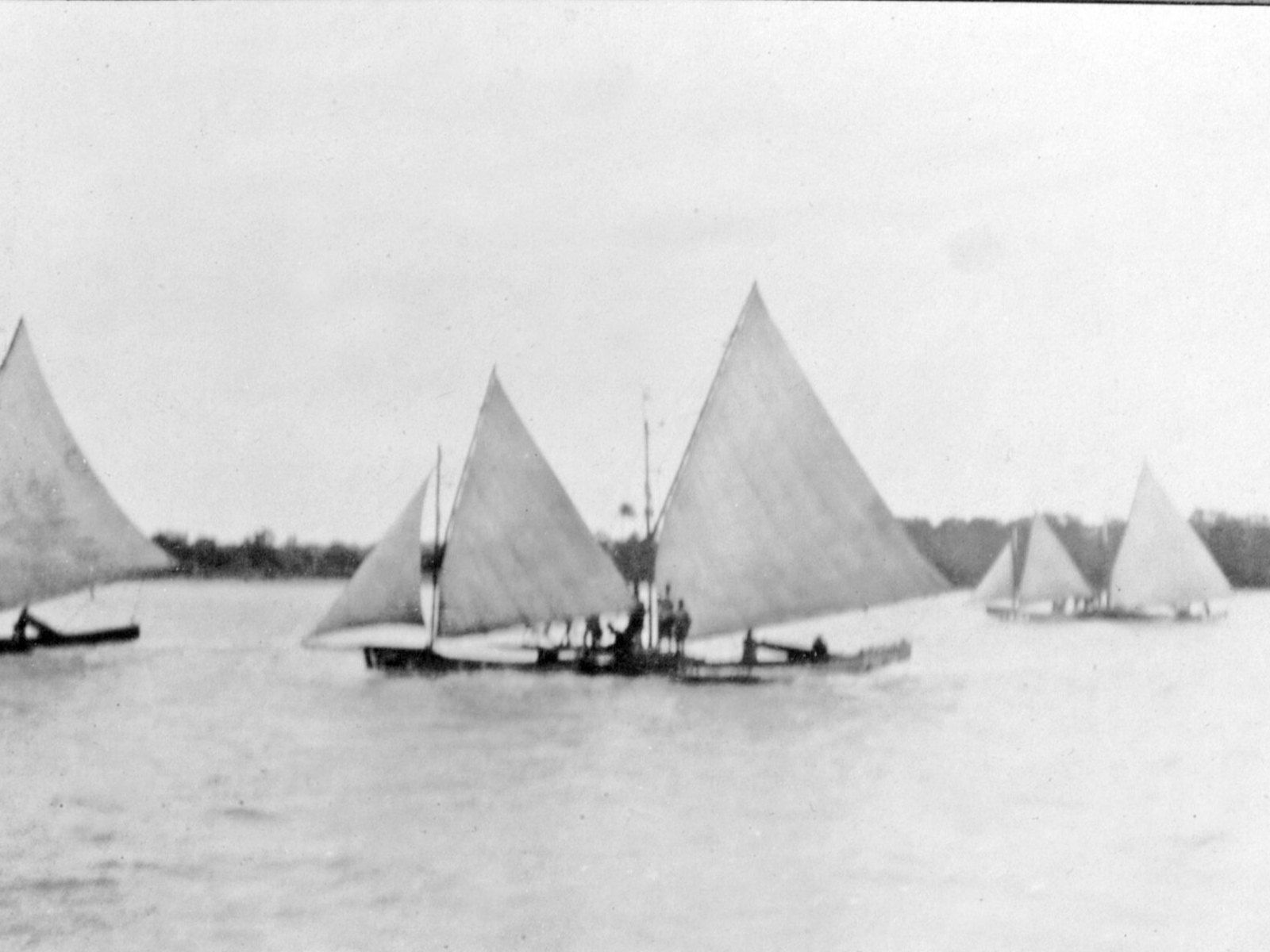
On the other side of the continent, Torres Strait Islander peoples—including the Meriam Mir peoples of the Eastern islands and the Kala Lagaw Ya peoples of the Western and Central islands—propelled their outrigger canoes using paddles.
Each stroke pushes water backward with a force. The water pushes the canoe forward with an equal and opposite force. This is Newton's third law of motion at work on every voyage across open ocean.
We would like to acknowledge and thank Professor Laura Diamond, Associate Professor Michelle Langley, Professor Ian McNiven and the Indigenous Science Committee (School of Science, RMIT University) for their consultation, which has helped shape this example. For further information, please explore the following resources:
Diamond, L. E., Langley, M. C., Cornish, B., Pizzolato, C., & Saxby, D. J. (2024). Aboriginal Australian weapons and human efficiency. Scientific Reports, 14, Article 25497. https://doi.org/10.1038/s41598-024-76317-w
Determine the resultant force needed to give a mass of \(6.4\,\text{kg}\) an acceleration of \(2.4\,\text{m s}^{-2}\) West.
\(15.4\,\text{N West}\)
If a resultant force of \(48\,\text{N}\) produces an acceleration of \(1.2\,\text{m s}^{-2}\) on an object, calculate the mass of the object.
\(40\,\text{kg}\)
A resultant force of \(5.0\,\text{N}\) acts on an object and causes it to reach a velocity of \(4.0\,\text{m s}^{-1}\) in \(2.5\,\text{s}\). Determine the mass of the object.
\(3.1\,\text{kg}\)
An object of mass \(6.0\,\text{kg}\) is at rest on a rough horizontal table. A horizontal force of \(2.4\,\text{N}\) acts on the mass to the East. The mass reaches a speed of \(1.2\,\text{m s}^{-1}\) in a distance of \(2.0\,\text{m}\).
Calculate the acceleration of the mass.
Calculate the net horizontal force acting on the object.
Determine the frictional force acting on the object.