Even at constant speed, circular motion involves constant acceleration. Your velocity is always changing direction, even if its magnitude stays the same. This is what you feel when a car rounds a sharp bend or a rollercoaster carves through a loop. This resource introduces centripetal acceleration and the centripetal force that produces it, shows you how to apply these ideas to real problems, and presents you with examples of how circular motion is applied, such as in Indigenous inventions.
Centripetal acceleration \(a\)
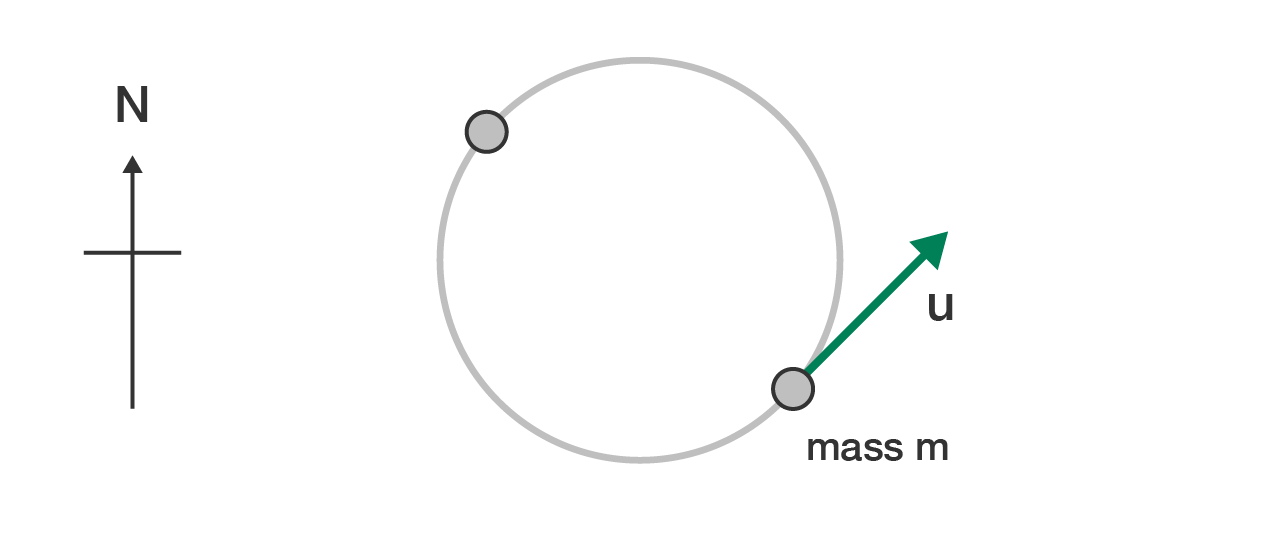
During horizontal circular motion, an object moves in a circle on a flat plane. Consider a mass \(m\) travelling at a constant speed in a horizontal circle. In the following position, the instantaneous velocity is shown as a vector \(u\) in a direction North East.
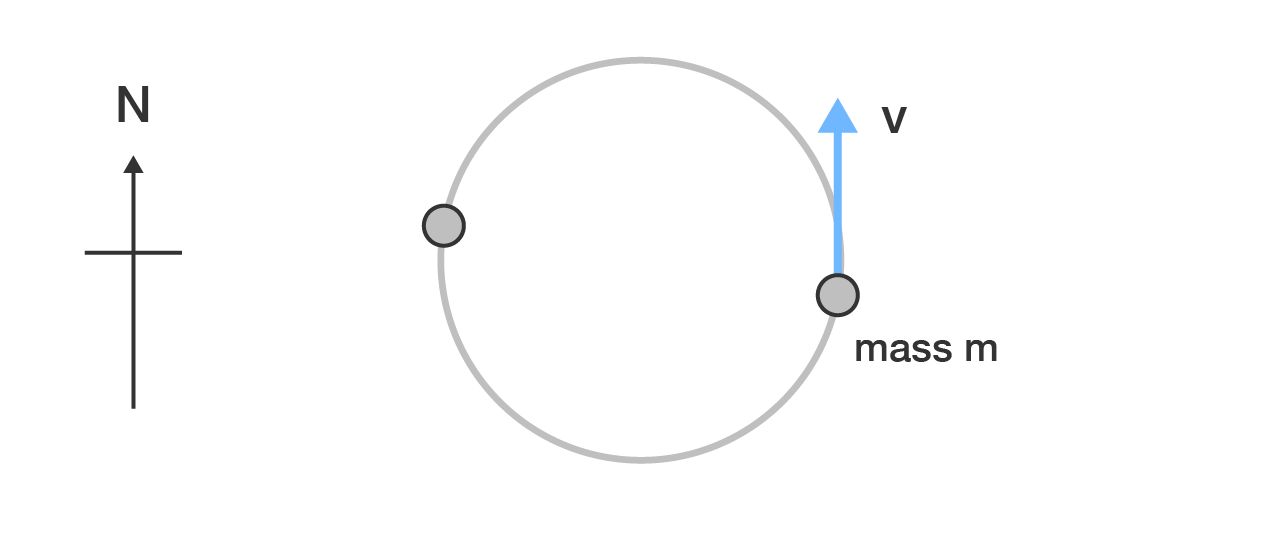
A short time later, this mass will be in the following position. The instantaneous velocity is now \(v\) in a direction North.
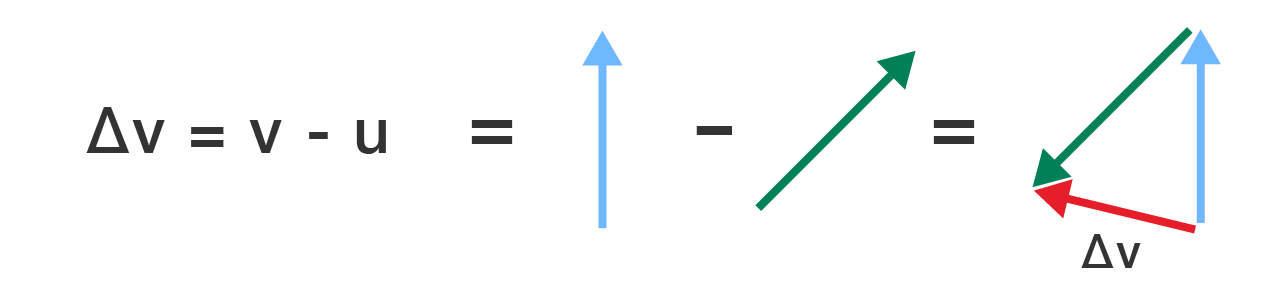
The change in velocity \(\Delta v\) is therefore given by:
\[\Delta v=v-u\]
We can represent this relationship with vectors in 2D space.
\(\Delta v\) always act radially inwards—or towards the centre of the circle—and the mass is accelerating even though the speed is not changing. This acceleration is called centripetal acceleration. It is the change in velocity with time for an object moving in a circular path at constant speed.
Centripetal acceleration is given by:
\[a = \frac{v^{2}}{r} = \frac{4\pi^{2} r}{T^{2}} = 4\pi^{2} r f^{2}\]
where:
\(a\) is the centripetal acceleration in metres per second squared \(\text{m s}^{-2}\)
\(v\) is the velocity in metres per second \(\text{m s}^{-1}\)
\(r\) is the radius of circle in metres \(\text{m}\)
\(T\) is the period of motion (how long it takes for one complete cycle of motion) in seconds \(\text{s}\)
\(f\) is the frequency of motion (the number of cycles occuring in one second) in hertz \(\text{Hz}\).
Consider a seat on a theme park swing ride. The seat and rider have a combined mass of \(80\,\text{kg}\), the chain has a length of \(6.0\,\text{m}\) and the ride completes one revolution every \(4.0\,\text{s}\). Even though the rider moves at a constant speed, they are continuously accelerating because their direction changes. The centripetal acceleration is:
This acceleration is directed inwards along the chain, towards the centre of the ride.
Centripetal force \(F_{C}\)
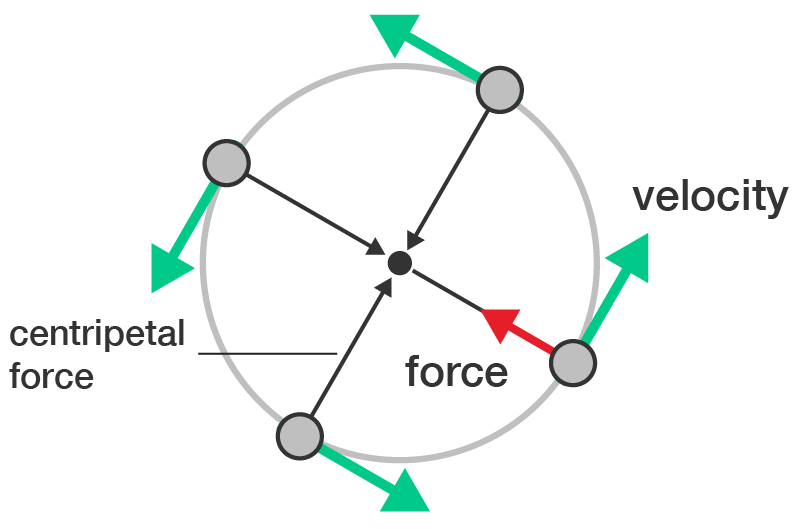
According to Newton’s second law of motion, the net or unbalanced force on an object is given by \(\sum F=ma\), where the net force is always in the same direction as the acceleration. This means that the net force—as with the centripetal acceleration—acts towards the centre of the circle. This net force is called the centripetal force \(F_{C}\).
Since many rotating systems—such as motors, wheels and satellites—are described in terms of angular velocity \(\omega\) rather than linear velocity \(v\), it is useful to express centripetal force in angular terms. Using the relationship \(v=r\omega\):
The centripetal force always acts inward—towards the centre of the circle—while the object's velocity points tangentially, at right angles to that force. Think of the swing ride again: the chain pulls the seat inwards, and the seat curves around the circle rather than flying off in a straight line. If the chain broke, the seat would immediately travel in a straight line tangent to the circle.
Forces that cause circular motion
Always try to identify the force causing the object to turn in a circle. There are three main forces that cause circular motion by acting towards the centre of the circular path.
Tensional force: A theme park swing ride seat is pulled inwards by tension in the chain connecting it to the rotating arm above.
Frictional force: A car moving in a circle does so because the centripetal force is due to the frictional force between the tyres and the road.
Gravitational force: The centripetal force causing a satellite (such as the Earth’s natural satellite, the Moon) to orbit the Earth is caused by the gravitational force of the Earth acting on the satellite.
Indigenous knowledges in physics
Circular motion in Indigenous inventions
Objects and tools may be designed to generate circular motion, but the true ingenuity lies in using that motion to achieve complex effects. For example, when a boomerang spins, it also generates lift perpendicular to its direction of motion. The centripetal acceleration is directed not just along the curve of flight, but also vertically.
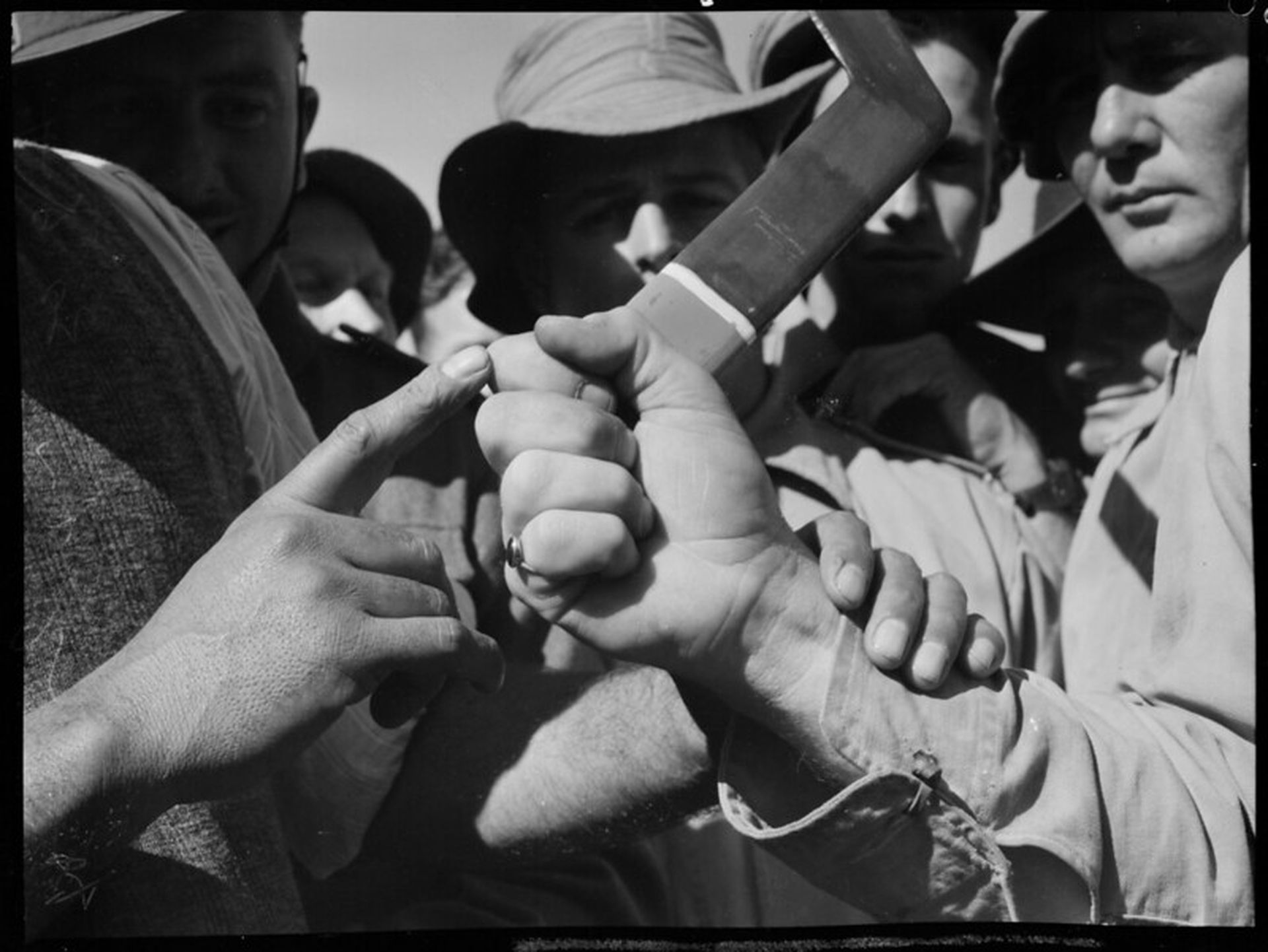
In the 1930s and 40s, William Townsend Onus Jr taught thousands of people how to throw a boomerang, including Australian soldiers. Onus was born at the Cummerangunja Aboriginal Reserve (near Echuca, New South Wales). His mother was of Yorta Yorta descent and his father was a Wiradjuri man. Image by State Library of New South Wales via Flickr, licensed under Flickr Commons
The boomerang is just one expression of a deep tradition of physics-based innovation among Aboriginal peoples, which has produced sophisticated tools, technologies and ideas across tens of thousands of years.
Here are two more examples of Aboriginal and Torres Strait Islander inventions that use circular motion.
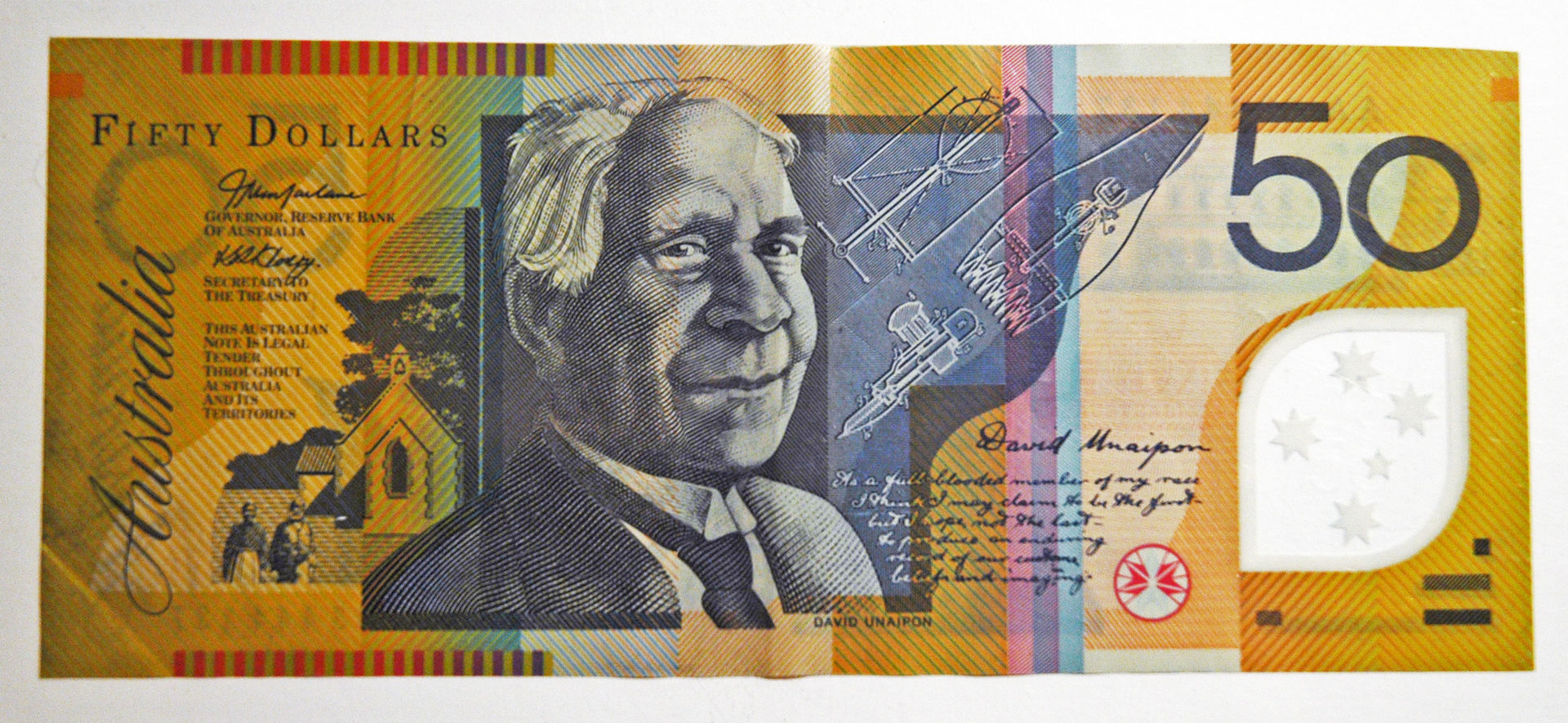
Proud Ngarrindjeri man David Unaipon, who is the face of the Australian \$50 note, is one of the most widely recognised Aboriginal inventors. In 1909, he patented a mechanism that transforms circular motion into linear motion – the principle underlying modern mechanical sheep shears. Technical drawings from this patent are shown beside his portrait on the \$50 note.
In 1914, he proposed that two boomerangs placed back-to-back could generate vertical lift, more than a decade before the first modern helicopter flew in 1936. More than 100 years later, researchers at UNSW Sydney, led by Dr Sonya A Brown, proved his theory correct: two 3D-printed miniature boomerangs placed back-to-back generated sufficient centripetal force directed upward to lift a small drone vertically.
Unaipon himself was clear that he was not an exception. 'I was always interested in inventing,' he remarked in 1914, 'as are most aboriginals.' He described himself as 'a fair sample' of Aboriginal peoples: not a singular genius, but a representative of a culture with a profound tradition of scientific inquiry.
Scholars argue that comparing him to da Vinci, however well-intentioned, repeats a colonial logic: it treats Aboriginal intellectual achievement as remarkable only because colonialism had worked so hard to deny it. To truly honour Unaipon's legacy is to recognise not one exceptional man, but the depth and breadth of Aboriginal knowledge systems that settler-colonialism sought to erase, and that endure.
We would like to acknowledge and thank Professor Barry Judd and the Indigenous Science Committee (School of Science, RMIT University) for their consultation, which has helped shape this example. For further information, please explore the following resources:
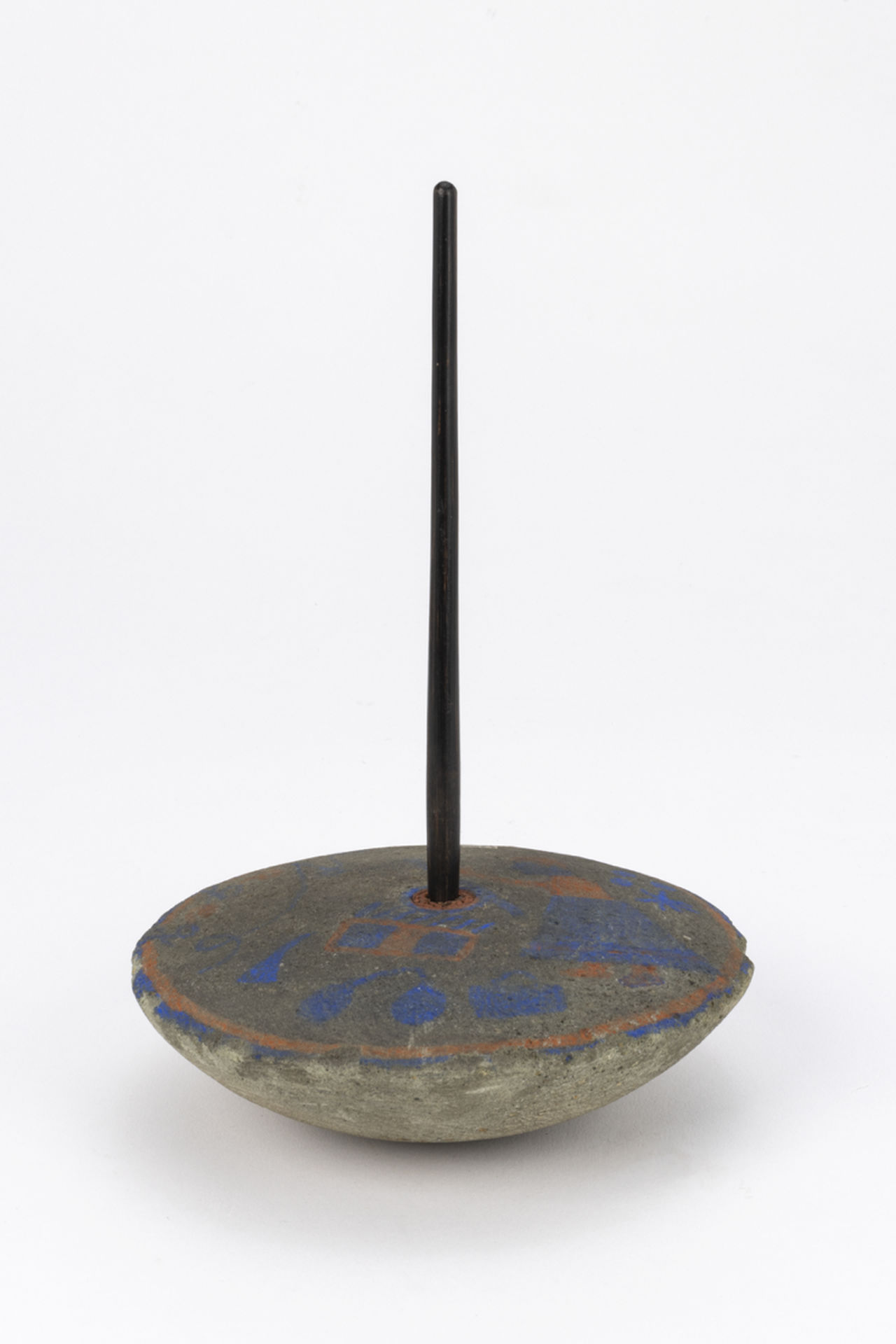
The Meriam peoples of Mer Island in the Eastern Torres Strait construct kolap (spinning tops carved from volcanic rock) for competitions to determine which top can spin for the longest time. Only men participate in the competitions, and special songs are sung while spinning.
To make kolap, the top is first chipped into a roughly circular shape, then ground smooth. The upper surface is made flat, the underside slightly convex, and a sharp central edge is achieved. Ochres are used to decorate the upper surface. A wooden spindle is held against a hole drilled into the centre of the top surface, and the spindle would be rotated to cause the kolap to spin.
As a kolap spins, every point on its outer edge travels in a circular path, with centripetal acceleration directed inwards toward the central spin axis at all times. If it has an uneven mass distribution, the centre of rotation shifts away from the geometric centre, causing wobble, exactly as an unbalanced object would leave a circular path and travel tangentially if the inward force were lost.
A well-crafted kolap spins for far longer; the time it takes to complete one revolution reflects its quality. One account even reports tops spinning for up to 27 minutes. Similar competitions were held across Australia. For example, the Yidinji language group from the Cairns region used gourds instead of volcanic rock to construct spinning tops.
We would like to acknowledge and thank the Indigenous Science Committee (School of Science, RMIT University) for their consultation, which has helped shape this example. For further information, please explore the following resources:
Example – calculating centripetal acceleration and force
A car of mass \(\mathbf{1200}\,\textbf{kg}\) travels around a roundabout at a constant speed of \(\mathbf{30}\,\textbf{km h}^{-1}\). The radius of the circular path is \(\mathbf{15}\,\textbf{m}\).
Determine the period of rotation.
First, we convert the speed to \(\text{m s}^{-1}\).
The period \(T\) is the time for one complete revolution – in other words, the circumference of the circle divided by the speed. We know the circumference is \(2\pi r\), so:
Calculate the centripetal acceleration of the car.
Even though the car moves at constant speed, it is continuously changing direction. We use the centripetal acceleration formula, where \(v\) is the linear speed and \(r\) is the radius of the roundabout.
\[\begin{align*} a & = \frac{v^{2}}{r} \\[6pt]
& = \frac{8.33^{2}}{15} \\[6pt]
& = 4.63\,\text{m s}^{-2}\,\text{towards the centre of the roundabout} \end{align*}\]
Determine the magnitude of the centripetal force acting on the car.
From Newton's second law, the net force equals mass times acceleration. Here, the net force is the centripetal force – the force needed to keep the car turning in a circle rather than travelling in a straight line.
Name the force that is responsible for the centripetal acceleration.
The road surface exerts a horizontal frictional force on the tyres, directed inward towards the centre of the roundabout.
Describe what would happen if the road was icy and friction was greatly reduced.
Without sufficient friction, there is no centripetal force to change the car's direction. According to Newton's first law, the car would continue in a straight line (the direction it was travelling at the moment friction was lost) rather than following the curve of the roundabout. In other words, the car would skid off the roundabout.
Exercise – calculating centripetal acceleration and force
An ice skater of mass \(50\,\text{kg}\) is skating in a horizontal circle of radius \(1.5\,\text{m}\) at a constant speed of \(2.0\,\text{m s}^{-1}\).
Calculate the skater's acceleration.
Find the horizontal component of the centripetal force acting on the skater.
Name the force that is providing the horizontal component of the net force that enables the skater to move in a circular path.
\(2.7\,\text{m s}^{-2}\) towards the centre of the circle
\(133\,\text{N}\) towards the centre of the circle
Horizontal frictional force exerted on the blades by the ice
A ball of mass \(0.3\,\text{kg}\) is attached to a string of length \(0.5\,\text{m}\) and swung in a horizontal circle at \(3.0\) revolutions per second.
Determine the period of rotation.
Calculate the speed of the ball.
Calculate the centripetal acceleration.
Find the tension in the string.
Name the type of force providing the centripetal force.
\(0.33\,\text{s}\)
\(9.42\,\text{m s}^{-1}\)
\(177.7\,\text{m s}^{-2}\) towards the centre
\(53.3\,\text{N}\)
Tensional force in the string
A cyclist of mass \(80\,\text{kg}\) (including bicycle) rides around a circular velodrome track of radius \(20\,\text{m}\) at \(8.0\,\text{m s}^{-1}\).
Calculate the centripetal acceleration.
Find the centripetal force.
Name the type of force providing the centripetal force.
\(3.2\,\text{m s}^{-2}\) towards the centre
\(256\,\text{N}\)
Frictional force between the tyres and track, directed inwards
The Moon orbits the Earth at a radius of \(3.84\times10^{8}\,\text{m}\) with a period of \(27.3\) days.
Calculate the orbital speed of the Moon.
Calculate the centripetal acceleration.
Name the type of force providing the centripetal force.
\(1023\,\text{m s}^{-1}\)
\(2.73\times10^{-3}\,\text{m s}^{-2}\) towards Earth
Gravitational force exerted by Earth on the Moon
A satellite of mass \(420\,\text{kg}\) orbits Earth at a radius of \(6.6\times10^{6}\,\text{m}\) with a period of \(92\,\text{min}\).
Calculate the orbital speed of the satellite.
Calculate the centripetal acceleration.
Calculate the centripetal force acting on the satellite.