Every time you charge your phone, flick a light switch or plug in a kettle, you are interacting with an electrical circuit. But what is actually happening inside it? Use this resource to learn about the key quantities used to describe and measure electricity, the calculations that connect them, and an example of how electrical phenomena are represented in Wandjina rock paintings.
Electric circuits
An electric circuit is a closed path that allows electric charge to flow. A simple circuit usually has a power source (such as a battery), conducting wires and one or more components (such as a light globe or motor). A circuit must be closed (with no breaks in the path) for current to flow.
Electricity also occurs naturally in the environment. Lightning is a large electrical discharge caused by the build-up of charge in clouds, while smaller static charges can build up on objects and discharge as a spark.
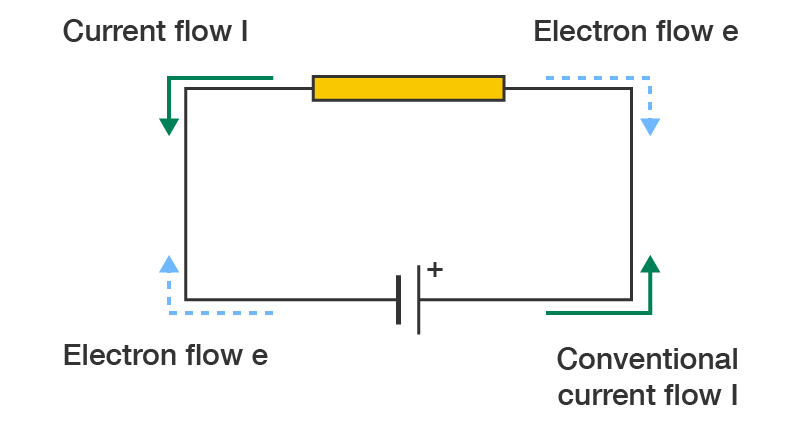
The direction of current we use in circuit diagrams is called conventional current flow. It flows from the positive terminal of the battery, around the circuit, to the negative terminal.
In reality, the moving charges in a metal wire are electrons (\(\text{e}^{–}\)). Electrons flow from the negative terminal to the positive terminal, in the opposite direction to conventional current. If you want to read more about electrons, check out this page.
Electrons all carry the same tiny amount of negative charge, so the total charge that flows in a circuit depends on how many electrons move past a point. Since the charge on a single electron is so small, electrical charge is usually measured in a large amount called a coulomb \(\text{C}\), rather than counting individual electrons.
\[1\,\text{coulomb of negative charge} = 1\,\text{C} = 6.25 \times 10^{18}\,\text{electrons}\]
Current \(I\) is the rate of flow of electric charge \(q\) past a point in the circuit.
\[\text{current} = \frac{\text{charge}}{\text{time}} \quad \text{or} \quad I = \frac{q}{t}\]
where \(I\) is measured in amperes (amps) \(\text{A}\), \(q\) is measured in coulombs \(\text{C}\) and \(t\) is measured in seconds \(\text{s}\).
Example – calculating charge
Consider a torch battery that produces a current of \(\mathbf{300}\,\textbf{mA}\). Determine the total amount of charge that has flowed through the circuit if the torch has been left on for \(\mathbf{20}\,\textbf{min}\).
The appropriate equation is \(q=I\times t\).
Remember, in this equation, \(I\) needs to be in \(\text{A}\) and \(t\) needs to be in \(\text{s}\). Let's complete the conversions separately, first.
If electric charges are moving in a circuit, they must be carrying energy. A battery or generator gives electrical potential energy to these charges so they can move around the circuit and do useful work (for example, lighting a globe or turning a motor). As the charges pass through components with resistance, they give up (transfer) some of this energy.
The voltage of a battery tells us how much energy is given to each coulomb of charge inside the battery. In other words, voltage is the energy per unit of charge (where the unit of charge is a coulomb \(\text{C}\)), measured in volts \(\text{V}\). One volt means that \(1\) joule (\(\text{J}\)) of energy is transferred to each coulomb of charge. For example, a \(6\,\text{V}\) battery transfers \(6\,\text{J}\) of energy to each coulomb of charge. Voltage is also called electromotive force (EMF).
When charges move through any component in a circuit and transfer energy to it, the energy transferred \(E\) per coulomb of charge \(q\) is called the potential difference (PD) across that component. Potential difference is also measured in volts, and is given by:
\[\text{voltage} = \frac{\text{energy}}{\text{charge}} \quad \text{or} \quad V = \frac{E}{q}\]
where \(V\) is in volts \(\text{V}\), \(E\) is in joules \(\text{J}\) and \(q\) is in coulombs \(\text{C}\).
In these introductory calculations, you may see all three terms used to refer to voltage – the distinctions between them matter more in advanced circuit analysis.
Since \(E = V \times q\) and \(q = I \times t\), we can combine them to obtain the equation:
\[E = V \times I \times t\]
Example – calculating energy
The potential difference across a torch globe is found to be \(\mathbf{2.7}\,\textbf{V}\). The current flowing through it is \(\mathbf{0.2}\,\textbf{A}\).
Determine how much charge flows through the torch globe in \(\mathbf{1}\) minute.
The relevant equation is \(q=I\times t\).
\[\begin{align*} q & = I \times t \\[6pt]
& = 0.2 \times 60\text{s}\\[6pt]
& = 12\text{C}\end{align*}\]
In \(1\) minute, \(12\,\text{C}\) of charge flows through the globe.
Calculate the amount of energy lost by this charge.
The potential difference of \(2.7\,\text{V}\) tells us that each coulomb of charge loses \(2.7\,\text{J}\) of electrical potential energy as it passes through the globe. This energy appears mainly as heat and light. We can calculate the energy loss using \(V=\dfrac{E}{q}\) by first rearranging it to make \(E\) the subject.
\[\begin{align*} E & = q\times V \\[6pt]
& = 12\times2.7\\[6pt]
& = 32.4\,\text{J}\end{align*}\]
When \(12\,\text{C}\) is flowing through the globe, \(32.4\,\text{J}\) of energy is lost.
Power \(P\)
Power \(P\) is the rate of energy transfer.
\[\text{power} = \frac{\text{energy}}{\text{time}} \quad \text{or} \quad P = \frac{E}{t} = \frac{V \times I \times t}{t} = V \times I\]
where \(P\) is measured in joules per second \(\text{J/s}\) or watts \(\text{W}\), where \(1\,\text{W}=1\,\text{J/s}\).
Indigenous knowledges in physics
The Wandjina, the natural world and the spritual world
Natural electrical phenomena, such as lightning, have long been observed and interpreted by Aboriginal and Torres Strait Islander peoples in ways that connect the environment, weather and culture.
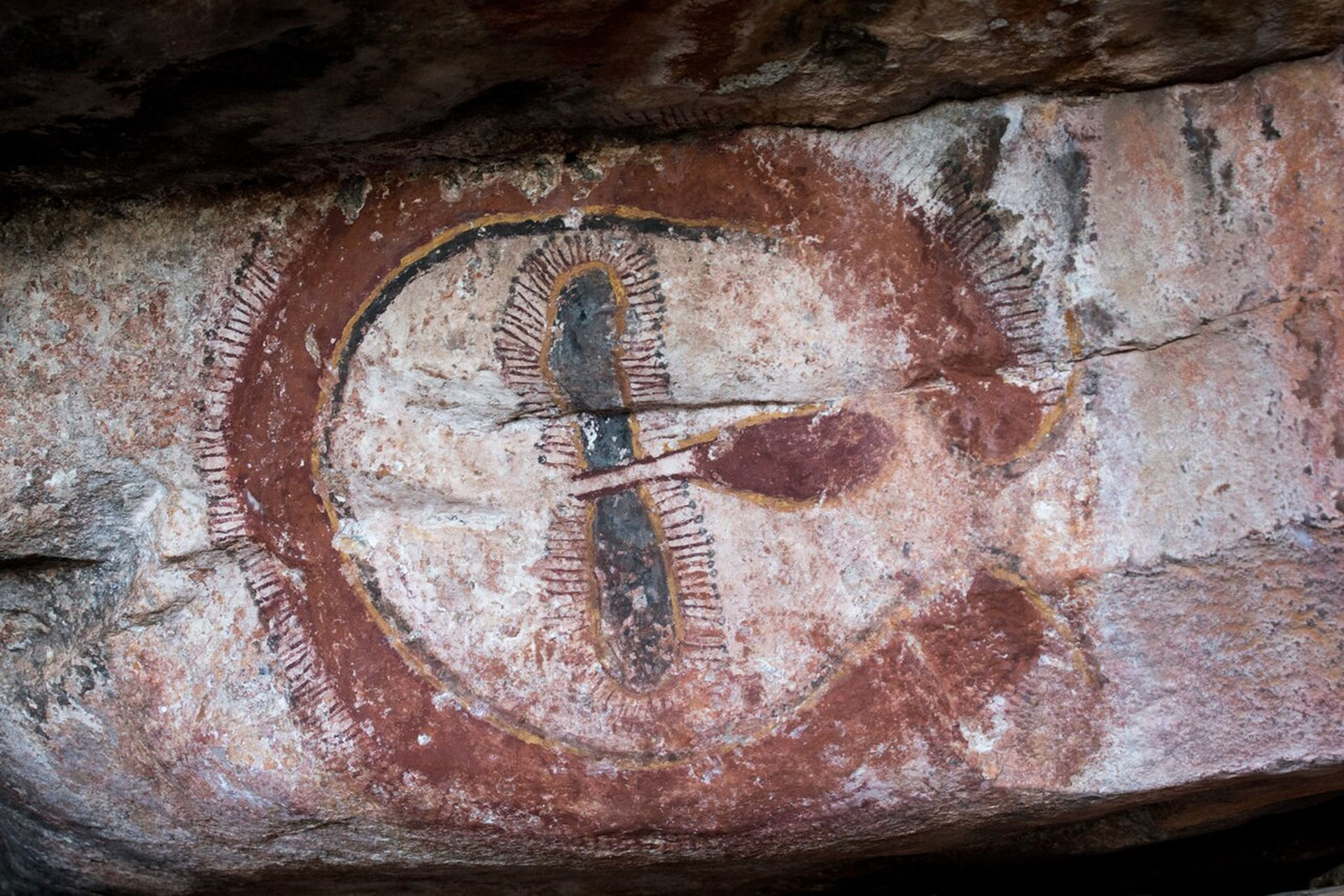
For the Worrorra, Ngarinyin and Wunambal peoples of the Kimberley region of Western Australia (the Wanjina Wunggurr cultural bloc), the Wandjina—or Gulingi, as referred to by the Wunambal people—symbolise land fertility and rain, and are considered the most important Creation Spirits. Sites home to Wandjina are treated as sacred. Each cave has a name and each Wandjina has a name and story. Paintings are occasionally repainted by the Mowanjum community to enable the continuous presence of the Wandjina and what they have created. They are not considered 'art', but rather, the Wandjina are believed to have turned into paintings – following their creative journey, the Wandjina lies down, another Wandjina paints an outline around them, and then the Wandjina returns to the spirit world. Because they are repainted, their representations have evolved over time.
All Wandjina figures are painted with lines around their eyes that are said to represent thunderstorms. The line between the eyes, often mistaken for a nose, is described as a power line used to transfer energy to the Earth. While this cultural understanding should not be treated as a direct equivalent of modern electrical theory, it provides an opportunity to reflect on how people observe, describe and make meaning from electrical phenomena in the environment.
Wandjina rock painting from Bachsten Camp in the Kimberley region, Western Australia, by Robyn Jay via Flickr, licensed under CC BY-SA 2.0
We would like to acknowledge and thank the Indigenous Science Committee (School of Science, RMIT University) for their consultation, which has helped shape this example. For further information, please explore the following resources:
Calculate the amount of charge that would flow through a:
\(5\,\text{mA}\) pocket calculator in \(10\,\text{min}\).
\(200\,\text{A}\) car starter motor in \(5\,\text{s}\).
\(400\,\text{mA}\) light bulb in \(1\,\text{h}\).
\(3\,\text{C}\)
\(1000\,\text{C}\)
\(1440\,\text{C}\)
\(1.7\times10^{26}\) electrons pass a point in a wire each second. Calculate the electric current that this represents.
\(2.7\times10^{7}\,\text{A}\)
A charge of \(5\,\text{C}\) flows from a battery through an electric water heater and delivers \(100\,\text{J}\) of heat to the water. Calculate the voltage of the battery.
\(20\,\text{V}\)
A portable speaker is powered by a \(9\,\text{V}\) battery. Calculate the amount of energy transferred from each coulomb of charge as it passes through the circuit that drives the speaker.
\(9\,\text{J}\)
A car motor is powered by a \(12\,\text{V}\) battery. Determine the amount of charge that must have flowed through the circuit for \(2\,\text{kJ}\) of energy to be delivered to the starter motor.