Why does a cheap phone charger cable get warm and charge your phone slowly, or a longer extension cord sometimes struggle to power a kettle or hairdryer? The answer lies in the relationship between voltage, current and resistance. This resource introduces Ohm's law—one of the most used relationships in electronics—and shows you how to apply it to real circuits.
Resistance \(R\)
When an electric current flows through a circuit, the components in the circuit can make it harder or easier for the charges to move. This opposition to the flow of current is called resistance.
Under constant physical conditions (such as temperature), the potential difference (voltage) across a component is proportional to the current through it (\(V \propto I\)).
This relationship is known as Ohm’s law and is written as:
\[V = I \times R\]
where \(V\) is the voltage across the component, \(I\) is the current through it, and \(R\) is the resistance.
This is exactly what happens with a cheap charger cable. A thinner wire has higher resistance, so for the same voltage, less current reaches your device and the energy lost to resistance is released as heat. A quality cable uses lower-resistance wire, so more current flows through with less wasted energy.
Ohmic conductors
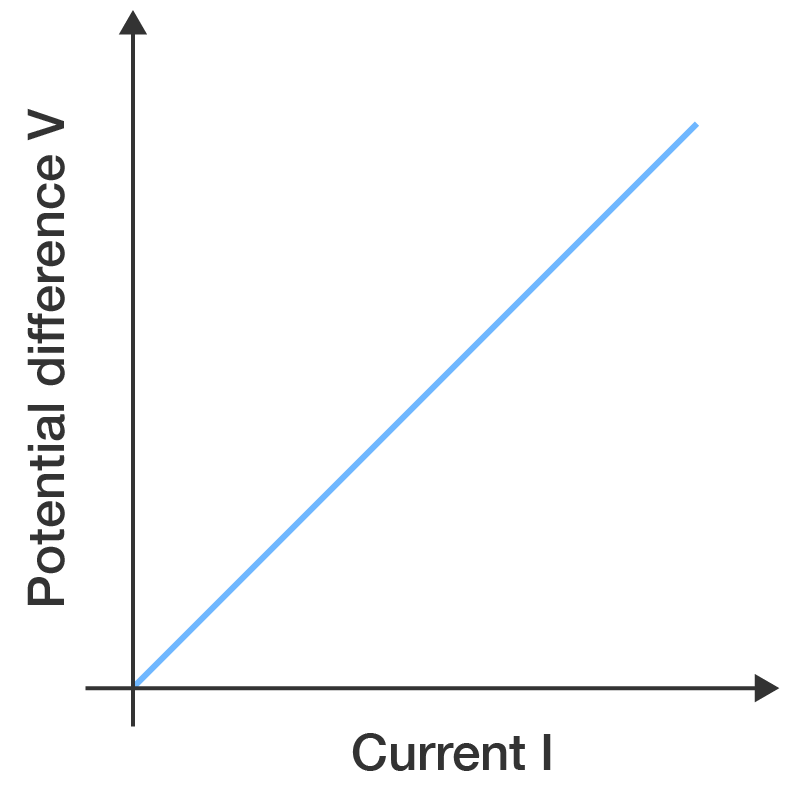
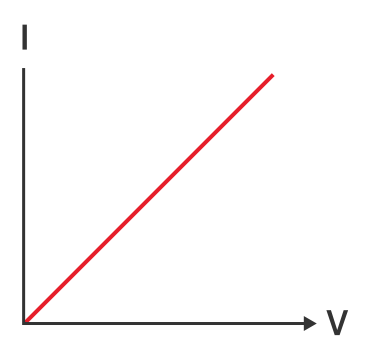
Some components obey Ohm’s law: when the voltage across them increases, the current through them increases in direct proportion. For these components, if you draw a graph of voltage \(V\) against current \(I\), you get a straight line through the origin.
If the circuit component obeys Ohm's law, it is said to be an ohmic conductor. The slope of its voltage–current graph is a constant and equal to its resistance \(R\), measured in ohms \(\Omega\). This resistance is therefore constant.
From the definition of power (\(P = VI\)) and Ohm’s law (\(V = IR\)), we can write:
\[P = VI = I^{2}R = \frac{V^{2}}{R}\]
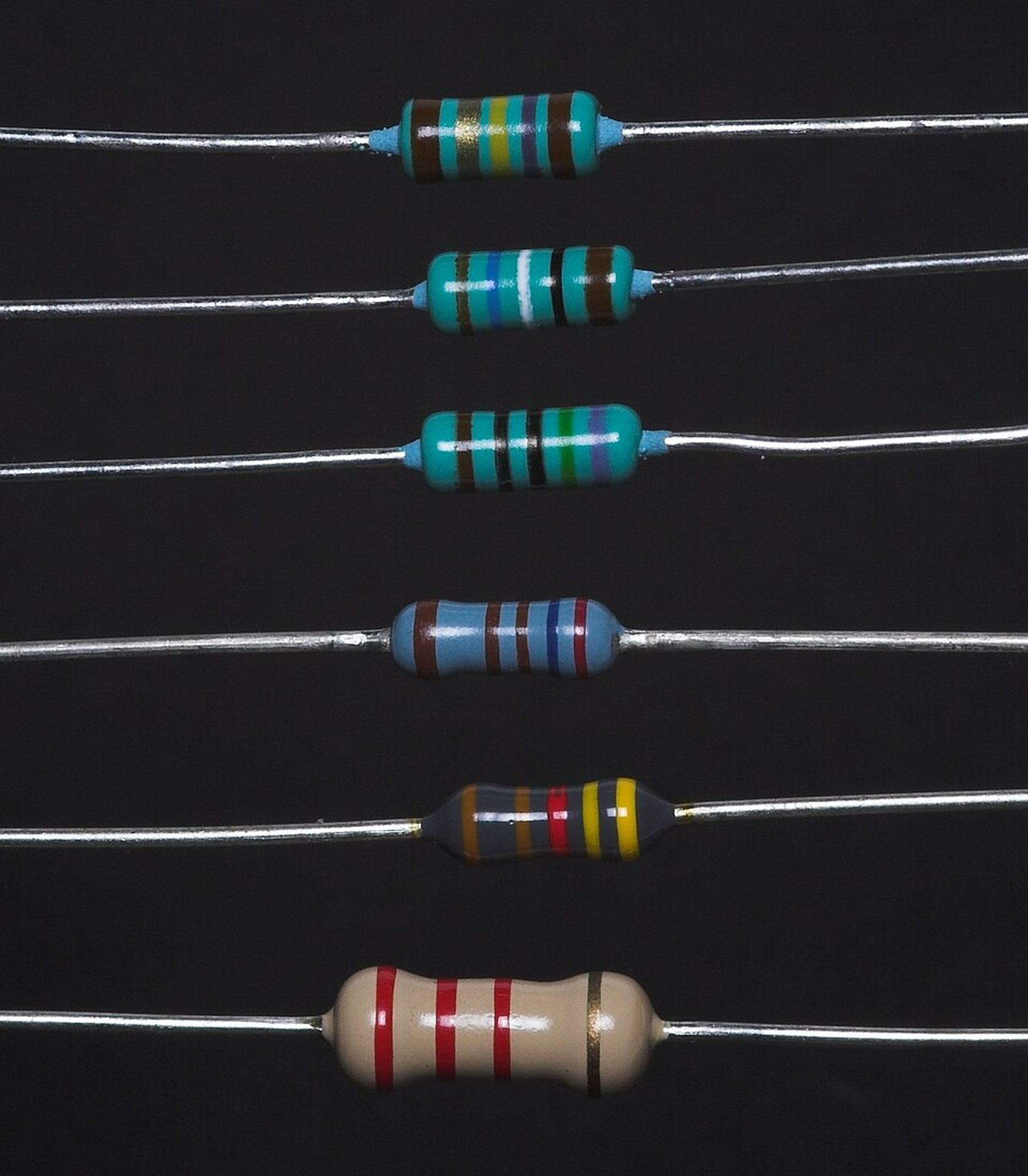
A component designed specifically to provide a fixed resistance is called a resistor. Resistors are ohmic conductors—their resistance stays constant regardless of the voltage applied—and are one of the most common components in electronic circuits.
An ohmic conductor of \(\mathbf{5\Omega}\) is supplied with a voltage which can vary from \(\mathbf{1}\,\textbf{V}\) to \(\mathbf{100}\,\textbf{V}\).
Determine the range of current that flows through the conductor.
The range of current will depend on the range of voltage and the resistance. We can calculate the current for each voltage level.
For \(1\,\text{V}\):
\[\begin{align*} V & = I\times R \\[6pt]
I & = \frac{V}{R}\\[6pt]
& = \frac{1}{5}\\[6pt]
& = 0.2\,\text{A}\end{align*}\]
For \(100\,\text{V}\):
\[\begin{align*} V & = I\times R \\[6pt]
I & = \frac{V}{R}\\[6pt]
& = \frac{100}{5}\\[6pt]
& = 20\,\text{A}\end{align*}\]
Therefore, the range of current flowing through the conductor will be \(0.2–20\,\text{A}\).
Calculate the amount of energy that will be dissipated (used up) in the resistor each second.
Energy dissipated per second is power \(P\), since power is the rate of energy transfer/use per unit of time. The question is asking for the range of power values correponding to the range from part a. We use the equation \(P=V\times I\).
For \(V=1\,\text{V}\) and \(I=0.2\,\text{A}\):
\[\begin{align*} P & = V\times I \\[6pt]
& = 1\times0.2\\[6pt]
& = 0.2\,\text{W}\end{align*}\]
For \(V=100\,\text{V}\) and \(I=20\,\text{A}\):
\[\begin{align*} P & = V\times I \\[6pt]
& = 100\times20\\[6pt]
& = 2000\,\text{W}\end{align*}\]
Therefore, the energy dissipated will vary from \(0.2–2000\,\text{W}\) per second or \(0.2–2000\,\text{J}\).
Non-ohmic conductors
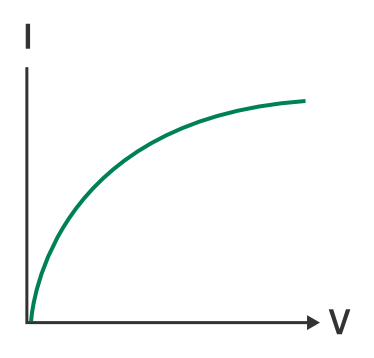
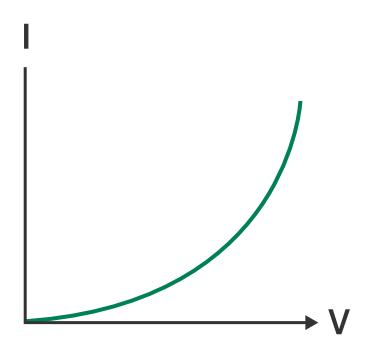
Many components do not behave like ohmic conductors. For these components, the current does not increase in direct proportion to the voltage, so the voltage–current graph is curved. These components are called non-ohmic conductors.
Light bulbs such as car headlamps are common examples of non-ohmic conductors. As the voltage increases, the current will not increase in proportion. Other non-ohmic conductors include devices with resistance that changes with light or temperature. These are particularly useful as detectors in sensors which need to respond to changes in light or temperature levels.
Ohmic conductor, e.g. resistorNon-ohmic conductor, e.g. diodeNon-ohmic conductor, e.g. car headlamp
Example – calculating resistance in non-ohmic devices
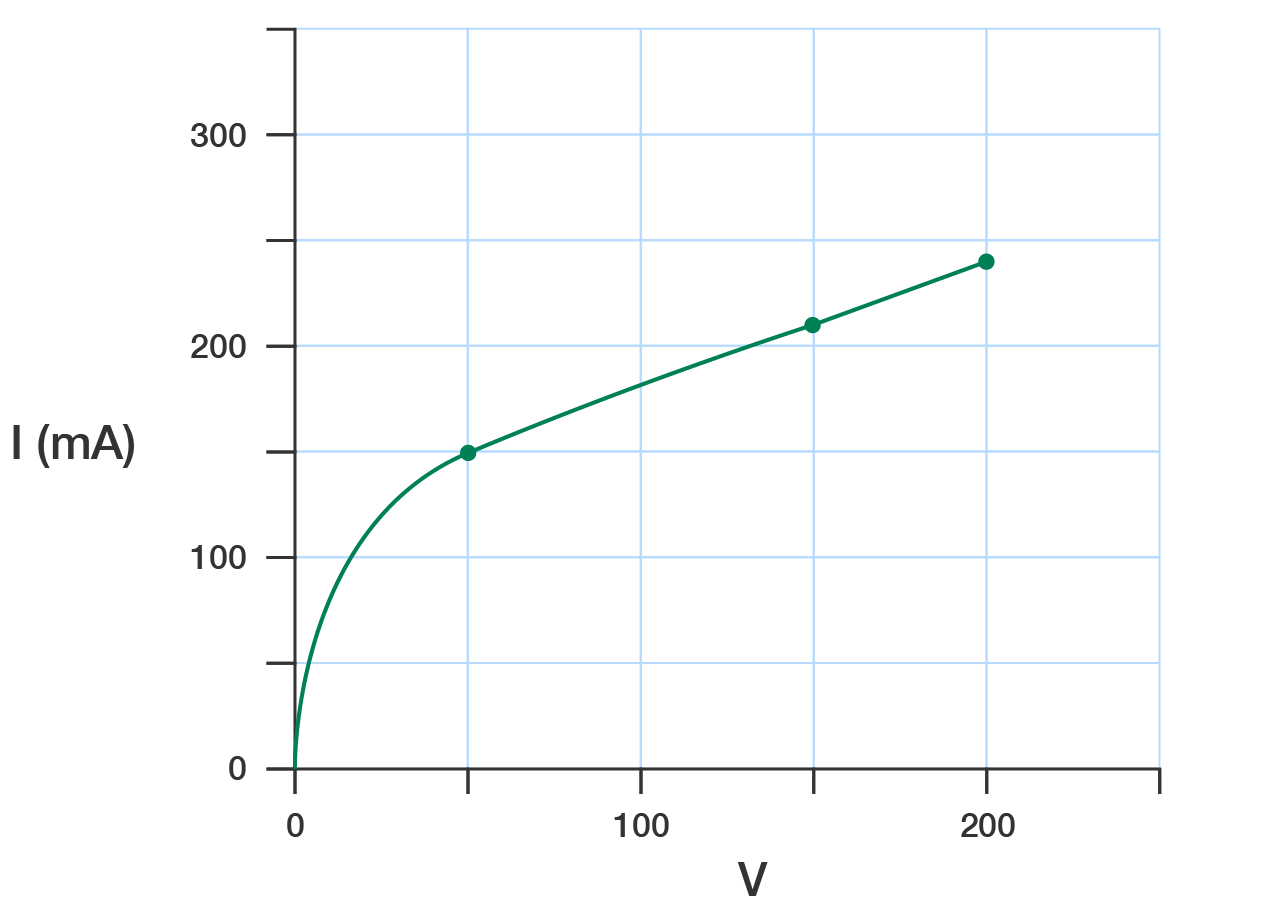
Consider the graph showing the current–voltage characteristics of a non-ohmic device.
Calculate the resistance at:
\(\mathbf{50}\,\textbf{V}\)
Unlike an ohmic device, the relationship between current and voltage is not linear; the curve shows that resistance changes at different voltages. We can still calculate the resistance at any specific point using \(\mathbf{F=\dfrac{V}{I}}\), where voltage and current are simply read off the graph at that point. This gives the resistance at that operating point.
In the graph, the current is given in \(\text{mA}\), so we must convert to \(\text{A}\).
At \(V=50\,\text{V}\), \(I=150\,\text{mA}\) or \(0.150\,\text{A}\). Therefore:
The resistance of a wire is a measure of how much the wire impedes the flow of electrons along its length. For a wire of a given material, the resistance depends on its length and cross-sectional area.
The resistance increases if the wire has a longer length (\(L\)): \(R\propto L\)
The resistance decreases if the wire is thicker or has a larger cross-sectional area (\(A\)): \(R\propto \dfrac{1}{A}\)
The resistance also depends on the material the wire is made from. This property of the material is called the resistivity \(\rho\) (pronounced rho).
These ideas can be summarised using the equation:
\[R = \frac{\rho L}{A}\]
where \(R\) is in \(\Omega\), \(\rho\) is in \(\Omega\text{m}\) and depends on the material used, \(L\) is in metres (\(\text{m}\)), and \(A\) is in square metres (\(\text{m}^{2}\)).
This explains the extension cord effect: a longer cord means a larger value of \(L\), which means a higher resistance. For a kettle or hairdryer drawing large currents, even a small increase in resistance produces a noticable voltage drop across the cord, leaving less voltage for the appliance itself.
Resistivity varies enormously between materials (e.g. copper vs rubber). It also depends on temperature, which—in the scope of this resources—we have not taken into consideration here.
Example – using resistivity
Normal household wiring uses \(\mathbf{1.8}\,\textbf{mm}\) diameter copper wire. The resistivity of copper is \(\mathbf{\rho=1.7\times10^{-8}\Omega}\textbf{m}\).
Determine the resistance of a \(\mathbf{10}\,\textbf{m}\) long piece of this copper wire.
The cross-sectional area of the wire, a circle, is given by \(A=\pi\times r^{2}\), so:
Note that \(0.9\times10^{-3}\) converts the \(\text{mm}\) units to \(\text{m}\). We are now ready to substitute these values into the equation \(R=\dfrac{\rho L}{A}\).
Calculate the drop in voltage drop along the wire if a current of \(\mathbf{10}\,\textbf{A}\) is flowing through it.
We use \(V=I\times R\) to find the voltage drop.
\[\begin{align*} V & = I\times R \\[6pt]
& = 10\times0.068\\[6pt]
& = 0.68\,\text{V}\end{align*}\]
Therefore, if the wire is carrying a \(10\,\text{A}\) current, there will be a voltage drop of \(0.68\,\text{V}\) along the length of the wire.
Exercise – applying Ohm's law
A student finds that the current through a resistor is \(3.5\,\text{A}\) while a voltage of \(2.5\,\text{V}\) is applied to it.
Calculate the resistance.
The voltage is then doubled and the current is found to increase to \(7.0\,\text{A}\). Determine whether the resistor is ohmic across the tested range.
\(0.71\,\Omega\)
Yes, it is ohmic across the tested range.
Nahia and Rachel are trying to find the resistance of an electrical device. They find that at \(5\,\text{V}\), it draws a current of \(200\,\text{mA}\) and at \(10\,\text{V}\), it draws a current of \(500\,\text{mA}\). Nahia says that the resistance is \(25\,\Omega\), but Rachel maintains that it is \(20\,\Omega\). Determine who is right and justify your decision.
Both are right at different voltages. Since the resistance is not constant, the device is non-ohmic.
Anil has an ohmic resistor to which he has applied \(5\,\text{V}\). He measures the current at \(45\,\text{mA}\). He then increases the voltage to \(8\,\text{V}\). Determine the current Anil will find now.
\(72\,\text{mA}\)
Sydney finds that when they increase the voltage across an ohmic resistor from \(6\,\text{V}\) to \(10\,\text{V}\), the current increases by \(2\,\text{A}\).
Calculate the resistance of the resistor.
Determine the current the resistor draws at \(10\,\text{V}\).
\(2\,\Omega\)
\(5\,\text{A}\)
The resistance of a certain piece of wire is found to be \(0.8\,\Omega\). Calculate the resistance of:
a piece of the same wire twice as long
a piece of the same wire double the diameter.
\(1.6\,\Omega\)
\(0.2\,\Omega\)
If the resistance of a copper wire \(20\,\text{m}\) long and \(1\,\text{mm}\) in diameter is \(0.44\,\Omega\), calculate the resistance of the same length of wire \(2\,\text{mm}\) in diameter.