When a bridge holds steady under traffic, or a bookshelf stays put under a heavy load, the structure is in static equilibrium. This means every force and every turning effect is perfectly balanced — nothing accelerates, nothing rotates. Use this resource to explore the two conditions for static equilibrium and learn how to apply them to real situations.
When objects are at rest, they are said to be in static equilibrium: the net force and moment on the object are both zero, meaning that:
the sum of the forces on the object in each direction is zero, i.e. there is translational equilibrium
the sum of the torques (or moments) in each direction is zero, i.e. there is rotational equilibrium.
Translational equilibrium
An object is in translational equilibrium when the net force acting on it is zero:
\[\sum F=0\]
This means the forces balance in every direction. For a two-dimensional problem, it is usually easiest to resolve the forces into horizontal and vertical components:
Forces to the left = Forces to the right
Forces upwards = Forces downwards
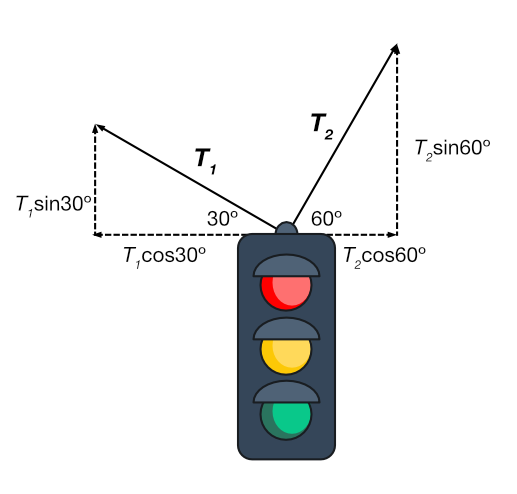
Consider a set of traffic lights of mass \(m\), suspended above an intersection by two wires of negligible mass.
Because the traffic lights are stationary, the upward and downward forces must balance. The upward components of the wire tensions are \(T_{1}\sin30^{\circ}\) and \(T_{2}\sin60^{\circ}\). The downward force is the weight, \(W=mg\).
The horizontal components must also balance. The left wire pulls to the left and the right wire pulls to the right:
\[\begin{align*} \text{Forces to the left} & = \text{Forces to the right} \\[6pt]
T_{1}\cos30^{\circ} & = T_{2}\cos60^{\circ} \end{align*}\]
Both conditions are needed for translational equilibrium. If either condition were not satisfied, the traffic lights would accelerate horizontally or vertically.
Example – applying translational equilibrium
Consider the traffic lights from the previous example. One wire is experiencing a tension force \(\mathbf{T_{1}}\) of \(\mathbf{1000}\,\textbf{N}\) at \(\mathbf{30^{\circ}}\) from the horizontal. The second wire is experiencing a tension force \(\mathbf{T_{2}}\) of \(\mathbf{2000}\,\textbf{N}\) at \(\mathbf{60^{\circ}}\) from the horizontal.
Using vertical forces only and \(\mathbf{g=9.8}\,\textbf{m s}^{-2}\), calculate:
the maximum weight of the traffic lights that can be supported by the cables.
To find the maximum weight, we use the vertical components of the two tensions.
The maximum mass of the traffic lights is approximately \(228\,\text{kg}\).
Rotational equilibrium
An object is in rotational equilibrium when the net moment about any chosen point is zero:
\[\sum M = 0\]
For problems with clockwise and anticlockwise moments, this can be written as:
Clockwise moments = Anticlockwise moments
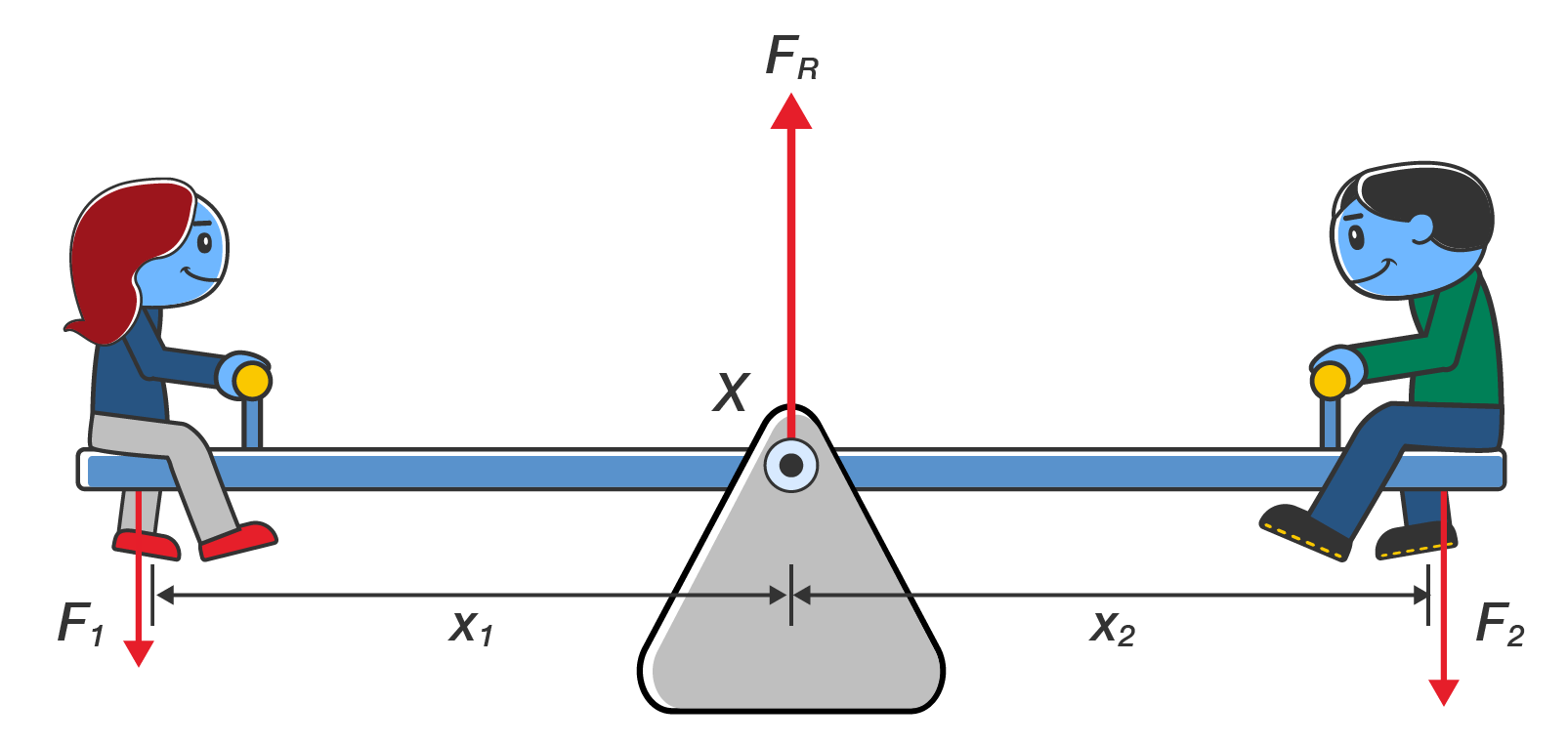
Consider a seesaw with two people sitting on opposite sides of its pivot (point X).
\(F_{1}\) and \(F_{2}\) are the downward forces exerted by the two people. These forces are usually their weights. The distances \(x_{1}\) and \(x_{2}\) are the perpendicular distances from the pivot to the lines of action of the forces.
In this example, the forces are vertical, so there are no horizontal force components to consider. Translational equilibrium is still required for the complete seesaw system, but the balancing condition for the turning effect is:
The support force \(F_{R}\) is the upward reaction force exerted by the pivot on the seesaw. For vertical translational equilibrium, it balances the total downward force:
\[F_{R}=F_{1}+F_{2}\]
Because \(F_{R}\) acts at the pivot, its moment about the pivot is zero. It therefore does not appear in the moment equation.
Example – applying rotational equilibrium
Two children are balanced on a seesaw supported in the middle. One child weighs \(\mathbf{200}\textbf{N}\) and is seated \(\mathbf{1.2}\,\textbf{m}\) from the axis. The other child is seated \(\mathbf{1.5}\,\textbf{m}\) from the axis. Calculate how much the second child weighs, ignoring the mass of the seesaw. Use \(\mathbf{g=9.8}\,\textbf{m s}\mathbf{^{-2}}\).
We will take moments about the pivot. This removes the support force from the calculation because its distance from the pivot is zero.
The clockwise and anticlockwise moments must be equal, so:
For the following questions, use \(g=9.8\,\text{m s}^{-2}\).
A uniform \(4.0\,\text{m}\) beam has a weight of \(200\,\text{N}\) acting at its centre. It is supported at both ends. Calculate the upward reaction force at each support.
\(100\,\text{N}\)
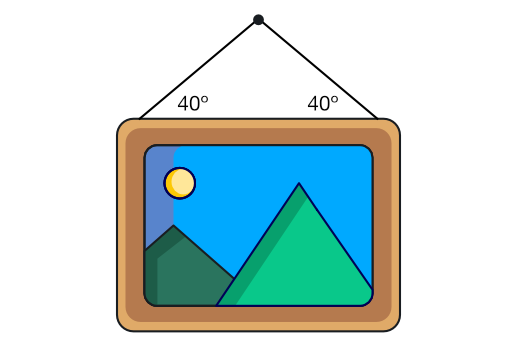
A picture is hung as shown in the following diagram.
If the hanging wire has a breaking strength of \(40\,\text{N}\), determine the maximum possible mass of the picture.
\(5.2\,\text{kg}\)
Two children want to make a seesaw from a \(5.0\,\text{m}\) plank of wood. The children weigh \(25\,\text{kg}\) and \(20\,\text{kg}\). They both want to sit right on the ends of the plank. Determine where the plank should be supported for it to balance.
\(2.22\,\text{m}\) from the heavier child
A sign of weight \(120\,\text{N}\) is held stationary by two cables. The cables make angles of \(30^{\circ}\) and \(45^{\circ}\) with the horizontal. Calculate the tension in each cable.
\(T_{1}=87.8\,\text{N}\) and \(T_{2}=107.6\,\text{N}\)
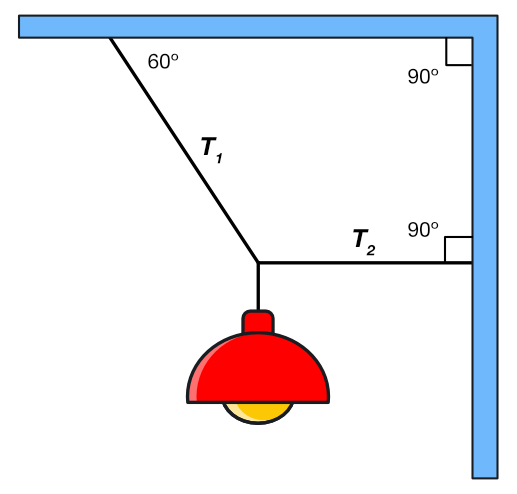
A \(100\,\text{g}\) pendant light is supported by two cables – one at an angle of \(60^{\circ}\) with the ceiling, and one perpendicular to the wall.
Assuming the mass of each cable is negligible, calculate the tension in each cable.
\(T_{1}=1.13\,\text{N}\) and \(T_{2}=0.57\,\text{N}\)
A \(300\,\text{N}\) load is placed \(0.8\,\text{m}\) from the pivot of a balanced beam. A second load is placed \(1.2\,\text{m}\) from the pivot on the opposite side. Calculate the size of the second load.