Blocks and pulleys are used throughout engineering: in cranes, elevators, cable-driven machines and stage rigging. Use this resource to learn about pulley systems and how to analyse two-pulley systems.
Pulley systems
A pulley system uses a rope that passes around one or more pulleys to lift or move a load. A single frame containing the wheels through which rope is threaded is called a block. Using several pulleys can change the direction of a force and reduce the force needed to move the load.
When multiple pulleys are connected by a single rope, the motion of one part directly constrains the motion of every other part: if one mass moves down, another must move up or sideways. Engineers often have to analyse how the motion of one part affects the motion of another.
In any pulley system, the rope itself doesn't stretch, so the total length of each rope stays the same throughout the motion:
\[L = \text{constant}\]
This is the starting point for every problem. Once you've written \(L\) in terms of the positions of the masses and pulleys, you know that its rate of change must be zero:
\[\dfrac{dL}{dt} = 0\]
This lets you relate the motion of one part of the system to another.
Velocity
If \(x\) is the position of a mass or pulley (measured from a fixed datum), then differentiating \(x\) with respect to time gives its velocity.
\[\dfrac{dx}{dt}=v\]
This lets us relate length to velocity.
Acceleration
Differentiating velocity with respect to time (or differentiating position twice) gives acceleration.
\[\dfrac{dv}{dt} = \dfrac{d^{2}x}{dt^{2}} = a\]
Movable pulley factor
When a pulley is fixed to a wall or the ceiling doesn't move, the pulley's position is a constant and drops out when you differentiate. A movable pulley, by contrast, 'hangs' in the rope and moves as the rope moves. If the rope wraps around a movable pulley twice (once on each side), that pulley's position is counted twice in the length equation, so it appears with a coefficient of \(2\). This factor of \(2\) is why the mass hanging from a movable pulley moves at half the speed of the rope pulling it.
Analysing pulley systems
The key principle that enables us to analyse the motion of pulley systems is that rope length is constant. By writing an equation for the total length of each rope in terms of the positions of the masses and pulleys, and then differentiating with respect to time, we can relate the velocities and accelerations of different parts of the system to one another, even when the geometry is complex.
Example – analysing a pulley system
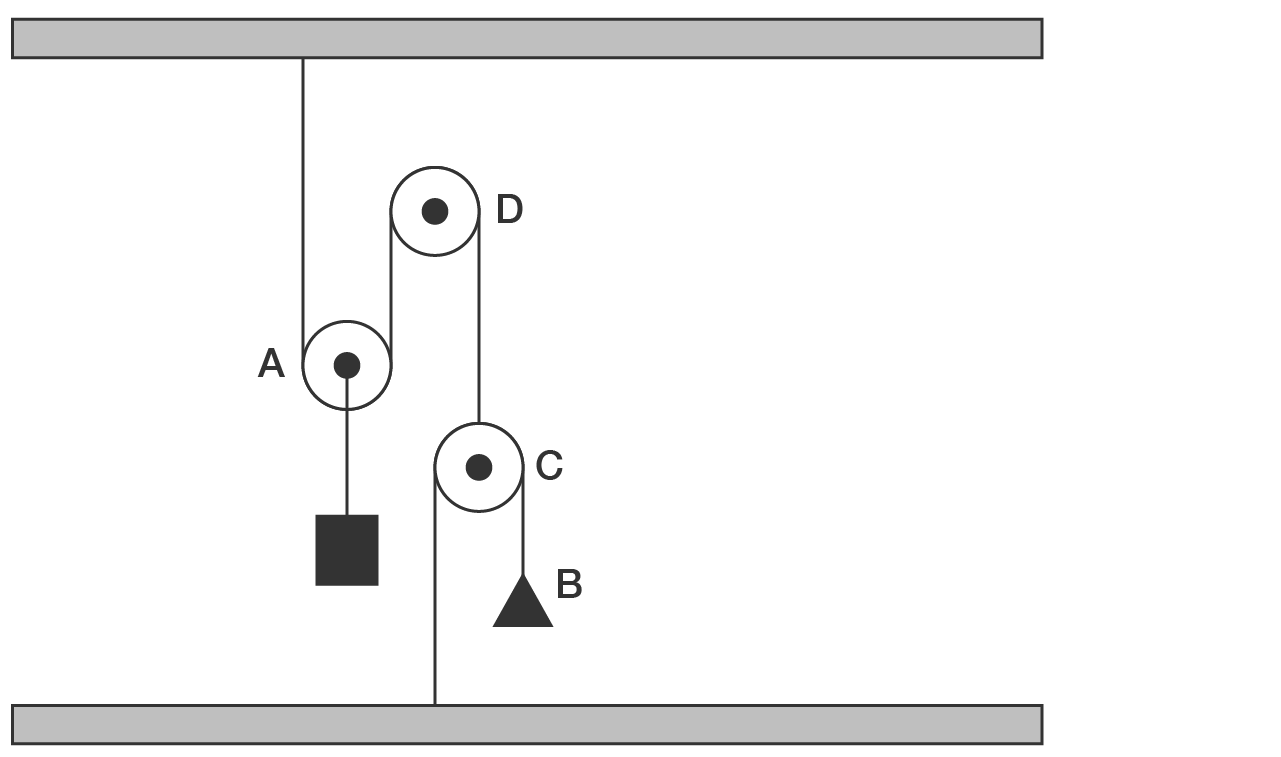
Consider the following two-mass pulley system. Mass B is pulled downwards with a velocity of \(\mathbf{1.2}\,\textbf{m s}\mathbf{^{-1}}\). This velocity is decreasing at a rate of \(\mathbf{0.6}\,\textbf{m s}\mathbf{^{-2}}\). Determine the velocity and acceleration of pulley A.
Blocks and pulleys problem image transcript
This image shows a two-mass pulley system with a rope threaded through pulleys A, D and C, with a rectangular mass hanging from pulley A and a triangular mass B hanging from pulley C.
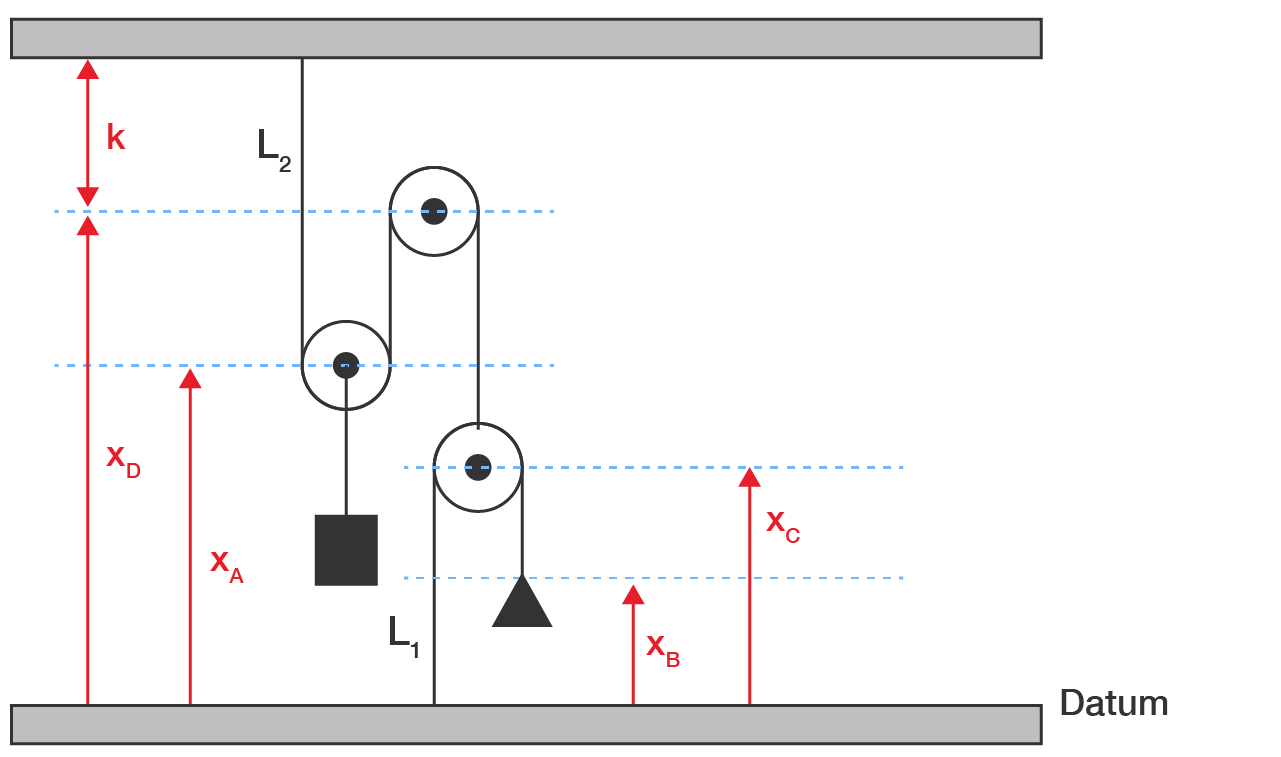
First, measure the position of all masses from a common datum, and add dimensions to the drawing. These dimensions are position vectors and direction is important. Let the upwards direction (\(\uparrow\)) be positive (\(+\text{ve}\)).
Labelled blocks and pulleys problem image transcript
This image presents the same drawing labelled with dimensions.
The ground is labelled as the datum. The rope coming from the ceiling is \(L_{2}\) and the rope coming from the ground is \(L_{1}\).
Arrows are shown extending upwards from the datum to:
the centre of pulley A, labelled \(x_{A}\)
the top of mass B, labelled \(x_{B}\)
the centre of pulley C, labelled \(x_{C}\)
the centre of pulley D, labelled \(x_{D}\).
The distance between the ceiling and pulley D is \(k\).
From the problem, we know that mass B is moving downwards at \(1.2\,\text{m s}^{-1}\). Since we have defined upwards as positive, \(v_{B}\) is negative:
\[v_{B} = -1.2\,\text{m s}^{-1}\]
The velocity of B is decreasing – that is, B is slowing down. Since B moves downwards, slowing down means the acceleration acts in the opposite direction (upwards) which is positive.
\[a_{B} = 0.6\,\text{m s}^{-2}\]
The constants \(L_{1}\), \(L_{2}\), \(x_{D}\) and \(k\) do not change with time. Pulley D is fixed to the ceiling, so \(x_{D}\) is constant. The rope segment \(k\) (from the ceiling to pulley D) is also a fixed length. When we differentiate, both terms become zero.
We write the length of each rope by tracing its path. Rope \(L_{1}\) runs from the fixed base, up to the underside of pulley A, back down and under pulley A again (it loops around the pulley), then continues up to pulley C. Tracing this path, the total rope length is the sum of each vertical segment. Using the upward-positive convention with the datum at the floor:
The factor of \(2\) appears because the rope passes pulley C twice – once on each side.
Rope \(L_{2}\) is anchored at the ceiling and runs down to pulley D (a fixed distance), down again to pulley A (wrapping underneath), back up to pulley D, then down to pulley C. Tracing the variable segments:
Since \(x_{D}\) and \(k\) are constants, the \(x_{D}+k\) term disappears when we differentiate.
Since velocity is the rate of change of position, differentiating a position variable \(x\) with respect to time gives velocity \(v\). That is, \(\dfrac{d}{dt}x=v\). Differentiating again gives acceleration \(a\). Because the rope lengths \(L_{1}\) and \(L_{2}\) are constant, their derivatives are zero. This is what links the motions of the different parts of the system.
Therefore, pulley A has a velocity of \(v_{A}=0.3\,\text{m s}^{-1}\) (upwards, since the result is positive) and an acceleration of \(a_{A}=-0.15\,\text{m s}^{-2}\). The negative sign tells us that pulley A is accelerating downwards. That is, it is slowing down as it moves upwards, consistent with mass B slowing down as it moves downwards.
Once the velocities and accelerations are known, Newton's second law can be applied to find the tension forces in the ropes, which is typically the next step in a full dynamics analysis of this kind of system.
Exercise – analysing a pulley system
A single rope passes over one fixed pulley, connecting mass P on one side to mass Q on the other. Mass P is lowered at \(0.8\,\text{m s}^{-1}\). Find the velocity of mass Q.
\(0.8\,\text{m s}^{-1}\) upwards
Using the same pulley arrangement as the worked example (pulleys A, C and D), suppose pulley C now moves downwards at \(0.9\,\text{m s}^{-1}\) with an acceleration of \(0.4\,\text{m s}^{-2}\) upwards. Determine the velocity and acceleration of pulley A.
Velocity: \(0.45\,\text{m s}^{-1}\) upwards
Acceleration: \(0.2\,\text{m s}^{-2}\) downwards
Mass B moves upwards at \(2\,\text{m s}^{-1}\), decelerating at \(1\,\text{m s}^{-2}\). Using Equation 1 from the worked example, find the velocity and acceleration of pulley C.
Velocity: \(1\,\text{m s}^{-1}\) upwards
Acceleration: \(0.5\,\text{m s}^{-2}\) downwards
Explain why a factor of \(2\) appears in Equation 1 (\(L_{1} = 2x_{C} - x_{B}\)) but pulley D does not appear at all in that equation.
The factor of \(2\) appears because the rope wraps around pulley C twice. Pulley D doesn't appear because rope \(L_{1}\) never passes over it – D only belongs to rope \(L_{2}\)'s path.
If pulley A is raised at a constant velocity of \(0.5\,\text{m s}^{-1}\) (zero acceleration), what does this imply about the velocity and acceleration of mass B?
Mass B moves downwards at \(2\,\text{m s}^{-1}\), at constant velocity (zero acceleration).