The resistance of an object to rotation depends not just on how heavy it is, but on how its mass is distributed. This property is called moment of inertia. Use this resource to understand two forms of moment of inertia: mass moment of inertia (used in dynamics) and area moment of inertia (used in structural analysis). Learn how to calculate each one and how they are applied to real world tools, such as Aboriginal weapons, the kodj and leangle.
Moment of inertia is a measure of how much an object resists rotational motion when a torque is applied. There are three main types:
mass moment of inertia
area moment of inertia (also called second moment of area)
polar area moment of inertia.
Mass moment of inertia \(I\)
Mass moment of inertia measures how difficult it is to change an object's rotation. Just as mass resists change to linear motion (Newton's second law: \(F=ma\)), mass moment of inertia resists change in rotational motion. The rotational equivalent of Newton's second law is:
\[\sum\tau=I\times\alpha\]
where:
\(\sum \tau\) is the net torque in Newton metres \(\text{N m}\)
\(I\) is the mass moment of inertia in kilograms metres squared \(\text{kg m}^{2}\)
\(\alpha\) is the angular acceleration in radians per second squared \(\text{rad s}^{-2}\).
Notice how this parallels Newton's second law. Torque is in place of force, moment of inertia is in place of mass and angular acceleration is in place of linear acceleration.
Calculating mass moment of inertia
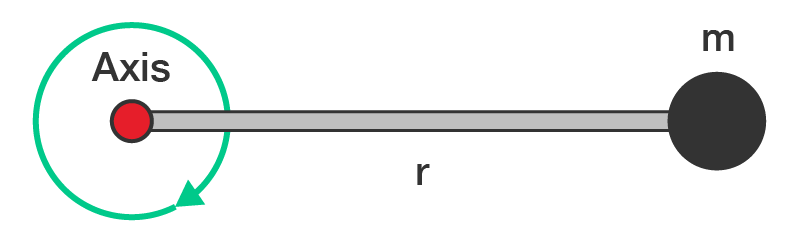
To calculate mass moment of inertia for a given object, we need to know how its mass is distributed. For a single point mass at a distance from the axis:
\[I = m r^{2}\]
where:
\(m\) is the mass of the body in kilograms \(\text{kg}\)
\(r\) is the distance from the mass to the axis of rotation in metres \(\text{m}\).
Different objects have different moments of inertia, assuming uniform composition.
For a disc: \(I=\dfrac{1}{2}mr^{2}\)
For a cylinder: \(I=\dfrac{1}{2}mr^{2}\)
For a thin hoop: \(I=mr^{2}\)
For a rod with its axis of rotation on one end: \(I=\dfrac{1}{3}mr^{2}\).
Calculate the mass moment of inertia of a wheel that has a net torque of \(\mathbf{15}\,\textbf{N m}\) and an angular acceleration of \(\mathbf{25}\,\textbf{rad s}^{-2}\).
\[\begin{align*} \sum\tau & = I\times\alpha \\[6pt]
I & = \frac{\sum\tau}{\alpha} \\[6pt]
& = \frac{15}{25} \\[6pt]
& = 0.6\,\text{kg m}^{2} \end{align*}\]
The mass moment of inertia is \(0.6\,\text{kg m}^{2}\).
Radius of gyration
The radius of gyration is a convenient way to express how far from the axis a body's mass would need to be concentrated (as a thin ring) to produce the same moment of inertia. It is defined by:
\[I = m k^{2}\]
where:
\(m\) is the mass in kilograms \(\text{kg}\)
\(k\) is the radius of gyration in metres \(\text{m}\).
For a solid disc, \(k=\tfrac{r}{\sqrt{2}}\). It is smaller than the disc's actual radius because most of the disc's mass lies closer to the centre than the rim.
A solid cylinder of mass \(\mathbf{5}\,\textbf{kg}\) and radius \(\mathbf{0.3}\,\textbf{m}\) rotates about its central axis. Calculate its:
The radius of gyration is \(0.212\,\text{m}\). This means the cylinder would have the same moment of inertia if all of its mass were concentrated in a thin ring \(0.212\,\text{m}\) from the axis.
This is consistent with \(k=\tfrac{r}{\sqrt{2}}=\tfrac{0.3}{\sqrt{2}}=0.212\,\text{m}\).
Indigenous knowledges in physics
Aboriginal weapons: the kodj and leangle
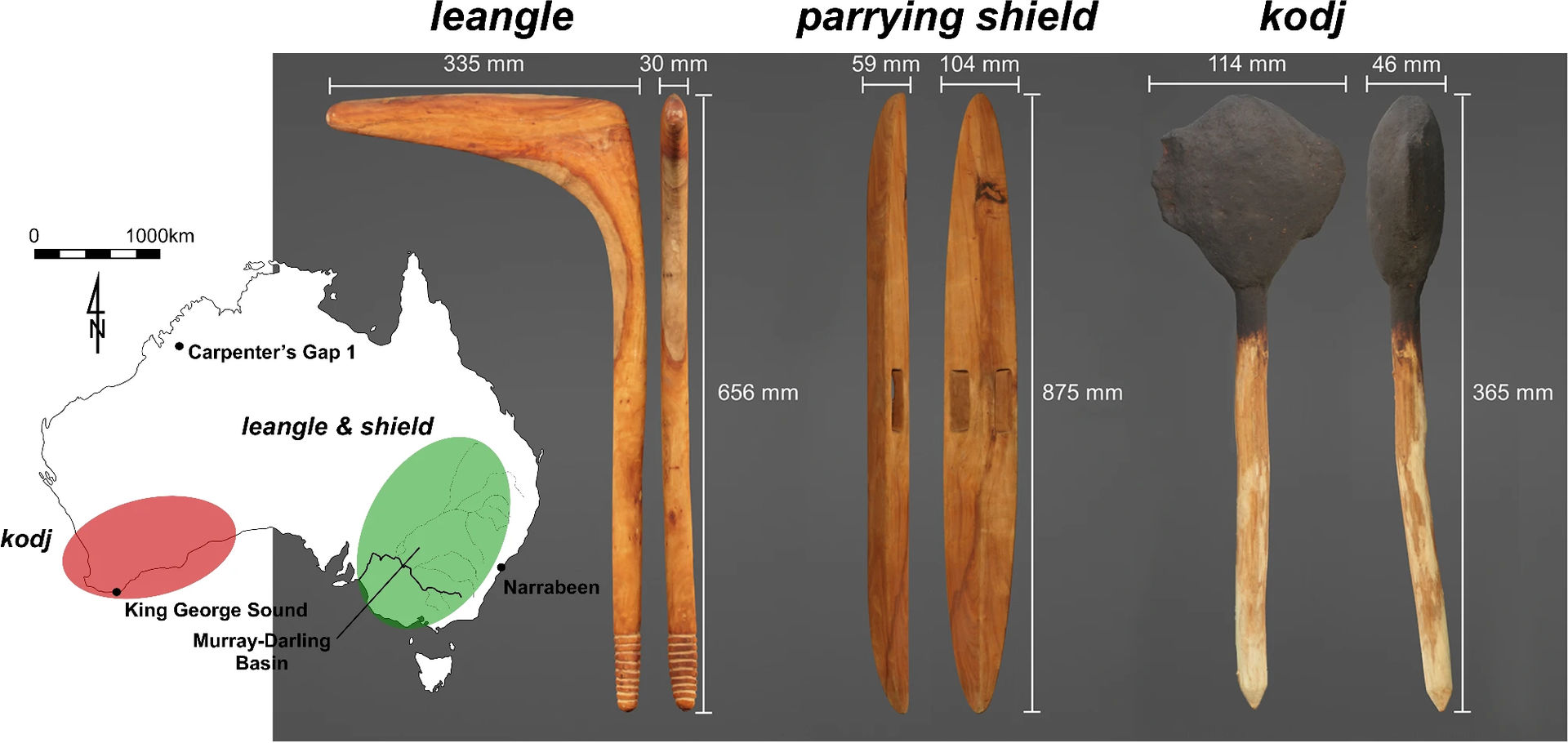
How much damage a weapon can deliver depends not just on how heavy it is, but on how its mass is distributed. That is exactly what moment of inertia describes. A 2024 study published in Scientific Reports by researchers at Griffith University applied this idea directly to two Aboriginal Australian weapons: the kodj, a multi-purpose stone hand axe from Noongar Country in the South West, and the leangle, a combat club used by the Dja Dja Wurrung peoples in Central Victoria.
The researchers created three-dimensional digital reconstructions of each weapon to calculate their centre of mass and mass moments of inertia. A swinging weapon rotates about the wielder's shoulder and wrist joints, so its mass moment of inertia—determined by both the mass of the weapon and how far that mass sits from the axis of rotation—directly influences how much torque is needed to set it in motion and how much kinetic energy it carries into a strike. This is the rotational equivalent of Newton's second law.
The leangle delivered peak kinetic energy more than three times greater than the kodj, driven primarily by its much larger mass rather than differences in peak velocity (which were comparable between the two weapons). In other words, more mass distributed further from the axis of rotation gave the leangle a greater moment of inertia and therefore, far greater striking power at the same angular velocity.
On the other hand, the kodj was more efficient for a human to manoeuvre. It required less energy to wield while still being capable of delivering severe blows. This reflects a design trade-off that Aboriginal peoples understood through practice: a tool built for everyday use needs a lower moment of inertia so it can be started, stopped and redirected with ease, even at the cost of raw striking power.
The leangle and kodj are used with a parrying shield. The kodj is generally found in the red area (around King George Sound), and the leangle is generally found in the green area (around the Murray-Darling Basin). Image by Diamond et al via Scientific Reports, licensed under CC BY 4.0
Aboriginal Australian weapons image transcript
Photograph of three Aboriginal Australian weapons—the leangle, parrying shield, and kodj—shown front and side, with annotated dimensions.
The leangle is a curved hardwood club, 656 mm long and 335 mm wide at its broadest point, with a handle 30 mm wide.
The parrying shield is a narrow, convex hardwood shield, 875 mm long, 104 mm at its widest and 59 mm at its narrowest visible point.
The kodj is a composite hand axe, 365 mm long, with a stone head 114 mm wide and 46 mm deep, hafted onto a wooden handle.
A map of Australia indicates the geographic origin of each weapon: the kodj (shown in red) originates from south-western Australia around King George Sound, and the leangle and parrying shield (shown in green) originate from south-eastern Australia in the Murray-Darling Basin region. Carpenter's Gap 1 in Western Australia and Narrabeen in New South Wales are also marked on the map.
We would like to acknowledge and thank Professor Laura Diamond, Associate Professor Michelle Langley and the Indigenous Science Committee (School of Science, RMIT University) for their consultation, which has helped shape this example. For further information, please explore the following resources:
Diamond, L. E., Langley, M. C., Cornish, B., Pizzolato, C., & Saxby, D. J. (2024). Aboriginal Australian weapons and human efficiency. Scientific Reports, 14, Article 25497. https://doi.org/10.1038/s41598-024-76317-w
Area moment of inertia
The area moment of inertia, also called the second moment of area, measures how a cross-section resists bending. It is used in beam and structural analysis. Unlike mass moment of inertia, it depends on the shape and size of a cross-section, not on its mass.
The reference axis may pass through the shape's centroid or may be offset from it – the centroidal and non-centroidal axes, respectively.
Centroidal area moment of inertia
When the reference axis passes through the centroid of a shape, the result is called the centroidal area moment of inertia, \(I_c\).
Standard formulas for common shapes are given in the following table.
Shape
Centroidal area moment of inertia \(I_{c}\)
Circle
\(\dfrac{\pi d^{4}}{64}\)
where \(d\) is the diameter of the circle
Square
\(\dfrac{l^{4}}{12}\)
where \(l\) is the length of one side
Rectangle
\(\dfrac{bh^{3}}{12}\)
where \(h\) is the length and \(b\) is the width
Triangle
\(\dfrac{b h^{3}}{36}\)
where \(b\) is the length of the base and \(h\) is the height
These formulas apply when the reference axis passes through the centroid.
During bending, the neutral axis is the line in a beam's cross-section where the bending stress and strain are zero. For a symmetrical cross-section under simple bending, the neutral axis usually passes through the centroid.
Calculating centroidal area moment of inertia
For simple shapes, we can use a standard formula. For an irregular shape, we can divide the area into many small elements and add their contributions. This process is called integration.
Each small element \(dA\) is multiplied by the square of its perpendicular distance from the reference axis. The contributions are then added across the whole area:
\(I_{x}\) and \(I_{y}\) are the area moment of inertia about the \(x\) and \(y\) axes, respectively, in \(\text{m}^{4}\) or \(\text{mm}^{4}\)
\(y\) is the perpendicular distance from the area element \(dA\) to the \(x\)-axis in metres \(\text{m}\) or millimetres \(\text{mm}\)
\(x\) is the perpendicular distance from the area element \(dA\) to the \(y\)-axis in metres \(\text{m}\) or millimetres \(\text{mm}\).
The \(y{^2}\) term means that area elements further from the axis contribute much more, which is why deep beams (with more material far from the neutral axis) are so much stiffer in bending than shallow ones.
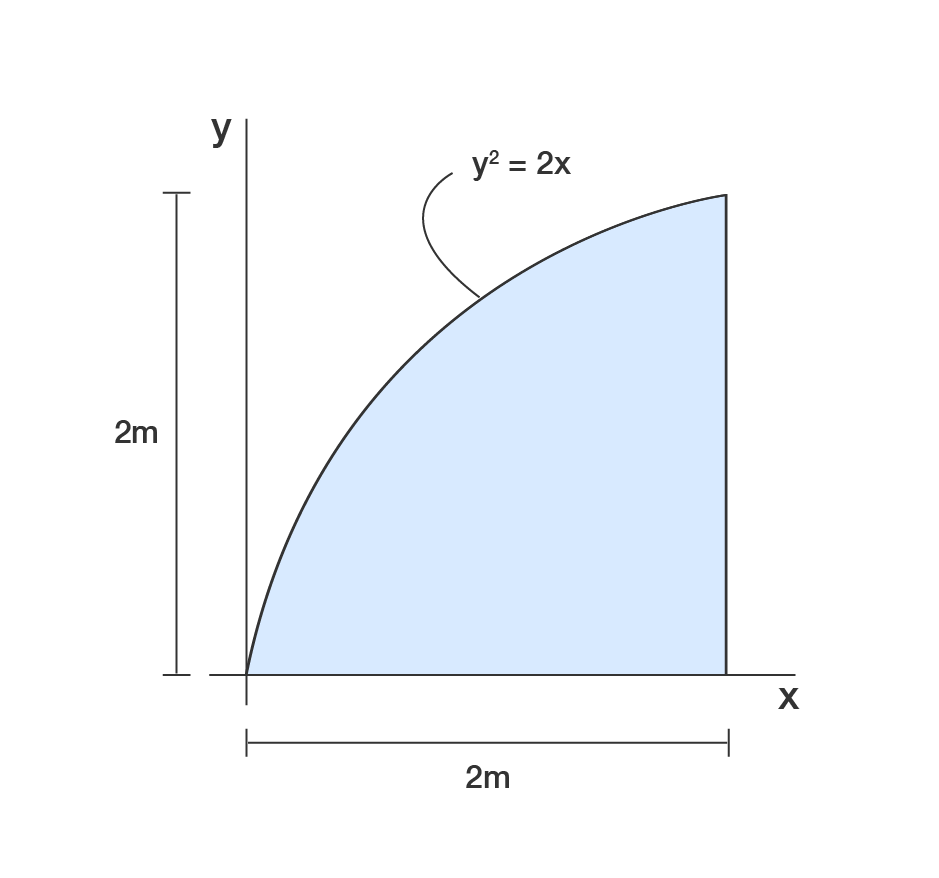
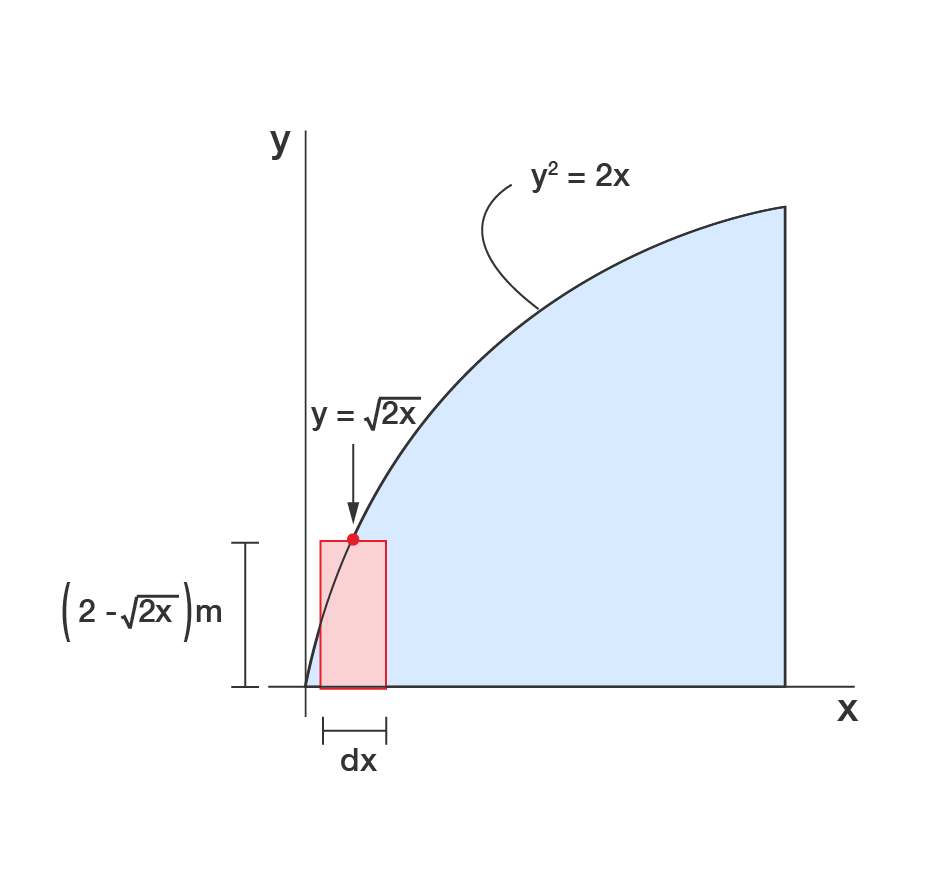
Consider the region bounded by the curve \(\mathbf{y^{2}=2x}\), the \(x\)-axis and the line \(\mathbf{x=2\,\textbf{m}}\).
Calculate the area moment of inertia:
about the \(\mathbf{x}\)-axis
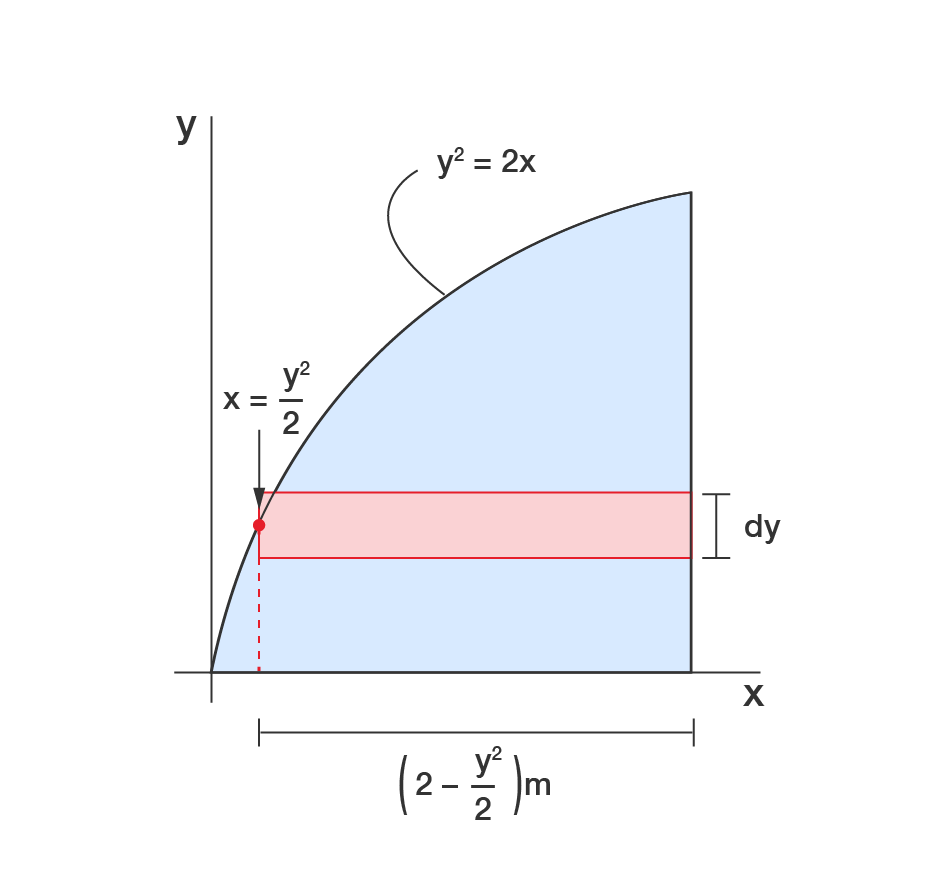
To find \(I_x\), we use a horizontal strip with thickness \(dy\). At height \(y\), the strip extends from the curve to \(x=2\). Its width is therefore \(2-x\). Rearranging the curve gives \(x=\dfrac{y^{2}}{2}\). The region extends from \(y=0\) to \(y=2\).
Therefore, the area of the horizontal strip is:
\[\begin{align*} dA & = \text{width}\times\text{thickness} \\[6pt]
& = \left(2-\frac{y^{2}}{2}\right)dy \end{align*}\]
For the moment about the \(x\)-axis, the distance of this strip from the axis is \(y\). Substituting \(dA\) into \(I_x=\int y^{2}\,dA\) gives:
In practice, we often need the moment of inertia about an axis that is not through the centroid – for example, the base of a beam rather than its neutral axis. The parallel axis theorem lets us calculate \(I\) about any axis parallel to the centroidal axis, using the centroidal value \(I_{c}\) from the previous table.
Calculating non-centroidal area moment of inertia
Many cross-sections are made from two or more simple shapes. These are called composite shapes. To find the moment of inertia of a composite shape, divide it into simple elements, such as rectangles.
For an element whose centroidal axis is a distance \(d\) from the required parallel axis, the parallel axis theorem is:
\[I = I_{c} + A d^{2}\]
where:
\(I\) is the moment of inertia about the new offset axis in \(\text{m}^{4}\) or \(\text{mm}^{4}\)
\(I_{c}\) is the moment of inertia about the centroidal axis in \(\text{m}^{4}\) or \(\text{mm}^{4}\)
\(A\) is the cross-sectional area in metres squared \(\text{m}^{2}\) or millimetres squared \(\text{mm}^{2}\)
\(d\) is the distance between the axes in metres \(\text{m}\) or millimetres \(\text{mm}\).
The term \(Ad^2\) is called the transfer term. It accounts for the distance between the element's centroidal axis and the required axis. For a composite shape, calculate \(I_{c}+Ad^{2}\) for each element and then add the results.
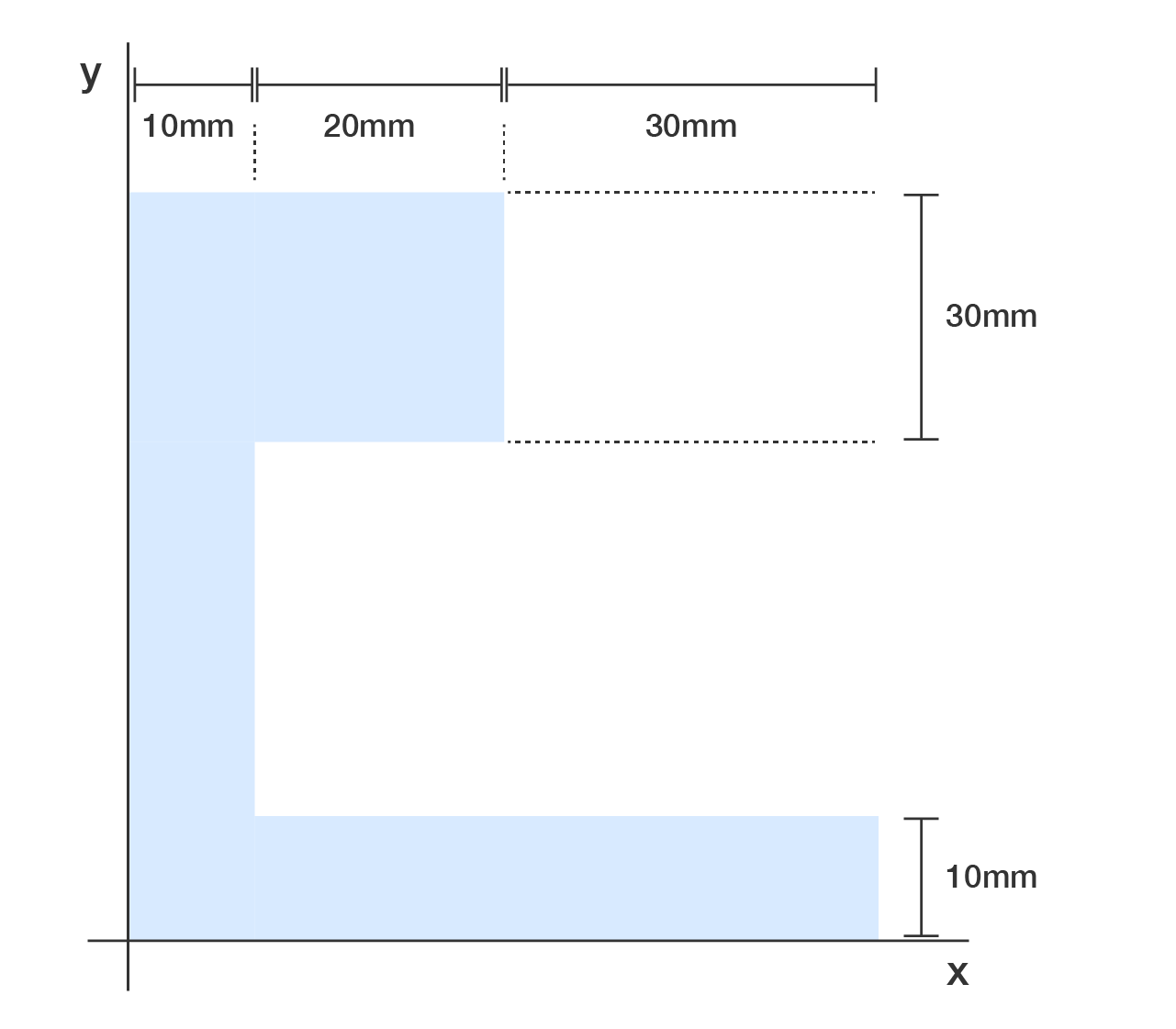
Calculate the area moment of inertia of the shaded area about the \(x\)-axis.
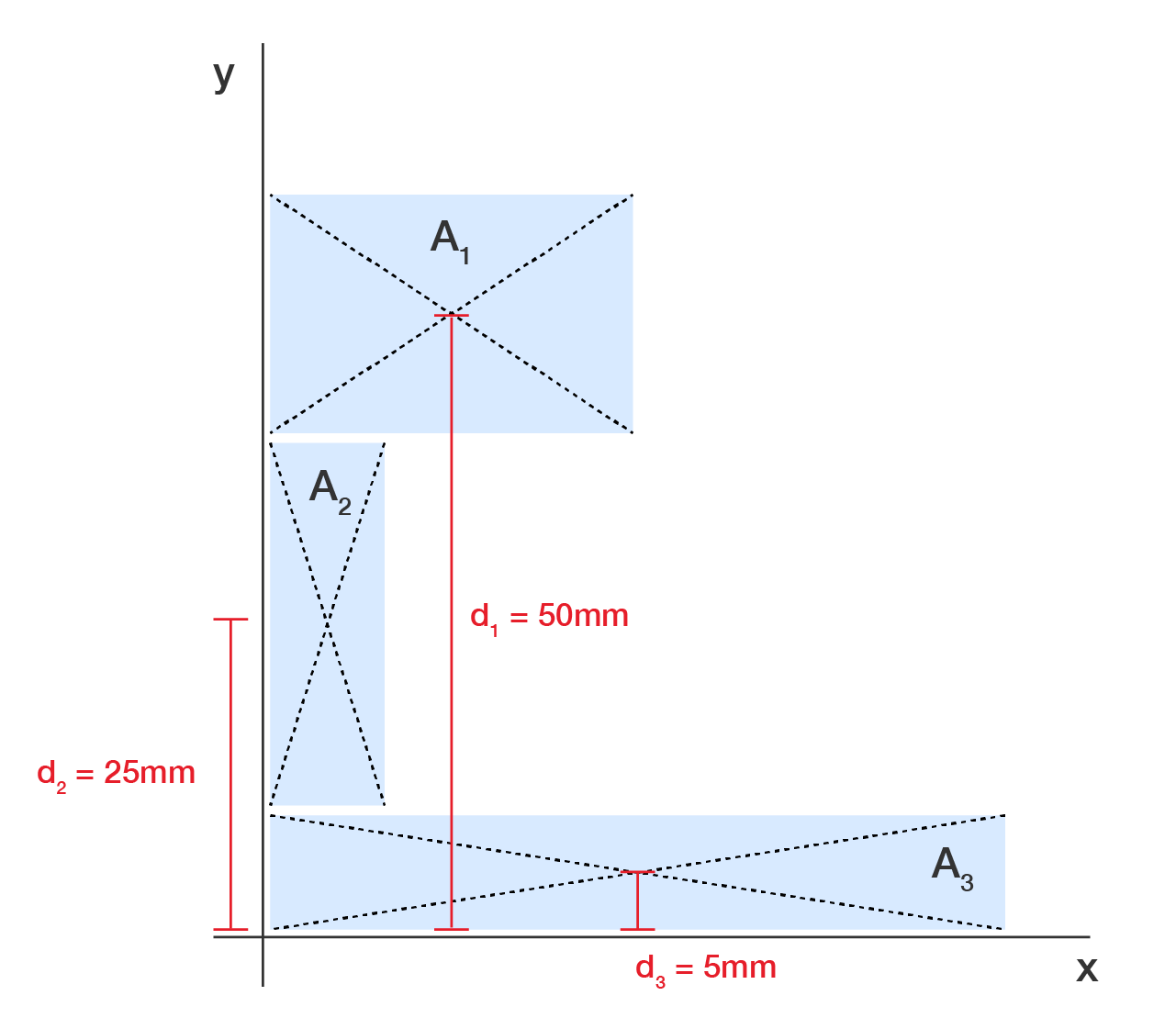
To make the calculation easier, let's divide the shaded area into three rectangular elements: \(A_1\), \(A_2\) and \(A_3\).
The centroid \(C\) of each rectangle is at the intersection of its diagonals. The distance from each centroid to the \(x\)-axis is labelled \(d_{1}\), \(d_{2}\) and \(d_{3}\).
For a rectangle, the centroidal area moment of inertia about a horizontal axis is given by \(I_{c}=\tfrac{b h^3}{12}\). Here, \(b\) is the dimension parallel to the \(x\)-axis and \(h\) is the dimension perpendicular to the \(x\)-axis. Let's find the area and centroidal moment of inertia of each rectangle.
Element
Area \(A\) \((\text{mm}^{2})\)
Distance \(d\) to the \(x\)-axis \((\text{mm})\)
Centroidal moment of inertia \(I_{c}\) \((\text{mm}^{4})\)
1
\(30 \times 20=600\)
\(50\)
\(\dfrac{30 \times 20^3}{12}=20\,000\)
2
\(30 \times 10=300\)
\(25\)
\(\dfrac{10 \times 30^3}{12}=22\,500\)
3
\(60 \times 10=600\)
\(5\)
\(\dfrac{60 \times 10^3}{12}=5\,000\)
Now, we can transfer each moment of inertia to the \(x\)-axis. For each rectangle, we use the parallel axis theorem \(
I=I_{c}+Ad^{2}\), with \(Ad^2\) accounting for the distance between the rectangle’s centroidal axis and the \(x\)-axis.
Element
Transfer term \(Ad^{2}\) \((\text{mm}^4)\)
Moment about the \(x\)-axis \(I=I_{c}+Ad^{2}\) \((\text{mm}^{4})\)
1
\(600 \times 50^2=1\,500\,000\)
\(20\,000+1\,500\,000=1\,520\,000\)
2
\(300 \times 25^2=187\,500\)
\(22\,500+187\,500=210\,000\)
3
\(600 \times 5^2=15\,000\)
\(5\,000+15\,000=20\,000\)
Finally, we sum the moments of inertia of the three rectangles.
Therefore, the area moment of inertia of the composite shape about the \(x\)-axis is \(1\,750\,000\,\text{mm}^{4}\).
Polar area moment of inertia
The polar area moment of inertia \(J\) measures how a cross-section resists twisting about an axis. It is used when analysing torsion in components such as shafts, axles and drive rods.
A cross-section with more area located far from the axis has a larger polar area moment of inertia. It will therefore resist twisting more strongly. The polar area moment of inertia is a property of the cross-section, not of the material.
Calculating polar area moment of inertia
For a circular cross-section, the polar area moment of inertia can be calculated using:
The polar area moment of inertia is approximately \(2.51\times10^{5}\,\text{mm}^{4}\).
Exercise – calculating moment of inertia
A flywheel is modelled as a solid disc with mass \(8\,\text{kg}\) and radius \(0.4\,\text{m}\). Calculate its mass moment of inertia.
\(0.64\,\text{kg m}^{2}\)
A motor applies a net torque of \(45\,\text{N m}\) to a shaft with mass moment of inertia \(3.6\,\text{kg m}^{2}\). Calculate the angular acceleration.
\(12.5\,\text{rad s}^{-2}\)
A uniform rod of mass \(2\,\text{kg}\) and length \(1.2\,\text{m}\) rotates about one end. Calculate its:
mass moment of inertia
radius of gyration.
\(0.96\,\text{kg m}^{2}\)
\(0.693\,\text{m}\)
Calculate the centroidal area moment of inertia of a rectangle with length \(h=120\,\text{mm}\) and width \(b=80\,\text{mm}\) about its centroidal axis, parallel to its length.
\(5\,120\,000\,\text{mm}^{4}\)
Using the parallel axis theorem, find the moment of inertia about the base of a rectangle with \(b=60\,\text{mm}\) and \(h=40\,\text{mm}\), whose centroid is \(d=20\,\text{mm}\) from the base.
\(1\,280\,000\,\text{mm}^{4}\)
A thin hoop has a mass of \(3\,\text{kg}\) and a radius of \(0.25\,\text{m}\). Calculate its mass moment of inertia about its central axis.
\(0.1875\,\text{kg m}^{2}\)
A solid disc has a mass of \(6\,\text{kg}\) and a radius of \(0.2\,\text{m}\). Calculate its radius of gyration about its central axis.
\(0.141\,\text{m}\)
Calculate the centroidal area moment of inertia of a circle with diameter \(d=100\,\text{mm}\).
\(4\,908\,739\,\text{mm}^{4}\)
A rectangle has a width of \(50\,\text{mm}\), a height of \(80\,\text{mm}\), and its centroid is \(40\,\text{mm}\) from the base. Calculate its area moment of inertia about the base.
\(8\,533\,333\,\text{mm}^{4}\)
A solid circular shaft has a diameter of \(60\,\text{mm}\). Calculate its polar area moment of inertia.
\(1\,272\,345\,\text{mm}^{4}\)
A solid circular shaft has a radius of \(25\,\text{mm}\). Calculate its polar area moment of inertia.