When a crane lifts a load, a broadcasting tower is guyed by cables, or a lighting rig is suspended above a stage, the support forces act in three dimensions – not just up, down, left or right. Analysing these forces requires vector methods, which let us resolve, combine and project forces in any direction. This resource introduces you to forces in 3D, and steps you through a worked example involving a 3D beam and cable system.
In two dimensions, a force can be resolved into horizontal and vertical components. In three dimensions, we resolve forces into three components along the \(x\), \(y\) and \(z\) axes, written as a vector:
where \(\hat{i}\), \(\hat{j}\) and \(\hat{k}\) are the unit vectors in the \(x\), \(y\) and \(z\) directions, respectively.
If you need a refresher on vectors and vector operations, visit this page.
Position vectors and cable vectors
A position vector describes the location of a point relative to the origin. If point A is at coordinates \((x_{A}, y_{A}, z_{A})\), then its position vector is \(\vec{r}_{A} = (x_{A}, y_{A}, z_{A})\).
To find the vector along a cable from point A to point B, we subtract the position vector of the start point from the end point:
\[\vec{AB} = \vec{r}_{B} - \vec{r}_{A}\]
Unit vectors and force vectors
A unit vector has magnitude \(1\) and points in the same direction as a given vector. It is found by dividing the vector by its magnitude:
The scalar projection of a force \(\vec{F}\) along a direction \(\hat{u}\) gives the component of the force in that direction. It is found using the dot product:
\[F_{u} = \vec{F}\cdot\hat{u}\]
A positive result means the force component acts in the same direction as \(\hat{u}\). A negative result means it acts in the opposite direction.
Perpendicular component
Once the parallel (scalar) projection is known, the perpendicular vector component of \(\vec{F}\) to a direction \(\hat{u}\) is:
\[\vec{F}_\perp = \vec{F} - F_{u}\,\hat{u}\]
Angle between two vectors
The angle \(\theta\) between two vectors \(\vec{a}\) and \(\vec{b}\) is found using the dot product:
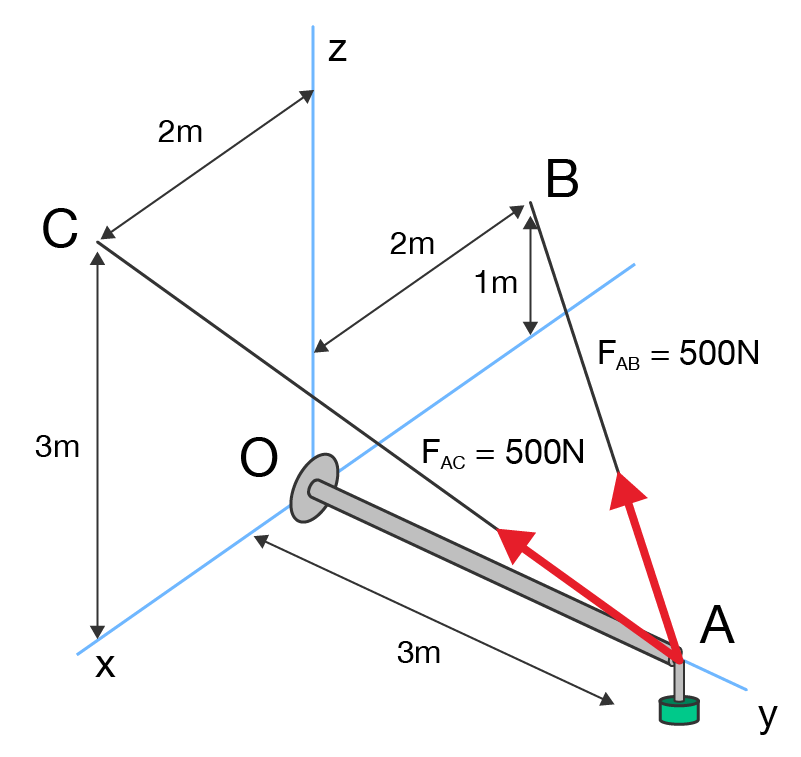
A beam is held in place by two cables attached at different points. Image by RMIT, licensed under CC BY-NC 4.0
Forces in three dimensions problem image transcript
A three-dimensional statics diagram showing a beam and two support cables. The coordinate axes are labelled \(x\) (pointing to the left), \(y\) (pointing to the right foreground) and \(z\) (pointing vertically upwards).
A beam extends diagonally from O (the origin) to point A, which is \(3\,\text{m}\) along the positive \(y\)-axis.
Two cables extend from point A:
Cable AB connects A to point B, which is located \(2\,\text{m}\) in the negative \(x\)-direction and \(1\,\text{m}\) in the positive \(z\)-direction from the origin.
Cable AC connects A to point C, which is located \(2\,\text{m}\) in the positive \(x\)-direction and \(3\,\text{m}\) in the positive \(z\)-direction from the origin.
Both cables carry a tension of \(500\,\text{N}\), shown as red arrows pointing from A toward B and from A toward C respectively, and labelled \(F_{AB}=500\,\text{N}\) and \(F_{AC}=500\,\text{N}\).
Determine:
the vector forces in the cables \(\mathbf{\vec{F}_{AB}}\) and \(\mathbf{\vec{F}_{AC}}\)
To find the forces in each cable, we must first find the position vectors. From the geometry and coordinates shown in the diagram, we can write them in component form:
Therefore, the scalar projection of \(\vec{F}\) along the beam AO is \(F_{AO}=721\,\text{N}\). Since the result is positive, the force component acts along AO in the direction of \(\hat{u}_{AO}\) (towards the origin).
the perpendicular vector component of \(\mathbf{\vec{F}}\) to the beam AO
To find the perpendicular vector component, we first express the parallel component in vector form:
Therefore, the angle between cables AB and AC is \(\theta=63^{\circ}\).
Exercise – analysing forces in three dimensions
A cable runs from point A at \((0,2,0)\,\text{m}\) to point B at \((-1,0,3)\,\text{m}\). Find the unit vector \(\hat{u}_{AB}\) along the cable.
\((-0.267,-0.535,0.802)\)
A cable runs from point A at \((0,4,0)\,\text{m}\) to point C at \((-2,0,2)\,\text{m}\) and carries a tension of \(400\,\text{N}\). Determine the vector force \(\vec{F}_{AC}\).
\((-163,-327,163)\,\text{N}\)
Two cables exert forces \(\vec{F}_1=(200,-300,150)\,\text{N}\) and \(\vec{F}_2=(-150,-200,100)\,\text{N}\) on the same point. Find the resultant force vector \(\vec{F}\).
\((50,-500,250)\,\text{N}\)
A resultant force \(\vec{F}=(-54,-721,454)\,\text{N}\) acts at point A, which is \(4\,\text{m}\) along the \(y\)-axis from the origin O. Find the scalar projection of \(\vec{F}\) along the beam AO.
\(721\,\text{N}\)
Two cables leave the same attachment point. Cable AB has direction vector \((-2,-3,1)\) and cable AD has direction vector \((1,-3,2)\). Find the angle between the cables.