Trigonometry
Delve into trigonometry to understand shapes, angles, and their relationships.
Every time you open a door, tighten a bolt with a spanner, or adjust a bike's handlebars, you're creating a turning effect. The further from the pivot you apply a force, and the more directly you push, the stronger that effect. This turning effect is called a moment or torque, and this resource shows you how to calculate and apply it. You will also explore how the physics of moments apples to Aboriginal digging sticks.
When a net force is applied through a point that is not the centre of mass, a moment (or torque) \(M\) is applied and rotation occurs. Just as a net force causes linear motion (an object moving in a straight line), a moment causes rotational motion – it is the rotational equivalent of a pushing or pulling force, also called the rotational analogue of force.
The size of a moment depends on:
The turning force is most effective when it is acting at right angles to the rotating object. For example, the turning force applied to the beam on the left (approximately \(45^{\circ}\) does not produce as great a moment compared to the beam on the right, where the force is at right angles to the beam.
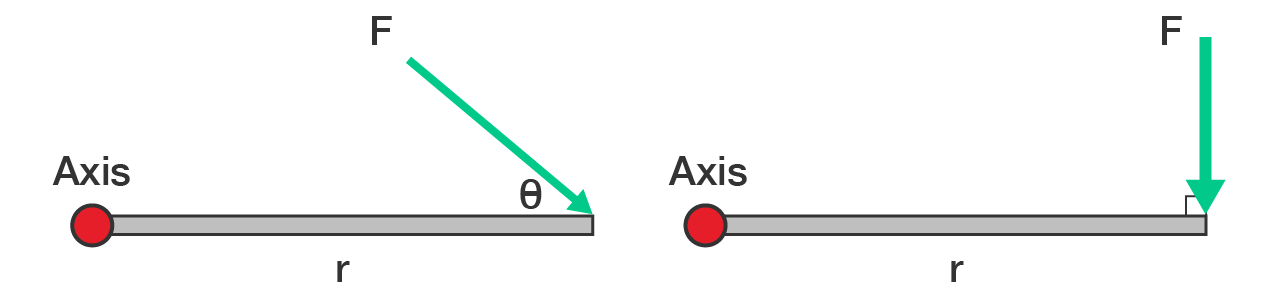
Moment is found using the equation:
\[M=F\sin\theta\times r\quad\text{or}\quad M=F_{\perp}\times r\]
where:
- \(M\) is the moment in Newton metres \(\text{N m}\)
- \(F\) is the force applied in Newtons \(\text{N}\)
- \(\theta\) is the angle between the force and object in degrees
- \(r\) is the distance from the axis of rotation (or moment arm) in metres \(\text{m}\).
Here, \(F\sin\theta\) is the component of \(F\) acting perpendicular to the moment arm – the part of the force that actually produces rotation.
Moment is a vector quantity. In 2D problems, we describe it as either clockwise or anticlockwise. In 3D problems, it has a direction in space.
Indigenous knowledges in physics
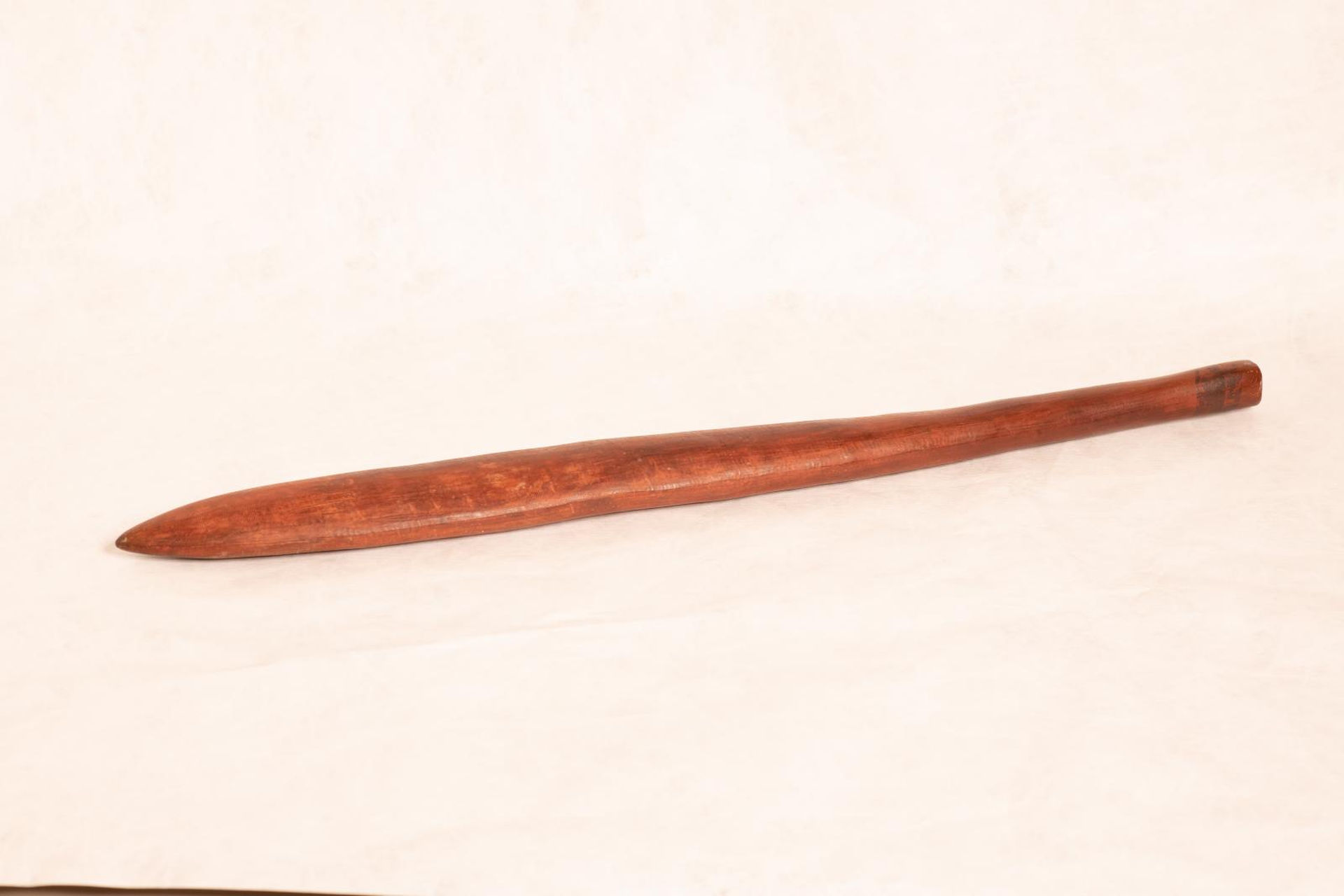
Used across the continent for thousands of years, the digging stick (sometimes called a yam stick) is a fire-hardened wooden tool. Typically around one metre in length, it is used by women to extract roots, tubers and burrowing animals from the ground. When pushed into the soil at an angle and then levered back, the point of ground contact acts as the pivot. The user's hands apply a force at a distance \(r\) from that pivot, producing a moment \(M\) that pries food free from the earth.
The angle of the stick relative to the ground directly affects the size of the moment: a stick held closer to perpendicular produces a greater perpendicular force component \(F\sin\theta\), and therefore a greater moment, for the same applied effort. The longer the stick, the greater the moment arm \(r\) and the less muscular effort required.
Length, hardness, design and material varies across different groups, reflecting careful adaptation to local soils and food sources. One variety of the digging stick is the wanna used by peoples of Whadjuk Noongar Country, North of Perth in Wanneroo. The suburb and local municipality of Wanneroo is named for the wanna digging stick. Diversity in digging stick design reflects sophisticated, accumulated knowledge of how moment arms and force angles work in practice, refined across thousands of years of use.
We would like to acknowledge and thank the Indigenous Science Committee (School of Science, RMIT University) for their consultation, which has helped shape this example. For further information, please explore the following resources:
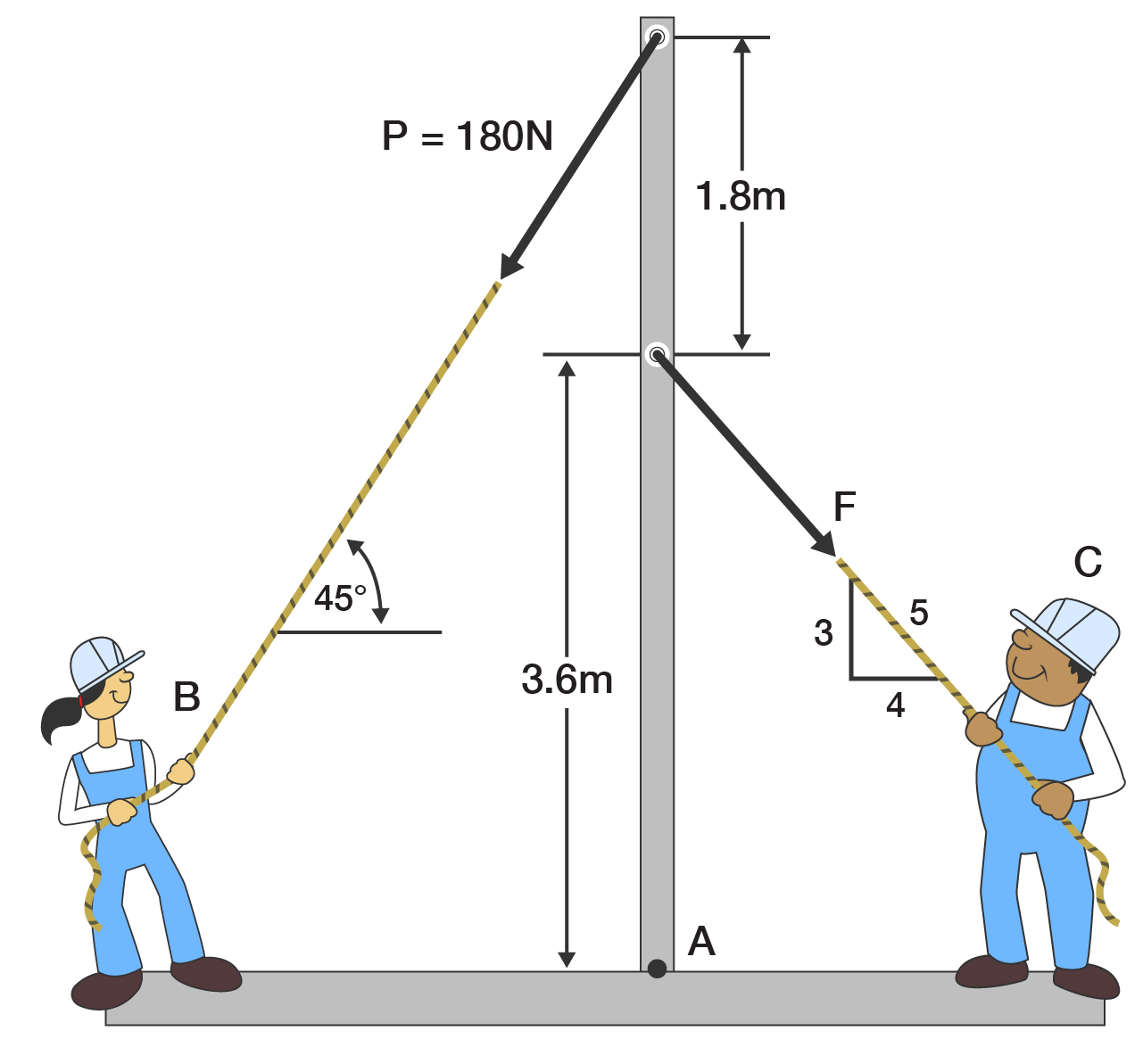
A force \(\mathbf{F}\) is applied to the handle of a hammer being used to extract a nail. The force must produce a clockwise moment of \(\mathbf{75}\,\textbf{N m}\) about point A (the nail head). Determine the magnitude of \(\mathbf{F}\).
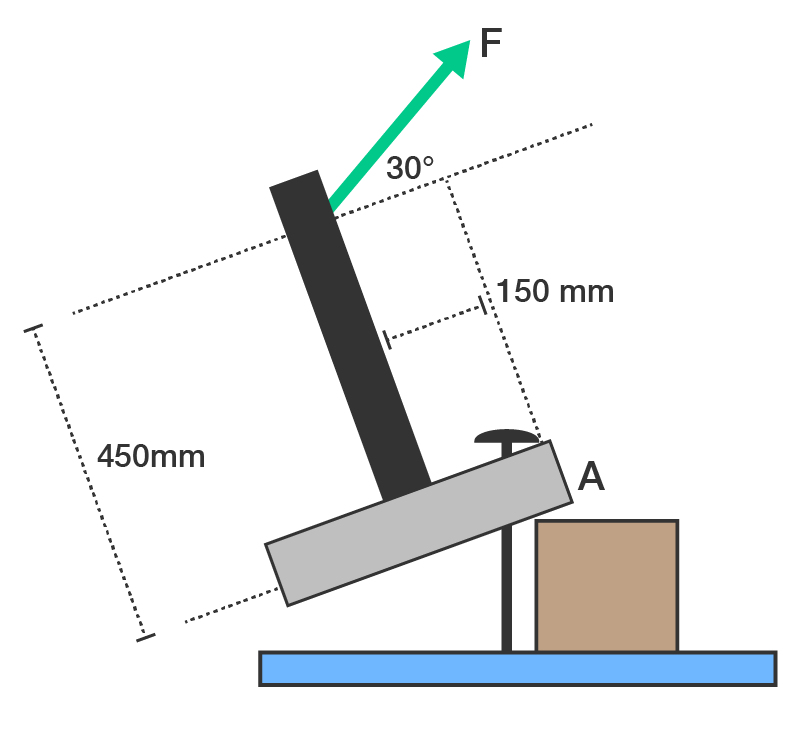
Since moment is a vector, we take clockwise moments as negative. The force \(F\) acts \(30^{\circ}\) to the handle, so we resolve it into two components:
Both components produce a clockwise (negative) moment about A. Setting up the moment equation:
\[\begin{align*} \sum M_{A} & = \sum \left( F_{\perp}\times r\right)_{A} \\[6pt]
-75 & = -\left(F\cos30^{\circ}\times0.15\right) - \left(F\sin30^{\circ}\times0.45\right) \end{align*}\]
Factoring out \(F\):
\[\begin{align*} -75 & = -F\left(0.15\cos30^{\circ}+0.45\sin30^{\circ}\right) \\[6pt]
& = -F\left( (0.15\times0.866)_+(0.45\times0.500) \right) \\[6pt]
& = -F\left(0.1299+0.225\right) \\[6pt]
& = -0.3549F \\[6pt]
F & = \frac{75}{0.3549} \\[6pt]
& = 211.3\,\text{N} \end{align*}\]
The magnitude of the force applied to the handle of the hammer is \(211.3\,\text{N}\).
The moment of a force can also be written as a vector cross product in the 3D space.
\[\vec{M}=\vec{r}\times\vec{F}\]
where:
- \(\vec{M}\) is the moment vector in Newton metres \(\text{N m}\)
- \(\vec{r}\) is the moment arm vector in metres \(\text{m}\)
- \(\vec{F}\) is the force vector in Newtons \(\text{N}\).
Vector \(\vec{M}\) is perpendicular to the plane containing \(\vec{r}\) and \(\vec{F}\).
To find the direction of \(\vec{M}\) using the right-hand rule: point your right-hand fingers in the direction of \(\vec{r}\) (the moment arm, from the point O towards where the force is applied), then curl them towards \(\vec{F}\). Your thumb points in the direction of \(\vec{M}\) – perpendicular to the plane containing \(\vec{r}\) and \(\vec{F}\). The order of the cross product matters: \(\vec{r}\times\vec{F}\) gives a different direction to \(\vec{F}\times\vec{r}\), so always write the moment arm first.
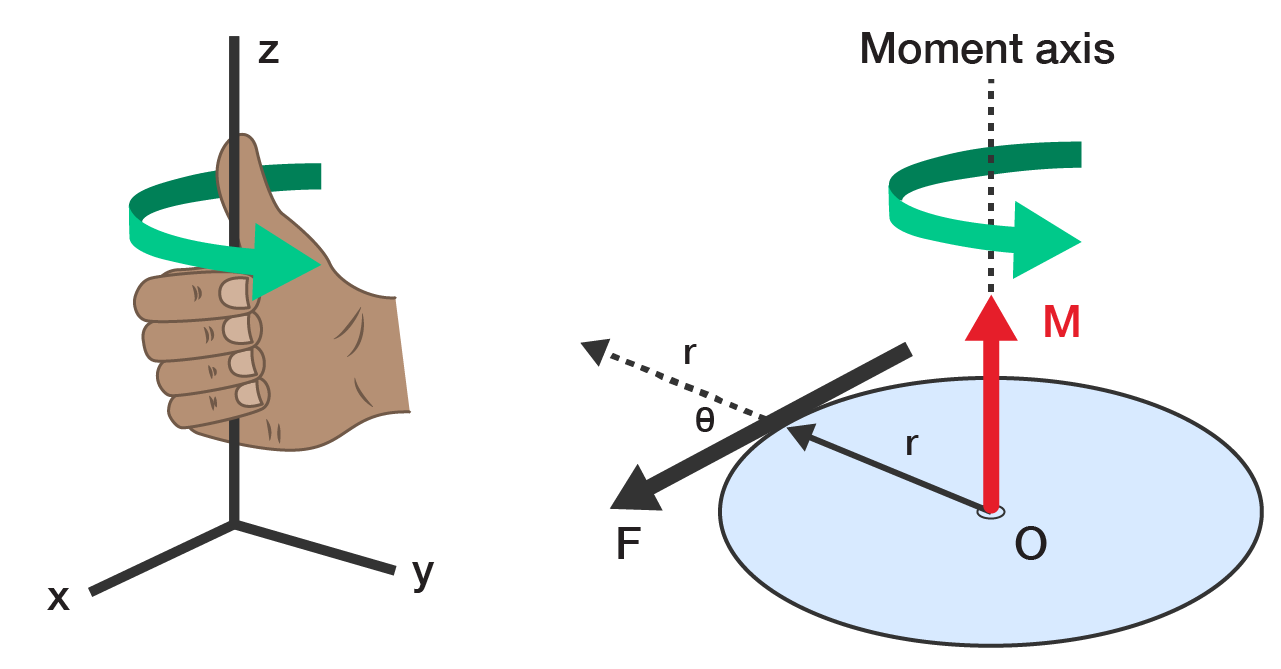
Since \(\vec{r}\) and \(\vec{F}\) are written as \(x, y, z\) coordinates, then \(\vec{M}\) can be found by finding the determinant.
\[\mathbf{M} = \vec{r} \times \vec{F} = \begin{vmatrix} \hat{i} & \hat{j} & \hat{k} \\
r_{x} & r_{y} & r_{z} \\
F_{x} & F_{y} & F_{z} \end{vmatrix} \]where:
- \(\hat{i}\), \(\hat{j}\) and \(\hat{k}\) are the unit vectors in the \(x\), \(y\) and \(z\) directions, respectively
- \(r_{x}\), \(r_{y}\) and \(r_{z}\) are \(x\), \(y\) and \(z\) components of the moment arm vector \(\vec{r}\), respectively
- \(F_{x}\), \(F_{y}\) and \(F_{z}\) are the \(x\), \(y\) and \(z\) components of the force vector \(\vec{F}\), respectively.
If you need a refresher on vector or cross product, visit this page.
Two forces act at point A on a 3D frame. If \(\mathbf{\vec{F}_{1}=80\hat{i}-100\hat{j}+60\hat{k}}\,\textbf{N}\) and \(\mathbf{\vec{F}_{2}=-150\hat{i}+200\hat{j}+90\hat{k}}\,\mathbf{N}\), determine the resultant moment produced by these forces about point O. Express your answer as a Cartesian vector.
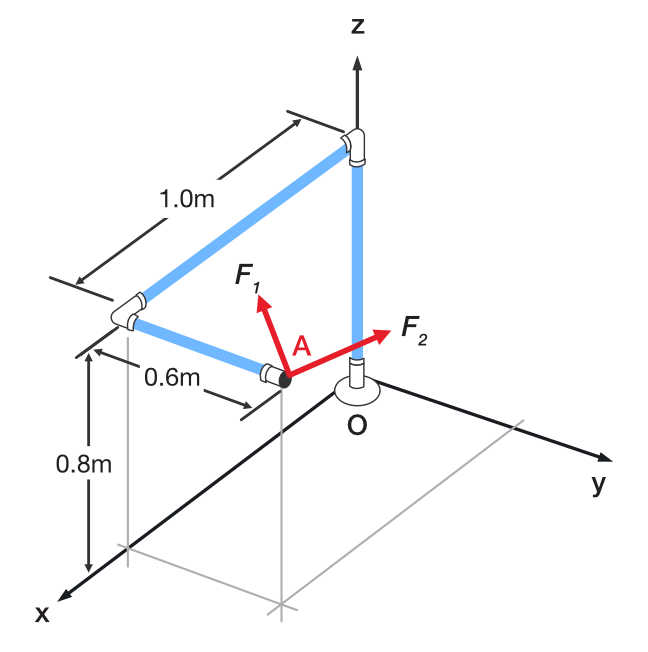
First, we need to find the resultant force \(\vec{F}_{r}\). Since both forces act at the same point A, we can combine them into a single resultant force before computing the moment. This simplifies the cross product to a single calculation.
\[\begin{align*} \vec{F}_{R} & = \vec{F}_{1}+\vec{F}_{2} \\[6pt]
& = \left( 80\hat{i}-100\hat{j}+60\hat{k} \right) + \left( -150\hat{i}+200\hat{j}+90\hat{k} \right) \\[6pt]
& = \left( -70\hat{i}+100\hat{j}+150\hat{k}\right) \,\text{N} \end{align*}\]
Now, we identify the position vector \(\vec{r}_{A}\). From the diagram, point A is located at coordinates \((1,0.6,0.8)\,\text{m}\) from the origin O. The position vector is therefore:
\[\vec{r}_{A} = \{ 1.0\hat{i}+0.6\hat{j}+0.8\hat{k} \} \,\text{m}\]
We are ready to calculate the moment using the cross product.
\[\begin{align*} \vec{M} & = \vec{r}_{A} \times \vec{F}_{R} \\[6pt]
& = \begin{vmatrix} \hat{i} & \hat{j} & \hat{k} \\
1.0 & 0.6 & 0.8 \\
-70 & 100 & 150 \end{vmatrix} \end{align*}\]
Expanding the determinant:
\[\begin{align*} M_{i} & = \left( r_{y}\times F_{z} \right) - \left( r_{z}\times F_{y} \right) \\[6pt]
& = (0.6\times150)-(0.8\times100)\\[6pt]
& = 90-80\\[6pt]
& = 10 \end{align*}\]
\[\begin{align*} M_{j} & = -[ \left( r_{x}\times F_{z} \right) - \left(r_{z}\times F_{x} \right) ] \\[6pt]
& = -[ (1.0\times150) - (0.8\times-70) ] \\[6pt]
& = -(150+56) \\[6pt]
& = -206 \end{align*}\]
\[\begin{align*} M_{k} & = \left(r_{x}\times F_{y}\right) - \left(r_{y}\times F_{x}\right) \\[6pt]
& = (1.0\times100)-(0.6\times-70) \\[6pt]
& = 100+42 \\[6pt]
& = 142 \end{align*}\]
The resultant moment about O is \(\vec{M} = \{ 10\hat{i}-206\hat{j}+142\hat{k} \}\,\text{N m}\).
Images on this page by RMIT, licensed under CC BY-NC 4.0


RMIT University acknowledges the people of the Woi wurrung and Boon wurrung language groups of the eastern Kulin Nation on whose unceded lands we conduct the business of the University. RMIT University respectfully acknowledges their Ancestors and Elders, past and present. RMIT also acknowledges the Traditional Custodians and their Ancestors of the lands and waters across Australia where we conduct our business - Artwork 'Sentient' by Hollie Johnson, Gunaikurnai and Monero Ngarigo.
More information