In many cases, acceleration changes over time. You see this when a car that has been stopped at a traffic light speeds up to \(\mathbf{60}\,\textbf{km/h}\) after the light changes to green. Acceleration also varies throughout a rollercoaster ride. Both of these scenarios demonstrate non-constant (or non-uniform) acceleration. Use this resource to learn about non-constant acceleration, including how it applies to Aboriginal spear-throwing.
So far, you've used the constant acceleration equations because acceleration stayed fixed throughout the motion. But when acceleration itself changes, those equations no longer apply, and we need a more general approach.
Recall that velocity is the rate of change of displacement, and acceleration is the rate of change of velocity. Written using calculus notation, these are:
\[v=\dfrac{dx}{dt}\qquad a=\dfrac{dv}{dt}\]
This means we can find velocity and acceleration at any instant by differentiating displacement with respect to time – once, to get velocity, and again, to get acceleration.
Integration reverses differentiation, so we can also work backwards: starting from acceleration, we can integrate to find velocity, and integrate again to find displacement.
When a hunter throws a spear, it starts from rest and accelerates – but not at a constant rate. The force and geometry of the throw change continuously, meaning the spear's acceleration changes throughout the motion. This is non-constant acceleration in action.
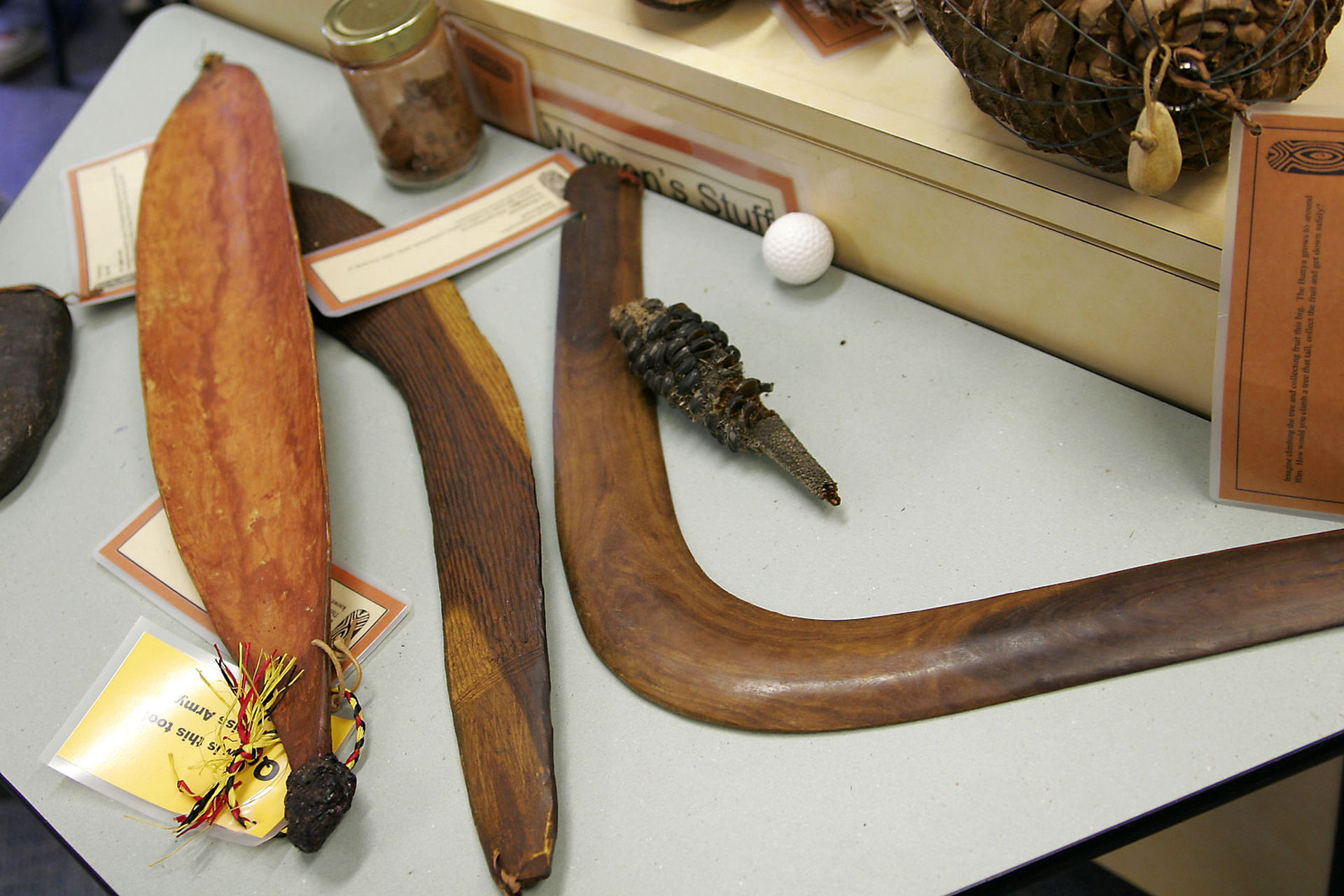
Aboriginal peoples across Australia developed the woomera, a wooden spear-throwing tool, to maximise the velocity of the spear at the moment of release. The word comes from the Dharug language of the Eora people of the Sydney Basin. Across the continent, many nations developed their own designs with their own names: miru in Pitjantjatjara, spoken around Uluru; wamirri in Warumungu Country in the central Northern Territory; and meru in Noongar Country in South-West Western Australia, among many others.
The woomera (pictured on the left) is an Aboriginal wooden spear-throwing tool. Image by fir0002 via Wikimedia Commons, licensed under CC BY-NC 3.0
Once airborne, the spear travels with constant horizontal velocity and is pulled back to Earth by the constant downward acceleration of gravity. The effectiveness of the woomera is a testament to tens of thousands of years of careful observation and refinement. Archaeological evidence suggests this technology may be over 20,000 years old, making it one of the earliest applications of acceleration physics in human history.
We would like to acknowledge and thank the Indigenous Science Committee (School of Science, RMIT University) for their consultation, which has helped shape this example. For further information, please explore the following resources:
A toy car moves along a straight track. Its position is given by \(\mathbf{x=t^{3}-6t^{2}}\), where \(\mathbf{t}\) is in seconds and \(\mathbf{s}\) is in metres.
Calculate the time(s) when:
the velocity is zero
the acceleration is zero
We have the equation for displacement. If we differentiate once with respect to time, we get velocity. Therefore:
\[\begin{align*} x & = t^{3}-6t^{2} \\[6pt]
v & = \dfrac{dx}{dt}\\[6pt]
& = 3t^{2}-12t\end{align*}\]
For \(v=0\), we simply substitute the value in and solve for \(t\).
\[\begin{align*} 0 & = 3t^{2}-12t \\[6pt]
0 & = 3t(t-4)\\[6pt]
0=3t\quad & \text{ or }\quad 0=t-4\\[6pt]
t=0\,\text{s}\quad & \text{ or }\quad t=4\,\text{s}\end{align*}\] Therefore, the toy car starts from rest and stops at \(4\,\text{s}\).
The equation for acceleration is obtained from differentiating the equation for velocity with respect to time.
\[\begin{align*} a & = \dfrac{dv}{dt} \\[6pt]
& = 6t-12\end{align*}\]
For \(a=0\), we substitute the value in and solve for \(t\).
\[\begin{align*} 0 & = 6t-12 \\[6pt]
12 & = 6t\\[6pt]
t & = \frac{12}{6}\\[6pt]
t & = 2\,\text{s}\end{align*}\]
What is the total distance travelled by the car after \(\mathbf{5}\,\textbf{s}\)?
We can find the total distance covered using displacement. We can start by finding the starting position, i.e. when \(t=0\,\text{s}\).
\[\begin{align*} x & = 0^{3}-6(0)^{2} \\[6pt]
& = 0\end{align*}\]
The car changes direction when \(v=0\,\text{m/s}\), i.e. at \(t=0\,\text{s}\) and \(t=4\,\text{s}\). We can then find the distance it travels before it changes direction at \(t=4\,\text{s}\).
From \(t=4\) to \(t=5\), the car changes position from \(-32\,\text{m}\) to \(-25\,\text{m}\), which is \(7\,\text{m}\) in the positive direction.
The total distance travelled is the sum of these: \(32+7=39\,\text{m}\). This is different from the car's displacement, which would be the difference between the displacement at \(t=5\) and \(t=0\): \(-25\,\text{m}\).
A small boat travelling in a straight line cuts its engine. Due to water resistance, its acceleration \(\mathbf{a}\) is related to its velocity \(\mathbf{v}\) by \(\mathbf{a = -0.5v}\). When \(\mathbf{t=0}\), \(\mathbf{v=16}\,\textbf{m}\,\textbf{s}\mathbf{^{-1}}\). Calculate:
the boat's velocity as a function of time
To find velocity as function of time, we need to integrate \(a=-0.5v\) with respect to time, \(a=\dfrac{dv}{dt}\). First, we separate the variables, then integrate:
Notice that the boat never fully stops in this model; its velocity keeps approaching zero but never quite reaches it. This is typical of resistance forces that depend on speed: as the boat slows, the resistance slowing it down also weakens.
Exercise – using non-constant acceleration
The position of a lift (elevator) moving up a shaft is given by \(x=2t^{3}-3t^{2}+4t\), where \(x\) is in metres and \(t\) is in seconds. Calculate:
the lift's velocity when \(t=3\,\text{s}\)
the lift's acceleration when \(t=3\,\text{s}\).
\(40\,\text{m}\,\text{s}^{-1}\)
\(30\,\text{m}\,\text{s}^{-2}\)
A skateboarder's velocity along a straight path is given by \(v=3t^{2}+2t\,\text{m}\,\text{s}^{-1}\), where \(t\) is in seconds. Calculate the skateboarder's displacement between \(t=0\,\text{s}\) and \(t=2\,\text{s}\).
\(12\,\text{m}\)
A rocket sled's acceleration is given by \(a=6t-4\,\text{m}\,\text{s}^{-2}\), where \(t\) is in seconds. If the sled's initial velocity (at \(t=0\)) is \(5\,\text{m}\,\text{s}^{-1}\), find the sled's velocity when \(t=3\,\text{s}\).
\(20\,\text{m}\,\text{s}^{-1}\)
A model train's position along a straight track is given by \(x=t^{3}-9t^{2}\), where \(x\) is in metres and \(t\) is in seconds. Calculate the time(s) when:
the train's velocity is zero
the train's acceleration is zero.
\(t=0\,\text{s}\) and \(t=6\,\text{s}\)
\(t=3\,\text{s}\)
A ball rolls along a straight, grooved track such that its position is given by \(x=t^{3}-12t\), where \(x\) is in metres and \(t\) is in seconds. Calculate the total distance travelled by the ball between \(t=0\,\text{s}\) and \(t=5\,\text{s}\).
\(97\,\text{m}\)
A sky diver's acceleration after opening their parachute is related to their (downward) velocity by \(a=-0.25v\,\text{m}\,\text{s}^{-2}\). At the moment the parachute opens (\(t=0\)), their velocity is \(40\,\text{m}\,\text{s}^{-1}\). Calculate:
the sky diver's velocity when \(t=4\,\text{s}\)
the distance fallen by the sky diver between \(t=0\,\text{s}\) and \(t=4\,\text{s}\).