Now that you are familiar with how an object's velocity changes over time in linear motion, we now shift our focus to angular motion, where similar principles apply to rotational systems. Use this resource to gain insight into the rotational behaviour of objects, and better understand the dynamics of systems in motion, both linearly and rotationally, including how Torres Strait Islander seafarers apply an understanding of angular motion at sea.
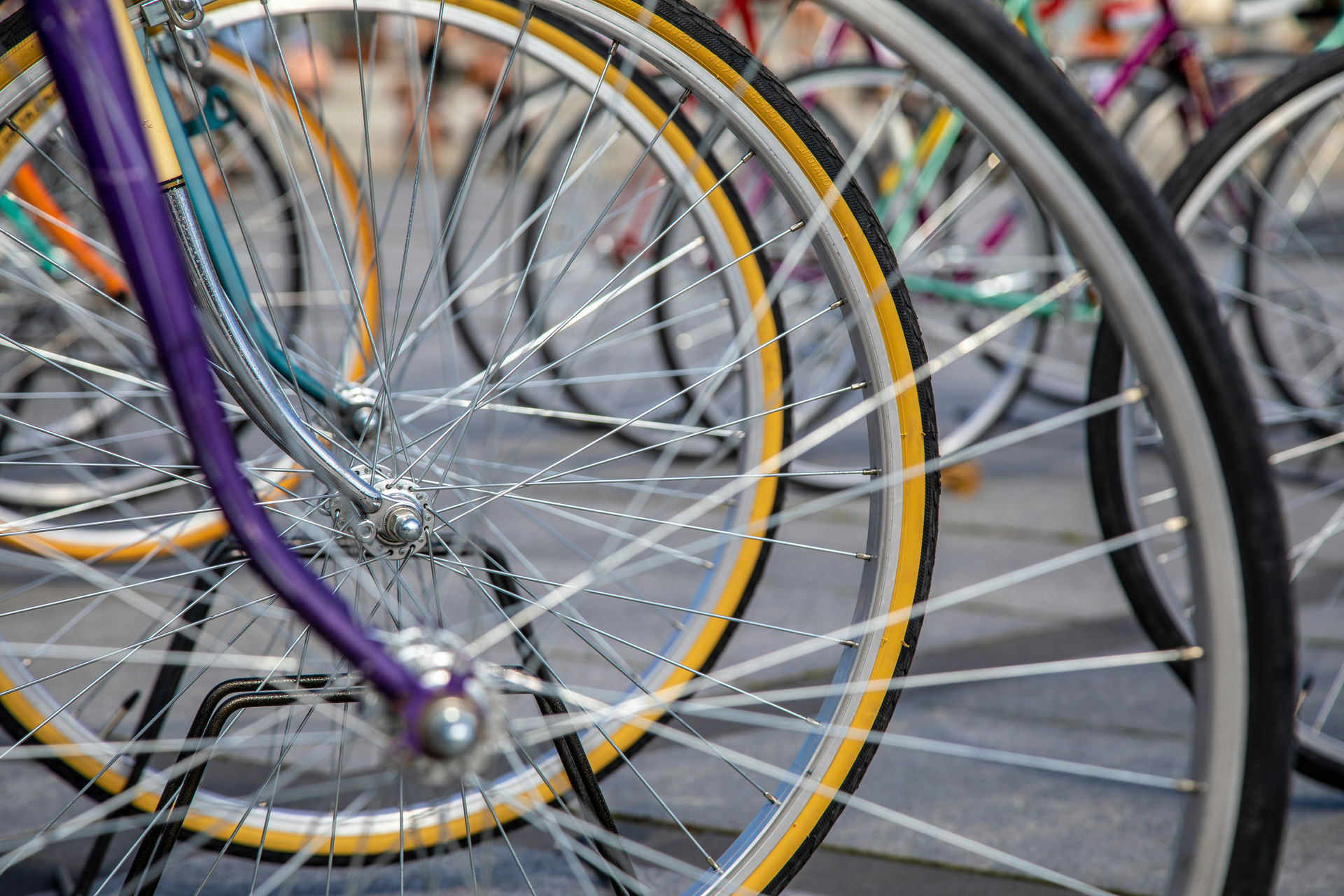
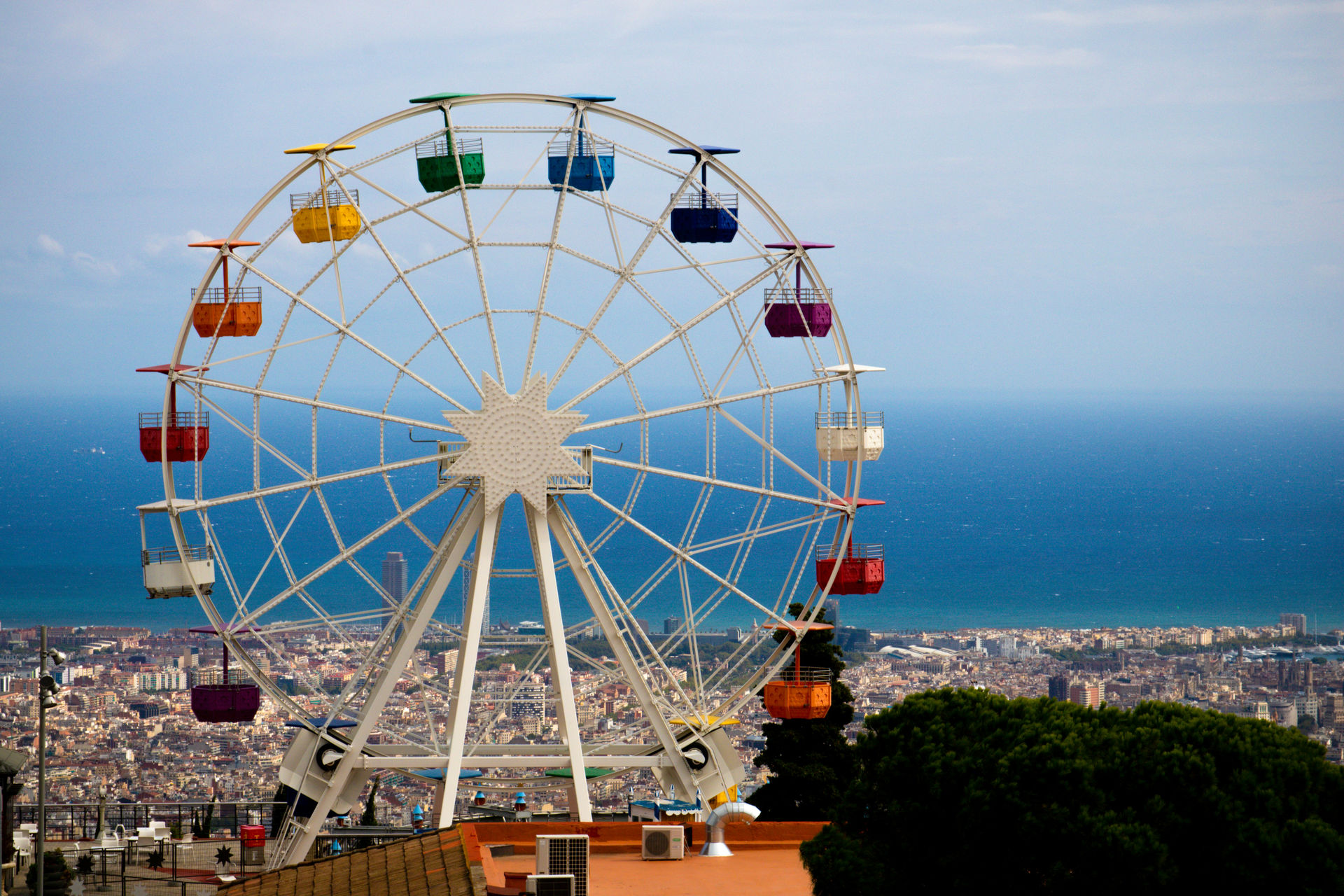
Angular motion is the movement of an object around a fixed point or axis – the object follows a circular path. This type of motion is characterised by arc length, angular displacement, angular velocity, and angular acceleration. A spinning bicycle wheel, a Ferris wheel carriage, and the hands of a clock are everyday examples of angular motion.
Bicycle wheels, by Katja Ano via Unsplash; Ferris wheel, by Angelina via Unsplash.
Arc length and angular displacement
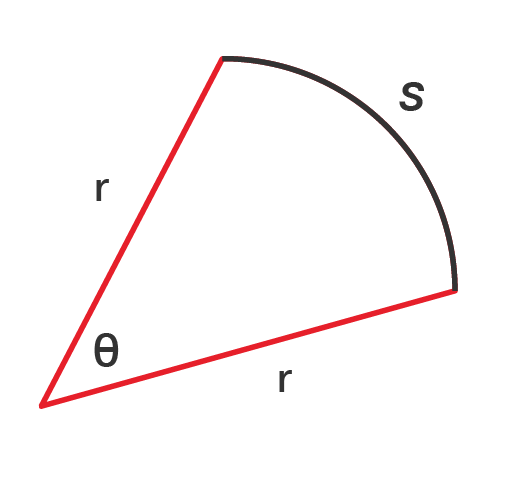
Arc length \(s\) is the distance measured along the curved path of a circle. It is like the length of the “piece” of the circle’s circumference that an object travels.
Angular displacement \(\theta\) is the angle an object turns through as it moves around a circle, measured from its starting position to its final position (usually in radians).
Converting between degrees and radians
Generally, any angle at the centre of a circle is defined in radians by the equation:
\[\theta = \frac{\text{arc length}}{\text{radius}} = \frac{s}{r}, \quad\text{or}\quad s = r\theta\]
where \(\pi=180^\circ\) and \(1\,\text{rad}=57.3^\circ\).
To convert between radians and degrees, use these conversions:
\[\text{From radians to degrees: }\times\frac{180}{\pi}\]\[\text{From degrees to radians: }\times\frac{\pi}{180}\]
Angular velocity \(\omega\)
Linear velocity \(v\) is the rate of change of displacement. It is calculated using the equation:
\[v = \dfrac{s}{t}=\dfrac{r \theta}{t}\]
Angular velocity \(\omega\) is the rate of change of angular displacement. It is calculated using the equation:
\[\omega=\frac{\theta}{t}\]
where \(\omega\) is measured in \(\text{rad}\,\text{s}^{-1}\).
From these equations, we can derive an equation that links linear and angular velocity.
\[v=r\omega\]
This equation only applies when angular velocity is constant – that is, when there is no angular acceleration.
Indigenous knowledges in physics
Outrigger canoes
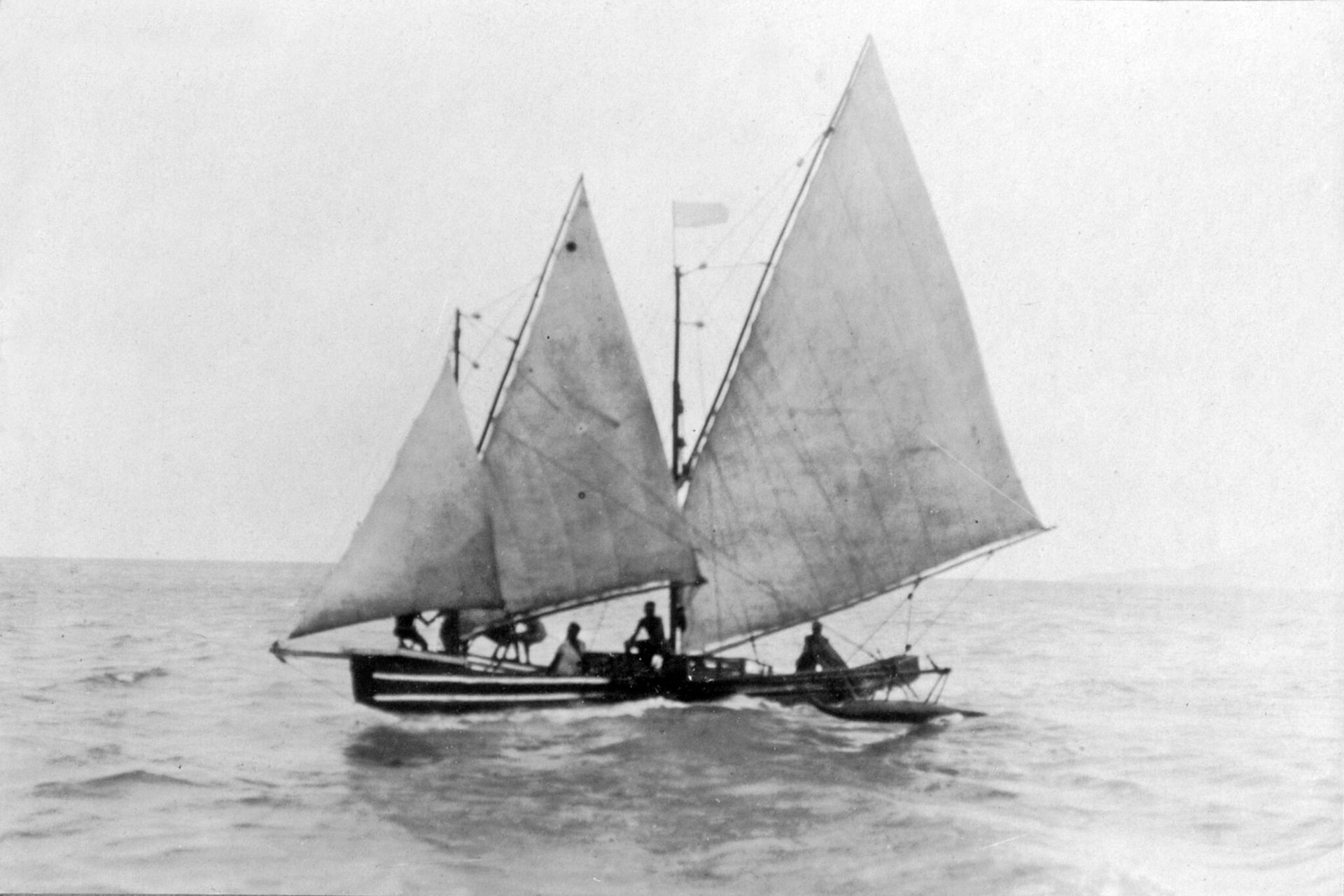
Torres Strait Islander peoples are the Traditional Custodians of over 270 islands and associated territorial seas between the Queensland mainland and Papua New Guinea. As expert seafarers, they developed outrigger canoes—vessels up to \(21\,\text{m}\) long—to navigate open ocean for fishing, trade and ceremony across hundreds of kilometres of seascape. These canoes (called gul in Western-Central language and nar in Miriam Mir language) are hypothesised to originate from New Guinea and the Queensland coast. Based on archaeological remains and evidence of resources harvested from the sea, it is suggested that their use in the Torres Strait dates back at least 7000 years. These vessels are the largest and feature the most complex designs of all Australian Indigenous watercraft.
An outrigger canoe has wooden floats (called saima in Western-Central language, sirib in Miriam Mir language and sarreem in the South-West Strait) attached to the one or both sides of the hull by a long bamboo boom (called tug in Western-Central and Miriam Mir languages). The floats help prevent the canoe from tipping over and also supported a deck or platform where people camped and cooked food. When a wave causes the canoe to roll, a float—positioned some distance from the centre of rotation—moves through the water at a greater linear speed than points closer to the hull. This follows the relationship \(v=r\omega\), where linear speed increases the distance from the axis of rotation. The higher speed of a float produces greater water resistance, which opposes the rolling motion and helps stabilise the canoe.
The Bamaga Family's Dauarti canoe (Saibai, Torres Strait Island), image by fir0002 via Flickr, licensed under PDM 1.0
It is suggested that early outrigger canoes featured floats that were directly attached to a boom, whereas those used over the past 2000 years were indirectly attached via upright sticks (called saiu pat in Western-Central language and kag in Miriam Mir language). As the canoe starts to tip, indirectly attached floats are pushed deeper into the water, increasing the buoyant force and helping the canoe resist tipping.
We would like to acknowledge and thank Professor Ian McNiven and the Indigenous Science Committee (School of Science, RMIT University) for their consultation, which has helped shape this example. For further information, please explore the following resources:
Revolutions per minute \(\text{rpm}\) is a common unit for describing how fast something rotates. It tells you how many complete revolutions an object makes in one minute.
Since our angular equations use radians per second rather than \(\text{rpm}\), we need a way to convert between the two.
\[\text{From rpm to radians: }\times\frac{\pi}{30}\]\[\text{From radians to rpm: }\times\frac{30}{\pi}\]
Example – converting between rpm and radians per second
A weight on the end of a string describes a circular path of radius \(\mathbf{0.5}\,\textbf{m}\). If its linear velocity is \(\mathbf{2}\,\textbf{m}\,\textbf{s}\mathbf{^{-1}}\), determine the angular velocity in:
\(\textbf{rad}\,\textbf{s}\mathbf{^{-1}}\)
We have \(r=0.5\,\text{m}\) and \(v=2\,\text{m}\,\text{s}^{-1}\).
To find angular velocity, we use the equation \(v=r\omega\). We can rearrange this to make \(\omega\) the subject.
Angular acceleration \(\alpha\) is the rate of change of angular velocity. It is calculated using the equation:
\[\alpha=\frac{\omega}{t}\]
Since linear velocity and angular velocity are related by \(v=r\omega\), we can substitute this into the equation for linear acceleration, \(a=\dfrac{v}{t}\) to find a relationship between linear and angular acceleration.
When angular velocity is not constant—for example, when a motor is speeding up or slowing down—we need a more complete set of equations. Just as the kinematic equations for linear motion account for acceleration, the following angular equations do the same for rotational motion.
The equations derived for linear motion apply equally to angular motion, provided that we use the angular symbols instead.
Linear equations
\[\begin{align*} x & = vt \\[6pt]
a & = \frac{v-v_{0}}{t}\\[6pt]
v & = v_{0}+at\\[6pt]
v^{2} & = v_{0}^{2}+2ax\\[6pt]
x & = v_{0}t+\frac{1}{2}at^{2}\end{align*}\]