Protein synthesis
Go to this resource to learn more about the process of protein synthesis.
Genes and genomes are the blueprints of life. Understanding how genes function and how the entire genome is organised helps us learn how traits are inherited and how organisms develop. This knowledge is essential for advancements in medicine, agriculture, and biotechnology. Use this resource to explore the roles genes and genomes play in biology.
Every living thing relies on genetic instructions to function and grow. To do this, we need proteins which are coded by sequences of DNA called genes. Genes determine our physical traits like eye colour, height, skin colour and facial features.
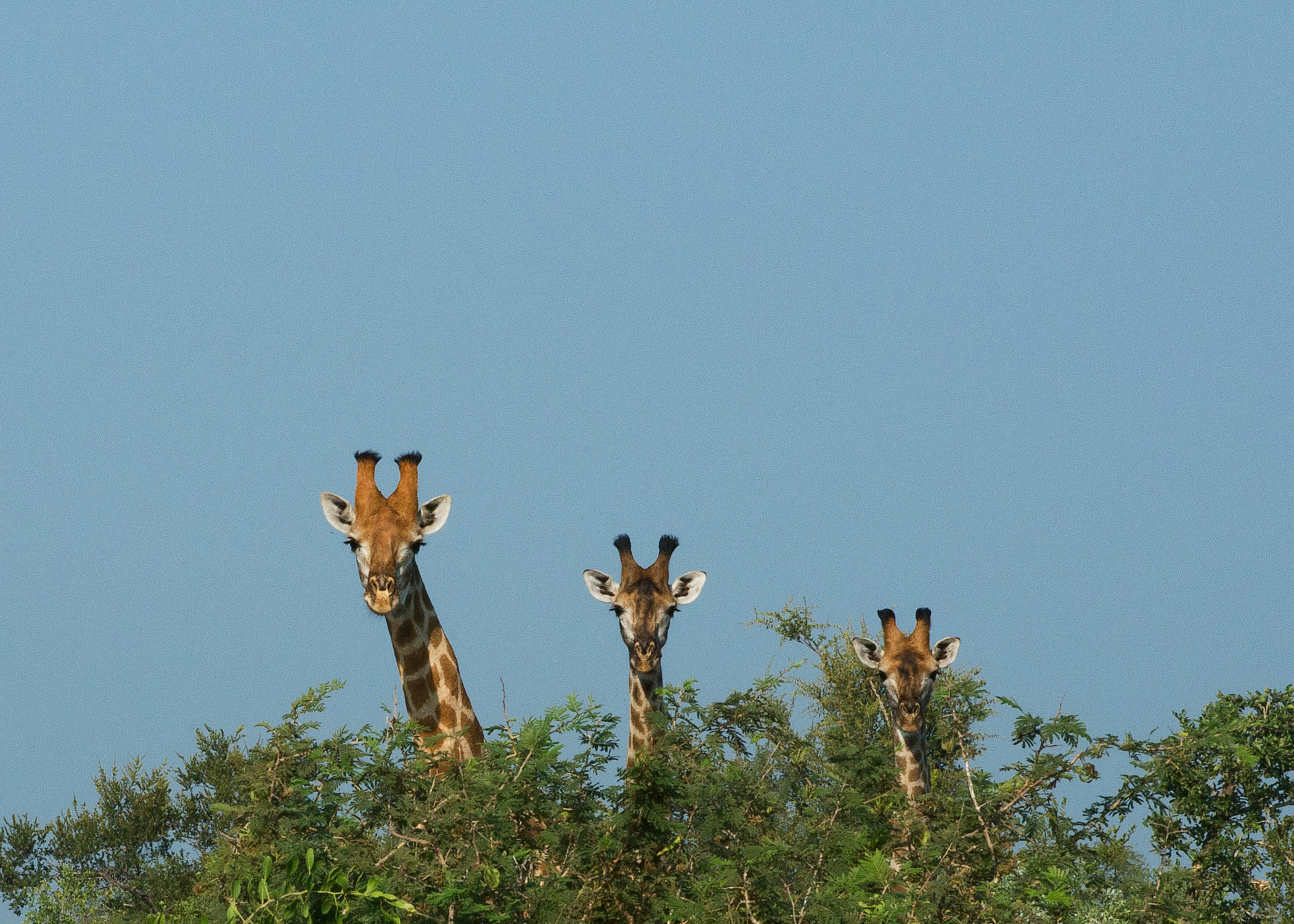
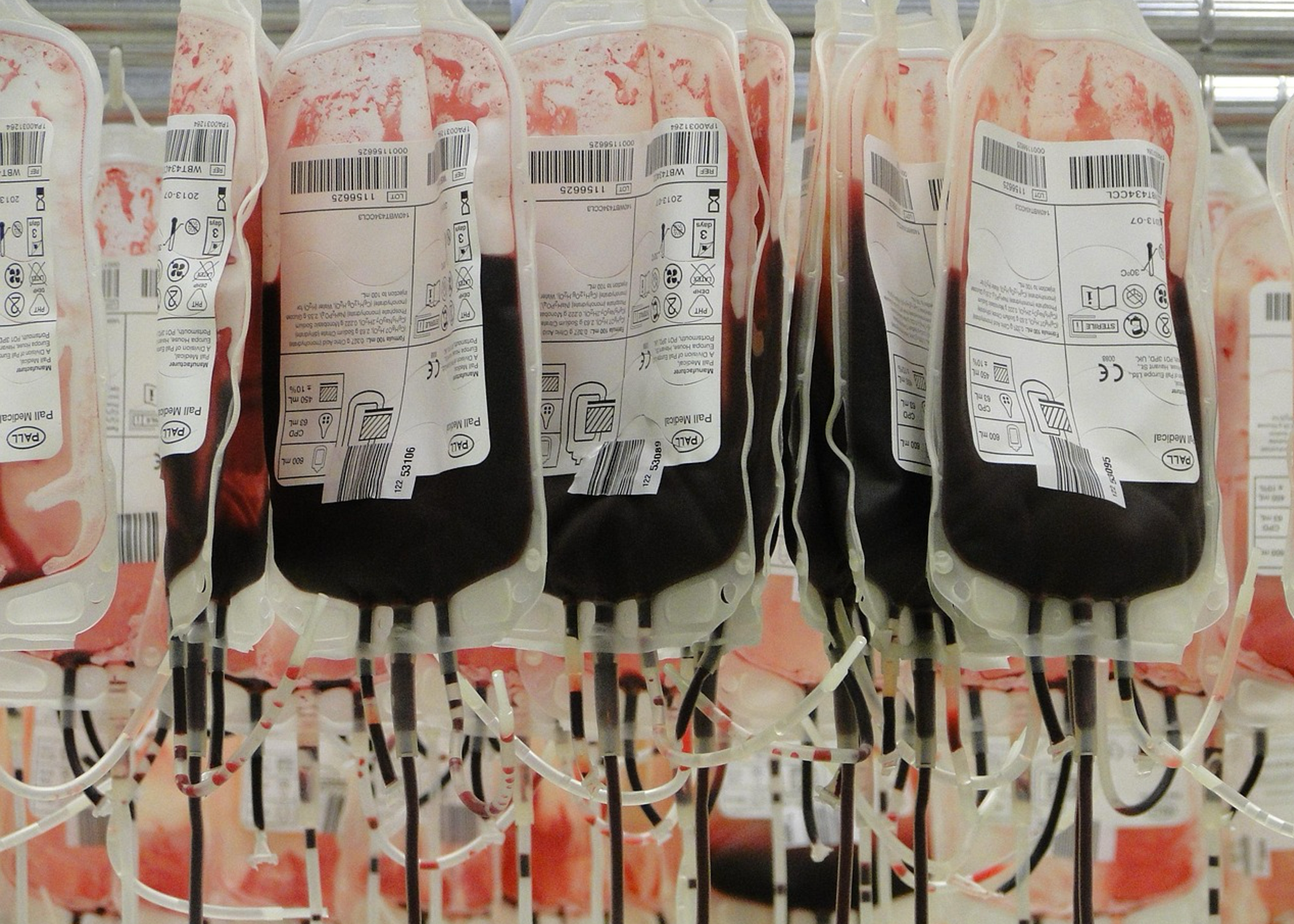

Giraffes, by Vincent van Zalinge via Unsplash; Blood bags, by sabinurce via Pixabay; Curly hair, by Tamas Pap via Unsplash.
An organism’s entire set of DNA, including all their genes and also non-coding sequences, is called its genome.
Gene expression is the process by which the instructions in a gene are used to produce proteins*, which perform essential functions in the cell. (*Find out more about Protein synthesis).
Not all genes are active at all times. Genes that are “on” at all times are called constitutive genes; they are continually transcribed. Important examples are ribosomal protein genes which are constantly needed for protein production.
Some constitutive genes, known as housekeeping genes, are expressed at stable levels. They are needed for basic cellular functions.
Genes that are expressed only when needed are called facultative genes. These genes allow cells to respond to environment changes or developmental signals.
Gene regulation involves controlling when and how much a gene is expressed. This ensures that proteins are produced at the right time, in the right amount, and in the right cells. Gene regulation is crucial for normal growth, development, and adaptation.
There are regulatory proteins that control this process.
These proteins bind to specific regions of DNA to control transcription.
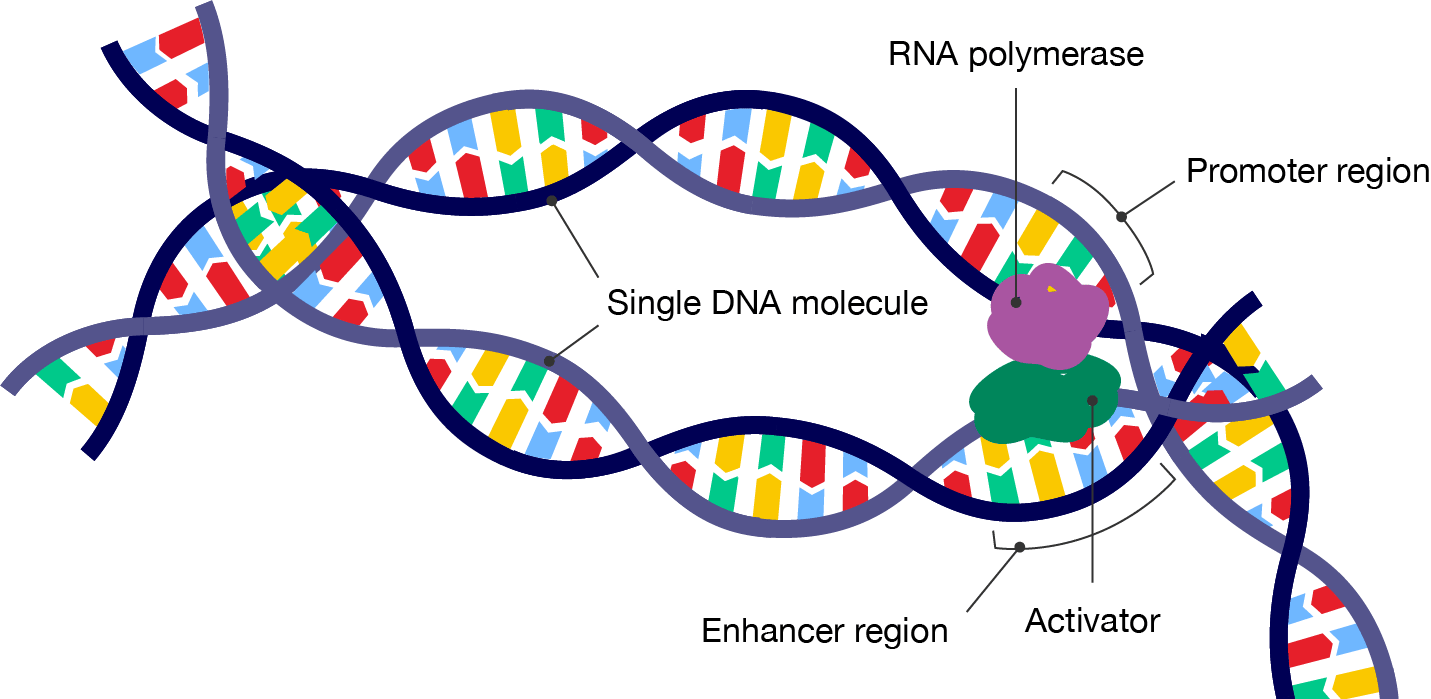
A diagram showing the different regions where proteins can bind on DNA to control transcription. Two segments of double-stranded DNA are shown. They belong to the same DNA molecule, as indicated by the label "Single DNA molecule", but are shown folded together.
RNA polymerase, shown as a purple blob, is attached to a section of the DNA called the "Promoter region". It is also bound to a green blob labelled "Activator". The activator has bound to a section of the DNA called the "Enhancer region".
Enhancers and silencers can be found between genes and in the introns of other genes, which are non-coding segments of DNA that do not produce proteins. Because DNA is folded and coiled, these regions can actually be close to the transcription start site for the gene.
The study of genomes, called genomics, gives us great insights into human health and disease. In Australia, a team of genetics and community engagement experts is using genomics to understand the unique genetic variations in Aboriginal and Torres Strait Islander populations. This research aims to develop more effective, targeted treatments for cancer to improve health outcomes for Aboriginal and Torres Strait Islander peoples. It also focuses on giving Indigenous communities more leadership and control over cancer research and policy that affects Indigenous peoples.
In recent studies, researchers found up to \(62\%\) of genetic variants in Aboriginal and Torres Strait Islander peoples from northern and central regions of Australia that had not been previously documented. With these datasets, clinicians may be able to find disease-causing variants and design treatments that work better and cause less harm.
Each gene can have different versions, called alleles. A single gene usually has two alleles, with one given to you from each parent. As the human has more than \(20,000\) protein-coding genes, think about all the possible combinations of alleles. This is what gives humans such diversity.
The alleles specific to you as an individual result is your genotype. These are indicated using a two-letter code, with each letter representing an allele.
For example, a gene for the colour of corn has two alleles, \(P\) and \(p\). The possible genotypes are \(PP\), \(pp\) and \(Pp\).
Each genotype may give a different physical trait or phenotype. In this case, \(P\) causes purple corn phenotype and \(p\) causes yellow corn phenotype.

See how well you understand genes and alleles with a quick quiz.
Read the scenario and use the information provided to answer the questions in the quiz.
Dr Mango conducts an experiment to investigate the levels of mRNA and protein expression for a specific gene, Gene X, across different tissues (liver, brain, and heart) under normal and stress conditions. Dr Mango records her results in the following table.
| Tissue | Condition | mRNA expression | Protein expression |
|---|---|---|---|
| Liver | Normal | \(1.0\) | \(1.0\) |
| Liver | Stress | \(1.5\) | \(1.3\) |
| Brain | Normal | \(1.2\) | \(0.9\) |
| Brain | Stress | \(2.0\) | \(1.7\) |
| Heart | Normal | \(0.8\) | \(0.7\) |
| Heart | Stress | \(1.6\) | \(1.4\) |
Protein synthesis
Go to this resource to learn more about the process of protein synthesis.
The status of the human gene catalogue
Cataloguing the human genome is a continuing endeavour. Read this Nature article to learn about some more recent findings.
Is gene therapy the next big step in vision loss treatment?
Gene therapy in action! Read this article to learn about how gene therapy could be a game changer in treating retinal diseases.
Measles cases are on the rise – here's how to make sure you're protected
Even viruses have genotypes! Read this article from The Conversation to learn about protecting yourself from measles, which comes in different strains (or genotypes!)


RMIT University acknowledges the people of the Woi wurrung and Boon wurrung language groups of the eastern Kulin Nation on whose unceded lands we conduct the business of the University. RMIT University respectfully acknowledges their Ancestors and Elders, past and present. RMIT also acknowledges the Traditional Custodians and their Ancestors of the lands and waters across Australia where we conduct our business - Artwork 'Sentient' by Hollie Johnson, Gunaikurnai and Monero Ngarigo.
More information