The Eukaryotic Cell Cycle and Cancer
Keen to dive a little deeper? Use this BioInteractive cell cycle Click & Learn to read more about the phases, checkpoints and protein regulators of the cell cycle, and where things can go wrong in cancer.
The cell cycle is a series of events that a cell goes through as it grows and divides. You need to understand the cell cycle to grasp how organisms grow, repair tissues, and stay healthy. Use this resource to learn about the cell cycle.
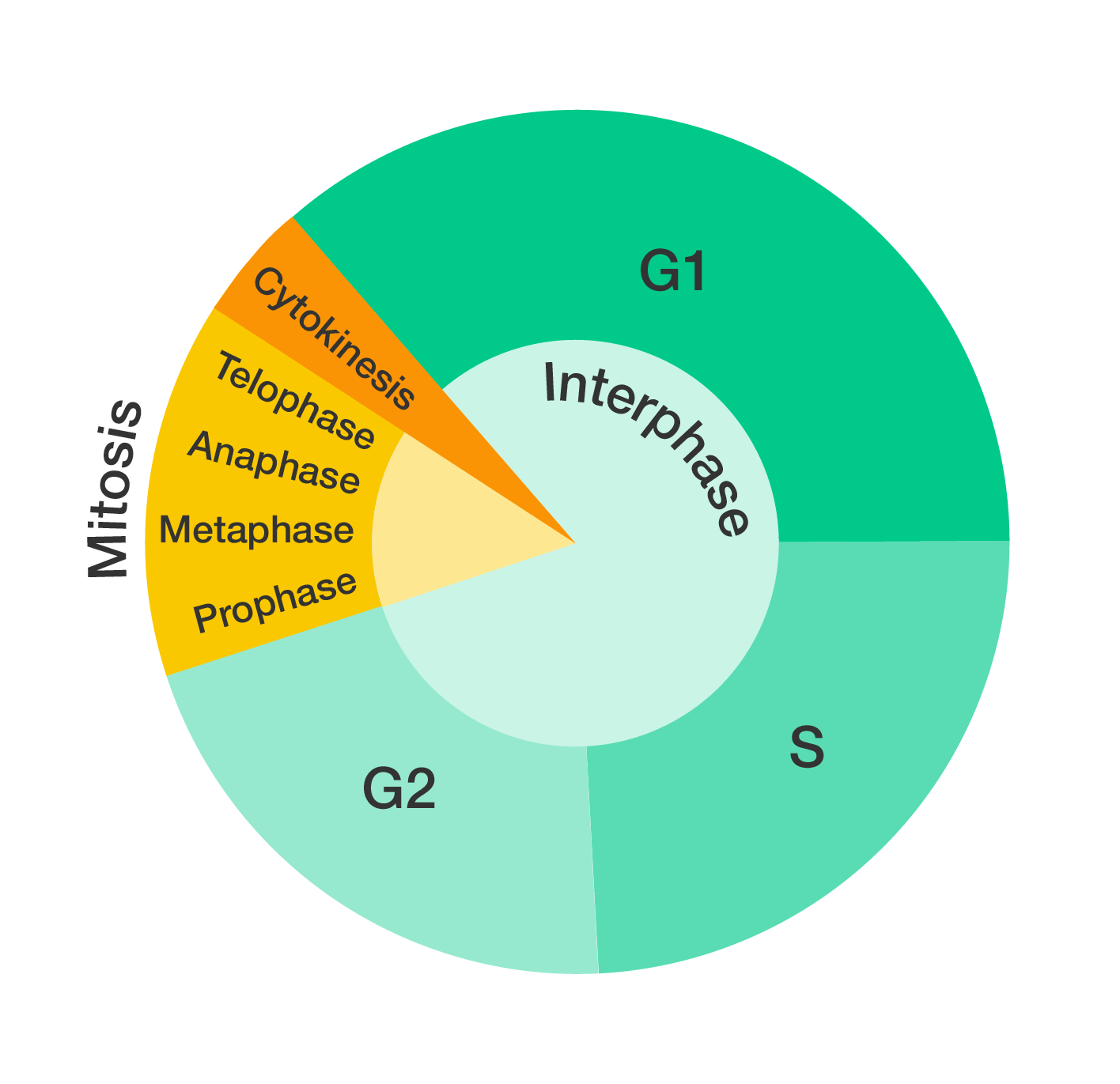
The cell cycle consists of several phases: interphase, mitosis and cytokinesis. We can compare these phases to preparing for and executing a theatrical play.
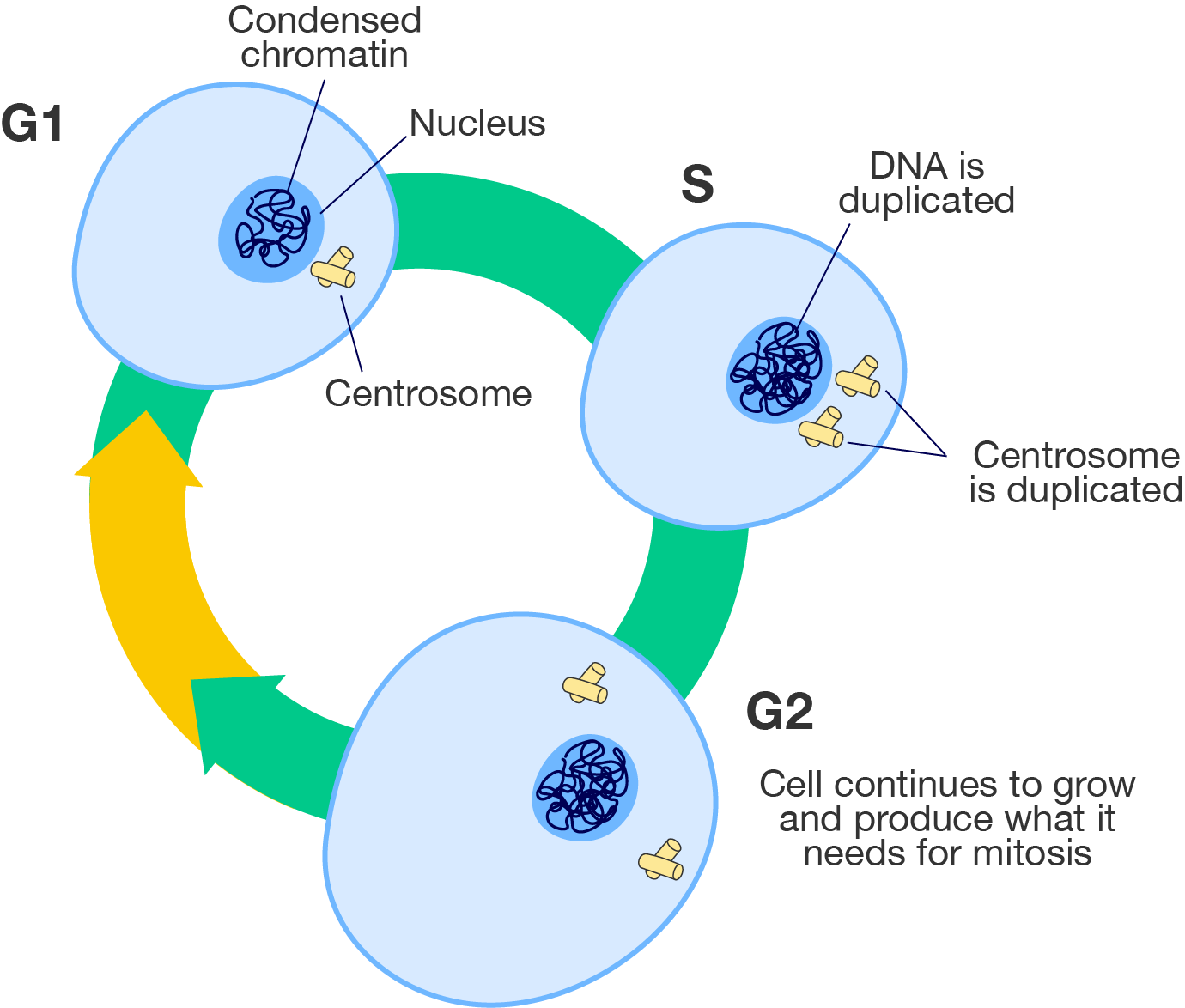
Interphase is like the rehearsal period before the big night. During this time, all the necessary planning, growth and organisation occur to make sure everything is ready for the show. It is when the cell grows and its genetic material (DNA) is replicated.
Interphase is the longest phase in the cell cycle. It consists of three stages:
Interphase is crucial for make sure the cell has all the parts it needs to divide successfully and accurately.
The stages of interphase as shown in the figure.
Mitosis is like the performance night. All the preparations made during interphase come together—the actors take the stage, deliver their lines and the story unfolds in front of an audience. Just as the play transitions through various scenes and acts, mitosis involves a series of stages where the cell divides its replicated DNA and splits into two identical daughter cells.
Mitosis consists of several stages:
Mitosis makes sure that each daughter cell has an exact copy of the parent cell's DNA, maintaining genetic consistency across cell generations.
The stages of mitosis are shown in the figure.
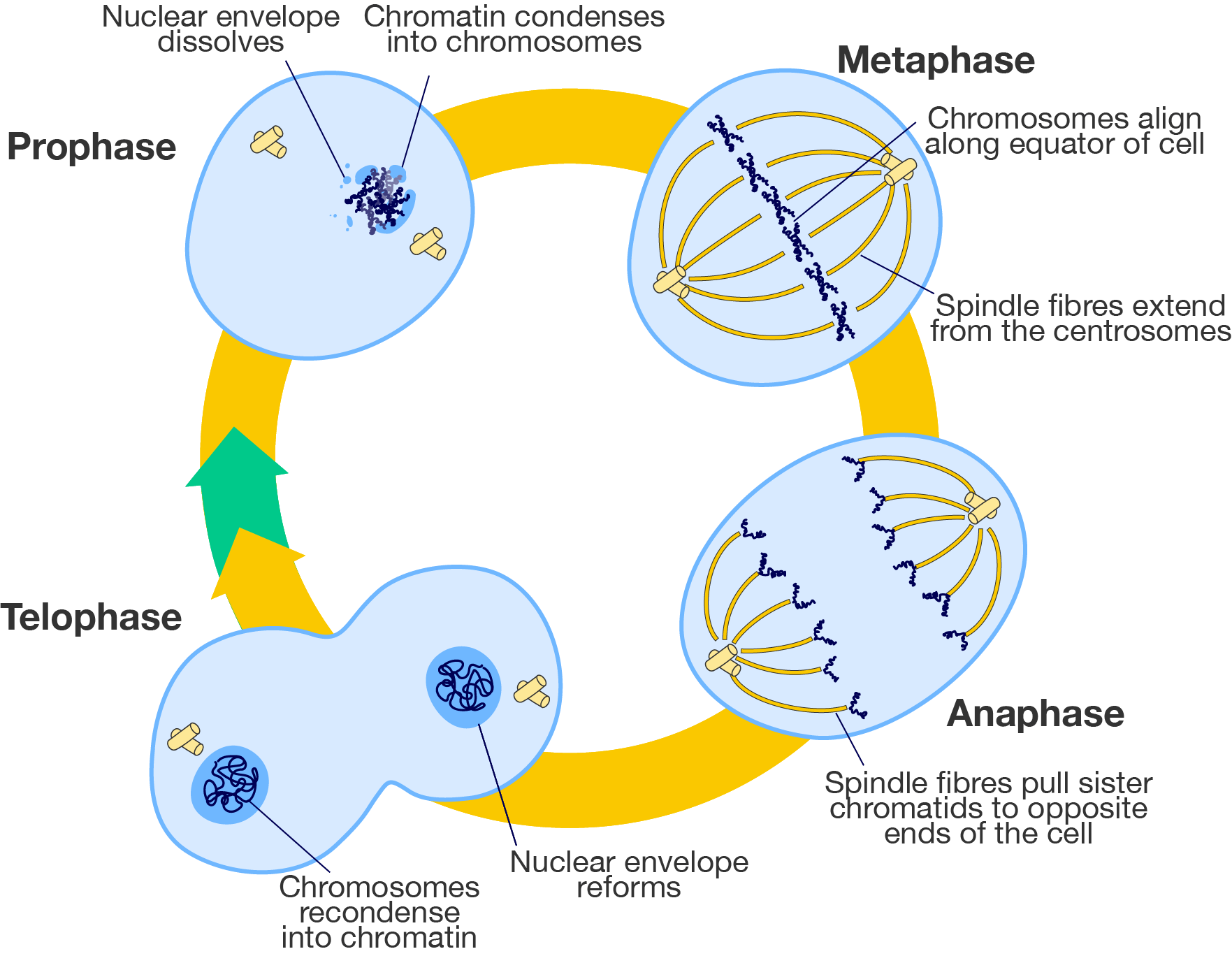
Use this mnemonic to remember the order of the phases in mitosis: Post Memes And Tiktoks.
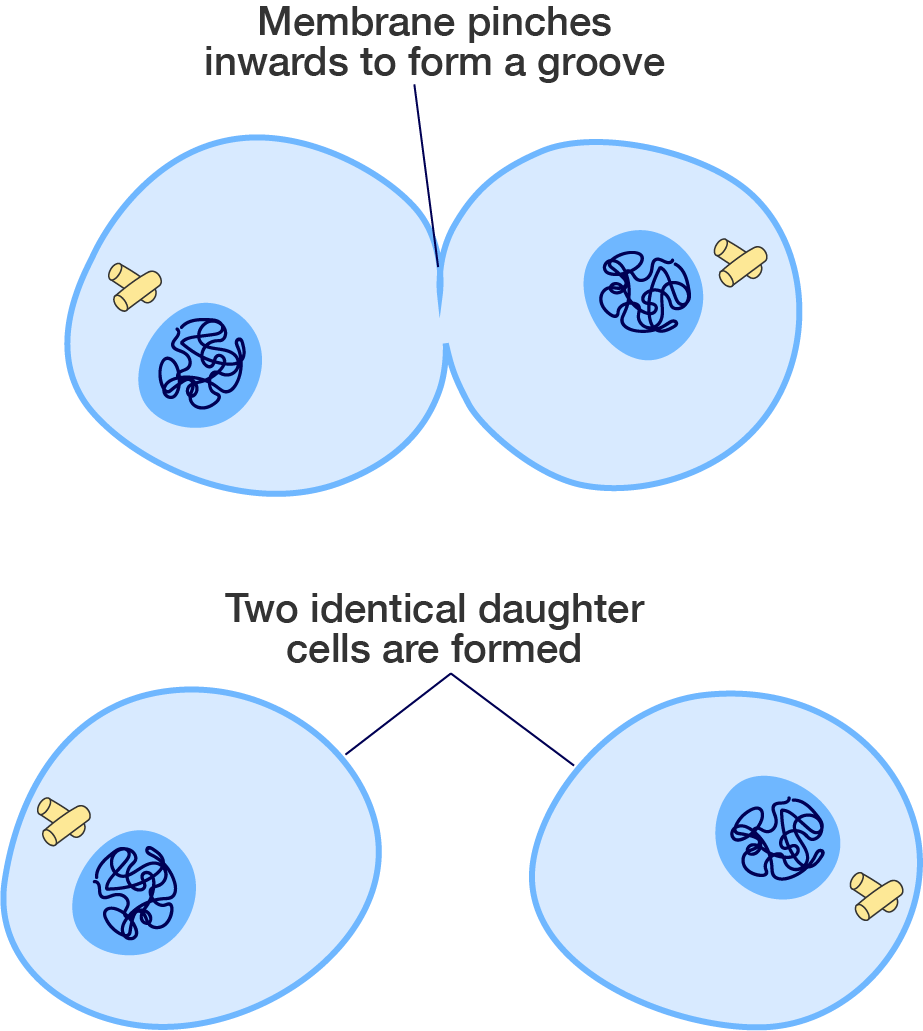
In the theatrical play analogy, cytokinesis would be like the stage crew closing the curtains and preparing for the next show. After the actors have finished their performance (mitosis), the stage is carefully reset and divided, ensuring everything is neatly organised. This process ensures that the two separate "productions" (or cells) are ready for future events.
Cytokinesis is the final step of the cell cycle, where the cell's cytoplasm divides to form two distinct daughter cells.
Cytokinesis ensures that each daughter cell receives not only an equal and complete set of genetic material but also the necessary organelles and resources to function independently.
The cell cycle is summarised in the figure.
See how well you understand the cell cycle with a quick quiz.
Read the scenario and use the information provided to answer the questions in the quiz.
Telomeres are protective caps on the ends of chromosomes that protect the DNA from damage. They also play important roles in DNA replication.
Researchers at the Institute of Dee and Aye published a study looking at telomere length and human aging. Telomere length in white blood cells was plotted against age, in years, and the p- and r-values are shown.
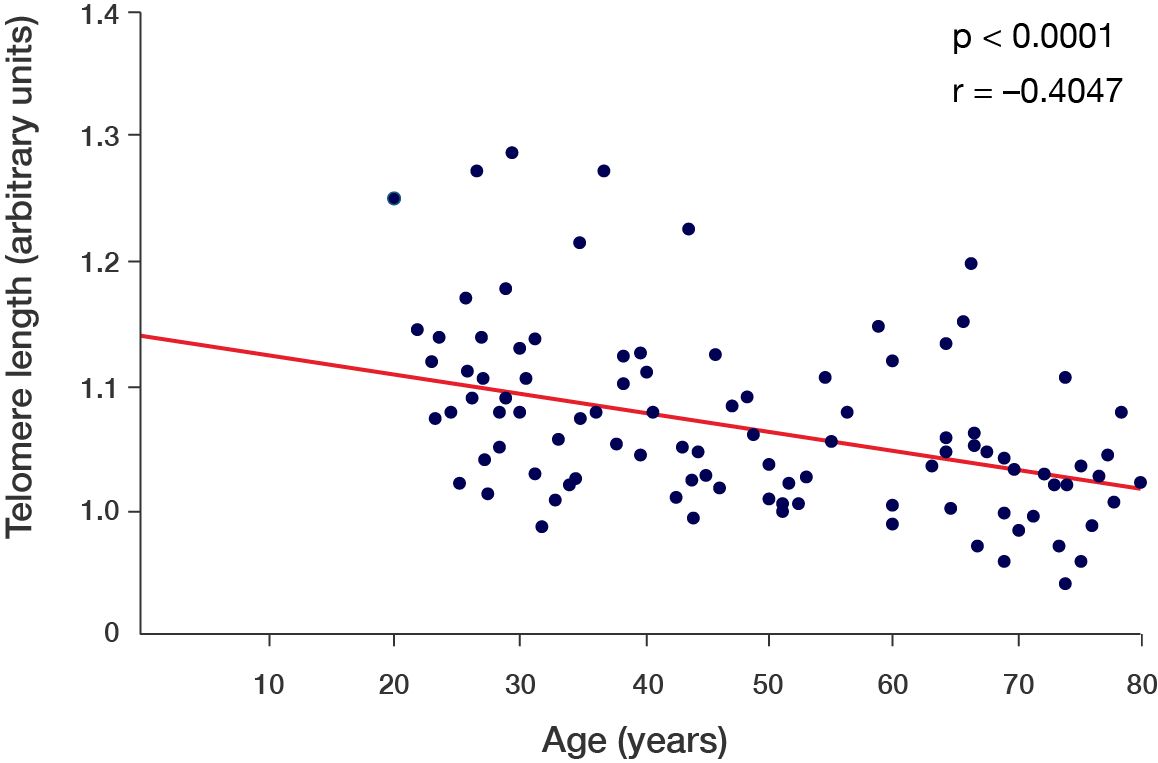
Scatter plot showing the relationship between telomere length and age. The x-axis is labelled "Age (years)", starting at 0 years and ending at 80 years, with increments of 10 years. The y-axis is labelled "Telomere length (arbitrary units)", beginning at 0 and ending at 1.4, with increments of 0.1.
There are 60 to 70 data points plotted on the graph. All of these points fall between ages 20 and 80. The line of best fit is shown, starting at about 1.14 arbitrary units at age 0, and gradually declines until it reaches about 1.01 arbitrary units at age 80.
The results of statistical analysis are shown, with a p-value less than 0.0001 and an r-value of negative 0.4047.
The data based on the line of best fit is summarised in the following table.
| Age (years) | Telomere length (arbitrary units) |
|---|---|
| \(10\) | \(1.124\) |
| \(20\) | \(1.108\) |
| \(30\) | \(1.091\) |
| \(40\) | \(1.075\) |
| \(50\) | \(1.059\) |
| \(60\) | \(1.043\) |
| \(70\) | \(1.026\) |
| \(80\) | \(1.010\) |
Images on this page by RMIT, licensed under CC BY-NC 4.0

RMIT University acknowledges the people of the Woi wurrung and Boon wurrung language groups of the eastern Kulin Nation on whose unceded lands we conduct the business of the University. RMIT University respectfully acknowledges their Ancestors and Elders, past and present. RMIT also acknowledges the Traditional Custodians and their Ancestors of the lands and waters across Australia where we conduct our business - Artwork 'Sentient' by Hollie Johnson, Gunaikurnai and Monero Ngarigo.
More information